

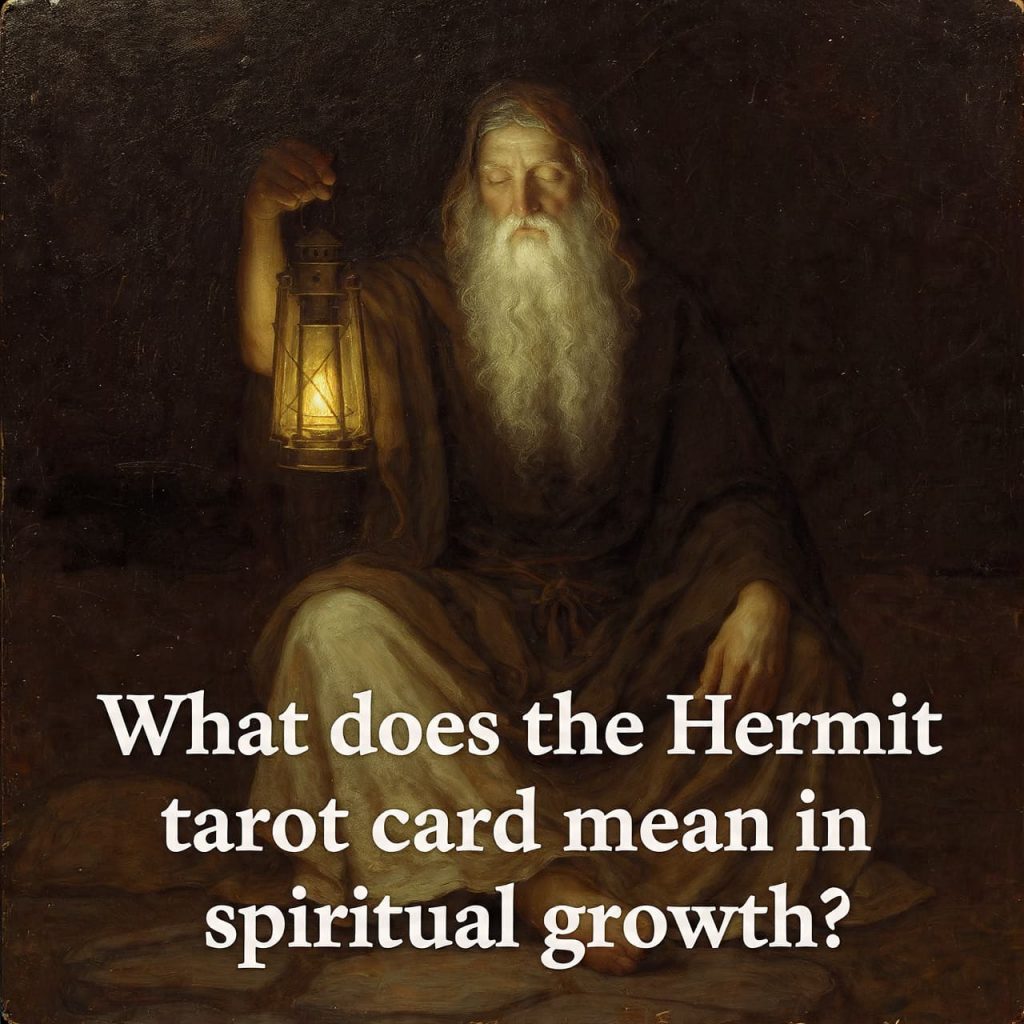
According to Astroideal experts, When the Hermit tarot card appears in a spiritual growth reading, it often signals a phase that feels quieter, slower, and more introspective than many people expect from spiritual development. In a culture that frequently associates growth with expansion, visibility, or dramatic breakthroughs, the Hermit can feel confusing or even discouraging. Yet many practitioners regard it as one of the most profound indicators of genuine spiritual maturity.

💜 Need a clear answer right now?
CONSULT THE YES OR NO TAROT Free · No registration · Instant resultThe Hermit represents inward turning, solitude with purpose, and the deliberate search for inner truth. Rather than pointing to isolation or withdrawal for its own sake, the card reflects a conscious decision to step away from external noise in order to listen more deeply to inner wisdom. Interpretive approaches outlined in resources such as cards meanings emphasize that the Hermit marks a stage where spiritual growth becomes internalized, personalized, and self-directed rather than guided by external validation.
This article explores what the Hermit tarot card means in spiritual growth, how practitioners interpret its appearance, and why it is widely considered a necessary and constructive phase on the spiritual path.
Understanding the Hermit as a Spiritual Growth Archetype
Core Symbolism and Inner Meaning
The Hermit traditionally symbolizes solitude, wisdom, discernment, and inner guidance. Spiritually, practitioners interpret this as a withdrawal from distraction rather than from life itself. The lantern the Hermit carries represents inner truth illuminated through reflection, experience, and contemplation.
In spiritual growth readings, this symbolism suggests that answers are found internally rather than through external authority.
Solitude Versus Isolation
A common misunderstanding is equating the Hermit with loneliness. Many practitioners emphasize that the Hermit represents chosen solitude, not abandonment or rejection. This distinction is critical in spiritual growth, where time alone is often required to integrate lessons meaningfully.
Solitude under the Hermit is intentional and nourishing.
Upright and Reversed Spiritual Interpretations
Upright, the Hermit is commonly interpreted as spiritual introspection, wisdom gathering, and inner alignment. Reversed interpretations vary. Some practitioners see a reversed Hermit as resistance to introspection, while others interpret it as excessive withdrawal or avoidance of connection.
In both cases, the message centers on balance between inner and outer worlds.
The Hermit’s Role in Spiritual Growth
Inner Guidance Over External Authority
A key spiritual lesson of the Hermit is learning to trust one’s own guidance. Practitioners often interpret this card as appearing when external teachings, teachers, or belief systems no longer fully resonate.
Spiritual authority begins shifting inward.
Integration of Past Spiritual Lessons
The Hermit frequently appears when spiritual lessons are being integrated rather than learned anew. Practitioners suggest this phase involves reflecting on experiences, refining understanding, and discarding beliefs that no longer align.
Growth becomes personal rather than theoretical.
Maturity Through Discernment
In readings conducted by qualified professionals, the Hermit is often framed as spiritual discernment—knowing when to listen, when to question, and when to remain silent.
This discernment is a hallmark of advanced spiritual development.
Is the Hermit a Positive Sign for Spiritual Growth?
Depth Over Speed
Many practitioners consider the Hermit a positive sign precisely because it slows things down. While progress may feel less visible, it becomes deeper and more sustainable.
The Hermit prioritizes depth over momentum.
When the Path Feels Lonely
Spiritually, the Hermit can feel challenging because it often coincides with a sense of separation from familiar beliefs or communities. Practitioners note that this discomfort frequently precedes clarity and self-trust.
Discomfort signals transition, not regression.
Avoiding Misinterpretation as Stagnation
Because the Hermit lacks outward movement, it is sometimes misread as stagnation. Many individuals therefore seek insight from reliable readers who understand that stillness can be an active phase of growth rather than a lack of progress.
The Hermit in Different Stages of Spiritual Development
Early Spiritual Awakening
In early spiritual exploration, the Hermit often appears when curiosity turns inward. Practitioners interpret this as a shift from consuming information to reflecting on personal experience.
Questions become more meaningful than answers.
Ongoing Practice and Inner Refinement
For those already on a spiritual path, the Hermit reflects refinement. Beliefs are examined, motivations clarified, and practices adjusted to align more authentically with inner truth.
This refinement strengthens spiritual integrity.
Differentiating Spiritual Growth From Emotional Withdrawal
While emotional introspection may also appear in love tarot readings, the Hermit’s role in spiritual growth is broader. It reflects conscious withdrawal for insight, not avoidance of emotional engagement.
Practical Spiritual Guidance When the Hermit Appears
Creating Intentional Space for Reflection
A consistent recommendation when the Hermit appears is intentional space. Practitioners often suggest reducing external input—social media, constant advice, or spiritual noise—to hear inner guidance more clearly.
Silence becomes a spiritual tool.
Constructive Practices Many Practitioners Suggest
When the Hermit appears in spiritual growth readings, readers often recommend:
- Journaling or reflective writing
- Meditative or contemplative practices
- Spending time alone in nature
- Reviewing beliefs and releasing outdated ideas
These practices support insight without forcing outcomes.
Accessing Thoughtful Spiritual Support
Because Hermit energy values independence, many individuals prefer online tarot sessions that encourage reflection rather than directive instruction.
The Hermit Compared to Other Spiritual Growth Cards
Hermit Versus The High Priestess
The High Priestess represents intuitive knowing, while the Hermit represents conscious seeking. Practitioners often interpret the Priestess as inner awareness already present and the Hermit as the journey toward that awareness.
Together, they represent intuition and understanding.
Hermit Versus The Hanged Man
The Hanged Man reflects surrender and altered perspective, while the Hermit reflects deliberate inquiry and wisdom-building. In spiritual growth, the Hermit often precedes the Hanged Man, preparing the mind for surrender.
This sequence clarifies progression.
Spiritual Timing and Broader Cycles
Some practitioners contextualize the Hermit within broader spiritual or life cycles, occasionally referencing horoscope insights to explore periods when introspection, withdrawal, and inner focus are emphasized over outward expansion.
Professional Spiritual Tarot and Ethical Interpretation
How Solitude-Oriented Cards Are Read Today
Modern spiritual tarot emphasizes empowerment. Practitioners frame the Hermit as an invitation to self-trust rather than isolation or withdrawal from responsibility.
This approach prevents fear-based interpretation.
Reading Formats, Pricing, and Accessibility
Spiritual growth tarot readings involving introspective cards like the Hermit are available in several formats.
| Format | Typical Duration | General Cost Range | Best For |
|---|---|---|---|
| Written insight | 20–30 minutes | Lower range | Private contemplation |
| Live voice session | 30–45 minutes | Mid range | Clarifying inner questions |
| Interactive video | 45–60 minutes | Higher range | Deep reflective dialogue |
Many individuals prefer video readings for nuanced discussion, while others choose phone readings when privacy supports honest introspection.
Structured Interpretation Frameworks
Experienced readers often rely on layered interpretive systems similar to those discussed in cards meanings. These frameworks help ensure the Hermit is interpreted as spiritual development rather than withdrawal or avoidance.
Accuracy, Insight, and Spiritual Growth Under the Hermit
Measuring Progress Without External Validation
The Hermit challenges conventional measures of progress. Practitioners suggest observing clarity, discernment, and self-trust rather than dramatic experiences.
These qualities indicate genuine growth.
Choosing the Right Guidance Style
Because the Hermit emphasizes autonomy, guidance should support independence rather than dependency. Formats that encourage reflection often align best with this energy.
Spiritual authority remains internal.
Accessibility and Emotional Safety
Periods of introspection can feel vulnerable. Accessible, calm guidance helps ensure insights are integrated gently rather than becoming overwhelming.
Frequently Asked Questions
Is the Hermit a good sign for spiritual growth?
Most practitioners suggest yes. It reflects wisdom, introspection, and inner alignment.
Does the Hermit mean spiritual loneliness?
No. It represents chosen solitude, not emotional isolation.
What if the Hermit appears reversed?
It may indicate resistance to introspection or excessive withdrawal.
Is the Hermit about stopping spiritual practice?
No. It emphasizes deepening practice rather than abandoning it.
Can the Hermit indicate a spiritual teacher?
Sometimes. It may represent becoming your own guide.
How long does Hermit energy last?
There is no fixed timeframe. It lasts as long as inner clarity is being developed.
Conclusion
The Hermit tarot card carries one of the most meaningful messages in spiritual growth readings. Rather than signaling withdrawal or stagnation, it reflects a deliberate turn inward—a phase where wisdom is cultivated through reflection, discernment, and self-trust. Many practitioners view the Hermit as a rite of passage, marking the transition from externally guided spirituality to inner authority.
When interpreted thoughtfully and in context, the Hermit reminds us that true spiritual growth is not always loud or visible. Sometimes, the most profound progress happens quietly, illuminated by a single inner light that guides us forward with clarity, humility, and purpose.
| Hermit Card Aspect | Spiritual Meaning | Life Application | Growth Indicator |
|---|---|---|---|
| Solitude and Withdrawal | Inner reflection and soul-searching | Need for alone time to understand self | Wisdom through introspection |
| The Lamp of Truth | Illuminating inner knowledge | Finding your own answers within | Self-discovery and clarity |
| The Mountain Setting | Elevated perspective and spiritual peak | Rising above mundane concerns | Higher consciousness access |
| The Journey | Spiritual pilgrimage and quest | Personal spiritual path | Evolution and transformation |
| Wisdom and Experience | Mastery through patience | Valuing inner knowledge | Spiritual maturation |
| Hermit Stage of Spiritual Growth | Characteristics | Internal Work | Expected Outcome |
|---|---|---|---|
| Early Spiritual Seeking | Questioning reality, exploring beliefs | Meditation and self-inquiry | Foundational understanding |
| Deep Inner Work | Shadow work, healing past wounds | Introspection and therapy | Emotional and spiritual healing |
| Wisdom Integration | Understanding spiritual lessons | Synthesizing learning | Inner peace and clarity |
| Teacher Phase | Sharing wisdom gained from solitude | Guiding and mentoring others | Contributing to collective growth |
| Return and Emergence | Bringing wisdom back to community | Balanced engagement | Living wisdom authentically |
Limitaciones de esta interpretación
Ninguna lectura de tarot es universal ni determinista. El significado de cada carta varía según el contexto personal, la posición en la tirada y la intuición del lector.
Usa esta guía como punto de partida para tu propia reflexión, no como verdad absoluta. Para situaciones importantes, consulta con un profesional.
Preguntas frecuentes
¿What does the Hermit card mean in spiritual growth readings?
The Hermit represents introspection, inner wisdom, spiritual seeking, and the necessity of solitude for self-discovery. It signals you’re entering or in a phase of deep inner exploration.
¿Is the Hermit card positive or negative in spiritual readings?
The Hermit is generally positive in spiritual contexts. It indicates necessary inner work, wisdom-seeking, and spiritual maturation. Reversed, it can suggest isolation or avoiding introspection.
¿What spiritual practices align with the Hermit card energy?
Meditation, journaling, solo retreats, spiritual study, shadow work, and contemplative prayer align with Hermit energy. These practices support the introspection this card represents.
¿How long does the Hermit phase typically last?
Duration varies individually. Some experience it for weeks, others for months or years. The Hermit appears when you need its lesson; trust the timing of your spiritual journey.
¿Does the Hermit card mean I should withdraw from relationships?
Not entirely. The Hermit suggests strategic solitude for inner work, not permanent isolation. You may reduce social activities temporarily to focus on spiritual development.
¿What inner wisdom does the Hermit card encourage finding?
The Hermit encourages discovering your authentic beliefs, understanding your spiritual purpose, connecting with intuition, and developing personal truth beyond external conditioning.
¿How does the Hermit support spiritual transformation?
The Hermit’s solitude creates space for releasing old patterns, integrating lessons, and accessing deeper spiritual truth. Transformation requires the stillness this card represents.
¿What challenges accompany the Hermit phase?
Common challenges include feeling isolated, questioning beliefs, processing difficult emotions, or struggling with uncertainty. These are healthy parts of genuine spiritual growth.
¿Can the Hermit card indicate spiritual enlightenment?
The Hermit represents the path toward enlightenment and wisdom, not the final destination. It shows you’re on a sincere spiritual journey of increasing awareness.
¿How does the Hermit relate to finding your spiritual purpose?
The Hermit’s inward journey helps clarify your authentic purpose by quieting external noise and allowing your true calling to emerge from within.
¿What comes after the Hermit phase in spiritual growth?
After integrating Hermit lessons, spiritual seekers typically move toward sharing wisdom, community service, or balanced engagement in the world with new understanding.
Artículos relacionados
¿Quieres una lectura personalizada? Consulta con nuestros tarotistas en Astroideal.
