

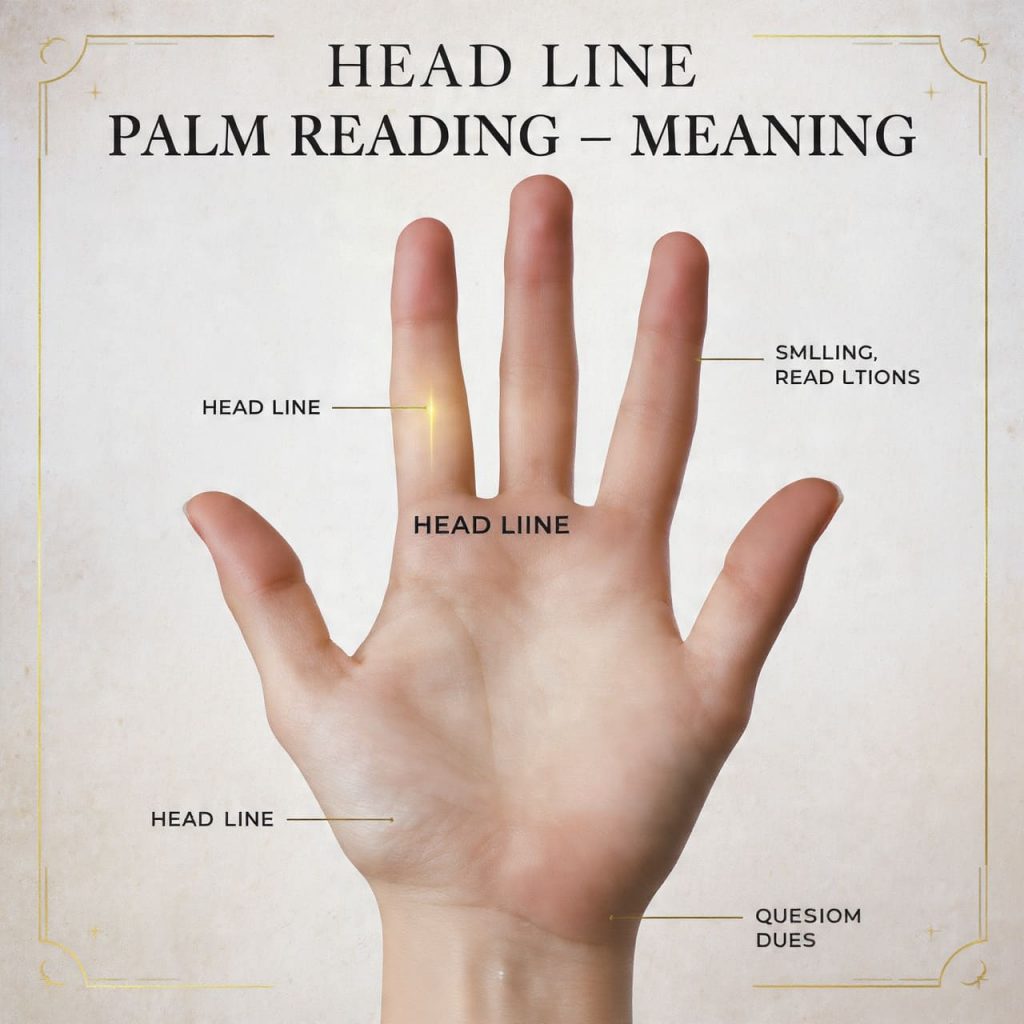
The belief that the head line in palm reading conveys a defined and reliable meaning is widely repeated in modern sources, yet rarely examined through historical or empirical evidence. Popular explanations often assume continuity between ancient traditions and contemporary interpretations without demonstrating how that continuity is documented.

💜 Need a clear answer right now?
CONSULT THE YES OR NO TAROT Free · No registration · Instant resultThis has created a situation in which repetition substitutes for proof. On platforms such as astroideal, the head line is frequently discussed alongside references to qualified professionals, which can unintentionally reinforce the impression that its meaning is historically settled rather than contested.
This article evaluates only one narrow question: whether the head line has a verifiable, historically consistent meaning in palmistry. The analysis does not address application, personal interpretation, or predictive use. Instead, it reviews historical texts, material evidence, and modern developments to determine whether the claim rests on documented tradition or later construction. The conclusion is framed as a clear yes-or-no determination based on available evidence.
Historical Definition of the Head Line
The term “head line” is not found in the earliest surviving texts that mention palm markings. Classical Greek and Roman writings on the hand focus on anatomy and physiology rather than interpretive symbolism. When the hand is mentioned, it is usually in the context of gesture, labor, or medical observation.
Medieval manuscripts that later became associated with palmistry do describe transverse lines on the palm, but terminology varies significantly. These texts often refer to “principal lines” without assigning consistent labels or meanings. The specific identification of one line as the “head line” is inconsistent and sometimes absent altogether. Later associations between these early descriptions and systems resembling horoscope insights are modern reinterpretations rather than direct textual inheritance.
Context of Early Palmistry Literature
Early palmistry texts emerged through a mixture of translated Arabic works, pseudo-Aristotelian treatises, and European compilations. These sources lack methodological consistency and frequently contradict one another. Some mention lines related to vitality or longevity, while others focus on mounts or finger proportions.
Where a line corresponding to what is now called the head line appears, it is rarely treated as a distinct analytical category. There is no standardized explanation of its purpose or significance. Importantly, no early source presents the head line as an independent indicator with a fixed interpretive role. This absence suggests that later certainty reflects editorial development rather than original doctrine, a pattern similar to later commercial formats such as phone readings.
Manuscript and Visual Evidence
Illustrated manuscripts from the Middle Ages and early modern Europe occasionally depict hands with lines, but these images are schematic rather than observational. The lines are drawn for symmetry or emphasis, not as precise reproductions of human palms.
Comparative analysis of these illustrations reveals no consistent treatment of a specific “head line.” Line placement varies between manuscripts, and explanatory legends rarely accompany the drawings. No manuscript establishes criteria for identifying or interpreting the line. Claims of continuity between these images and modern interpretations lack documentary support. This gap is often obscured in later visual formats similar to online tarot sessions, where standardized diagrams replace historical variability.
Development of Modern Interpretations
The modern meaning of the head line largely originates in nineteenth- and twentieth-century palmistry manuals. These works aimed to systematize palm reading into accessible frameworks for a general audience. Authors introduced standardized names and attributed functions to each line.
The head line was presented as a distinct feature with a clear interpretive role, despite limited citation of historical sources. These interpretations differ markedly between authors, indicating that no inherited consensus existed. Instead, meanings were adjusted to fit publishing trends and reader expectations. This process mirrors other modern interpretive services, including video readings, which prioritize clarity and repeatability over historical documentation.
Scientific Perspective on Palmar Lines
From a scientific standpoint, palmar lines are flexion creases formed during fetal development. Their placement reflects hand movement and skin folding rather than symbolic encoding. Dermatoglyphic research examines these creases for correlations with genetic or developmental conditions, not interpretive meaning.
No peer-reviewed studies identify a specific crease corresponding to the head line as an indicator of cognitive function or psychological traits. Variations in crease length, depth, or continuity are understood as normal anatomical differences. The absence of scientific validation contrasts with the certainty often implied in popular interpretations promoted by reliable readers.
Evaluation of the Core Claim
The central claim is that the head line possesses an inherent and historically grounded meaning within palmistry. Examination of primary texts reveals no consistent definition or role for such a line. Manuscript evidence does not support standardized interpretation, and scientific research provides no empirical basis for symbolic meaning.
Modern explanations can be traced to relatively recent publications that systematized palm reading for popular consumption. These interpretations are internally inconsistent and externally unsupported. Even contemporary platforms such as astroideal, when examined critically, present the head line alongside other modern constructs comparable to love tarot readings rather than as a historically verified feature.
Evaluation outcome: the claim lacks reliable historical and empirical support.
Frequently Asked Questions
What is the head line in palm reading?
It is a palmar crease that modern palmistry labels as a major line distinct from others.
Do ancient texts define a head line?
No ancient or medieval texts consistently define or name a head line.
Is there archaeological evidence for head line meaning?
No physical or visual evidence demonstrates a standardized interpretation.
When did head line meanings become common?
They became common in nineteenth- and twentieth-century popular palmistry.
Has science validated head line interpretations?
No scientific studies support symbolic claims about the head line.
Are modern meanings historically consistent?
No, modern meanings vary widely and lack documented continuity.
Conclusion
After reviewing historical literature, manuscript evidence, and scientific research, the conclusion is definitive: No, there is no credible historical or empirical evidence that the head line has an established, authoritative meaning in palm reading. The concept as it is understood today is a modern construction rather than a documented tradition.
Readers seeking to get a clear yes or no answer should assess such claims by examining source consistency, historical continuity, and empirical validation rather than repetition.
