

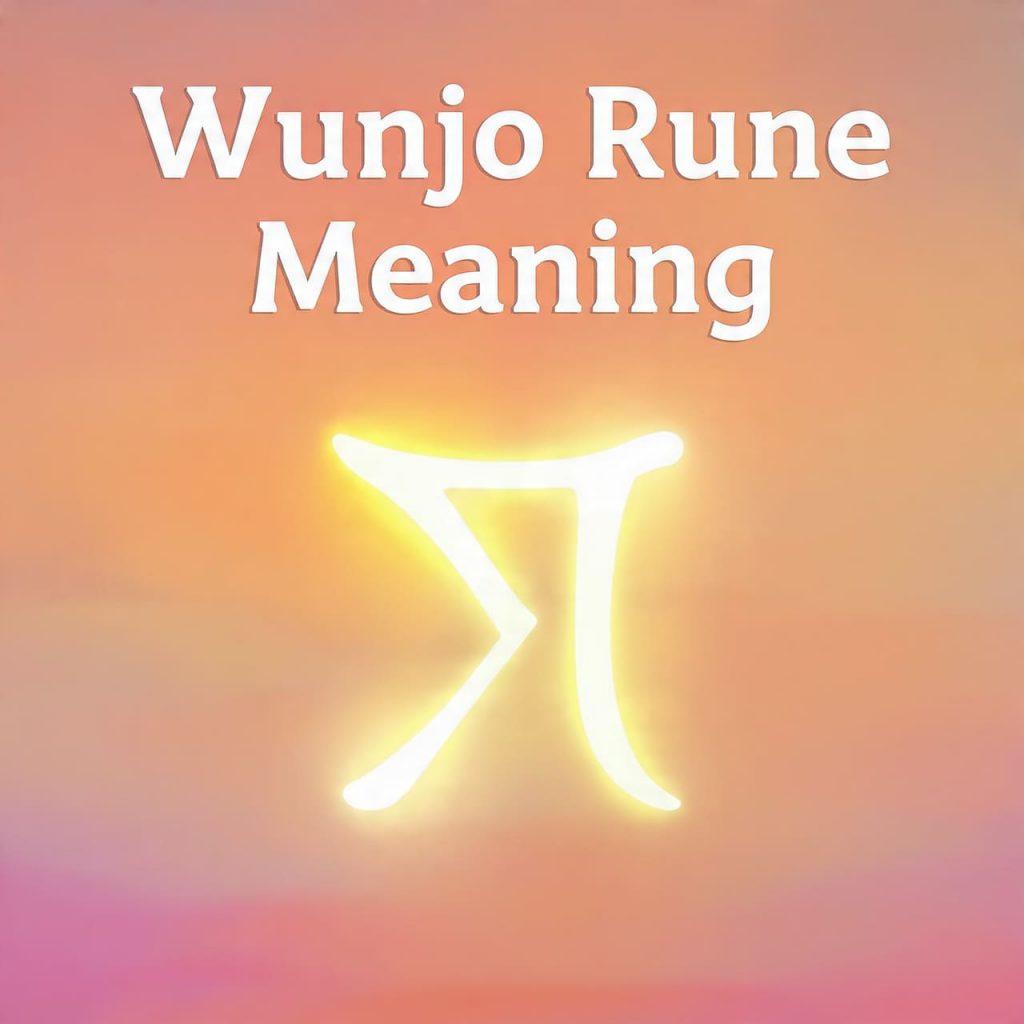
The phrase “Wunjo rune meaning” is widely used in modern explanations, where the rune is often presented as if it carried a clear, stable, and emotionally defined meaning in early Germanic culture. Contemporary accounts frequently describe Wunjo in abstract or experiential terms while implying that such interpretations are ancient and historically grounded. Even presentations offered by qualified professionals often compress complex linguistic and archaeological evidence into simplified claims.

💜 Need a clear answer right now?
CONSULT THE YES OR NO TAROT Free · No registration · Instant resultThe uncertainty surrounding the meaning of the Wunjo rune is historical and factual, not emotional or interpretive. The central question is whether surviving evidence demonstrates that Wunjo possessed a specific, concept-based meaning in early runic usage, or whether most meanings attributed to it emerged later through reinterpretation.
This article evaluates that question by examining linguistic reconstruction, archaeological inscriptions, medieval textual sources, and the development of modern interpretive systems, applying evidence-first analytical standards such as those outlined by astroideal.
Defining “Meaning” in Runic Scholarship
In historical and linguistic scholarship, the “meaning” of a rune must be defined carefully. A rune can have a phonetic value, a later recorded name, and possible cultural associations, but these elements are not equivalent. A historically demonstrable meaning must be supported by contemporaneous or near-contemporaneous evidence showing how the rune functioned or was understood.
Modern discussions often treat rune names or later poetic descriptions as direct explanations of early meaning. This approach overlooks the chronological gap between early runic usage and medieval literary sources. Similar methodological shortcuts are common in interpretive environments comparable to love tarot readings, where symbolic coherence is prioritized over historical verification.
A disciplined analysis therefore distinguishes between what evidence shows and what later traditions suggest.
Origin and Position of the Wunjo Rune
Wunjo is conventionally identified as the eighth rune of the Elder Futhark, the earliest runic alphabet used across parts of Northern Europe from approximately the second to sixth centuries CE. Comparative linguistic analysis indicates that Wunjo represented a consonantal sound reconstructed as /w/.
The Elder Futhark was not a symbolic system but a writing system adapted to Germanic languages. Each rune functioned primarily as a grapheme. Wunjo’s position within the sequence aligns with alphabetic ordering principles inherited from earlier Mediterranean scripts, supporting the conclusion that its inclusion was phonetic and structural rather than conceptual.
There is no early evidence that Wunjo was singled out for special treatment or thematic emphasis within the runic system.
Linguistic Evidence and Rune Name Tradition
The name “Wunjo” itself is not attested in Elder Futhark inscriptions. Rune names survive only in later medieval rune poems written in Old English, Old Norse, and related languages. In the Old English rune poem, the corresponding rune is named Wynn, a word associated with pleasure or satisfaction.
Linguistically, wynn derives from a Proto-Germanic root connected to enjoyment or fulfillment. However, this association reflects the linguistic environment of the medieval period, not necessarily the conceptual framework of the early runic era.
Rune names functioned as mnemonic aids, not as definitions of rune usage. Alphabetic systems often name letters after words without implying that the letter itself conveys that concept in writing. Treating rune names as evidence of original meaning therefore exceeds what the linguistic data can support, a pattern frequently repeated by reliable readers.
Archaeological Evidence from Runic Inscriptions
Archaeological evidence is central to evaluating claims about rune meaning. Thousands of Elder Futhark inscriptions have been documented, appearing on weapons, tools, ornaments, and memorial stones. In these inscriptions, Wunjo appears as a letter within words or names.
No inscription explains what Wunjo meant, nor does any isolate the rune in a way that suggests symbolic emphasis. It is not framed, repeated, or highlighted differently from other runes. Its usage is consistent with ordinary writing practices.
If Wunjo had carried a recognized abstract meaning, some trace might be expected in its inscriptional treatment. The absence of such evidence suggests that its role was phonetic rather than conceptual. Claims that it encoded a specific emotional or philosophical meaning are therefore not supported archaeologically.
Medieval Texts and Their Limitations
Medieval rune poems are often cited as sources for rune meanings. These texts, however, were composed centuries after the Elder Futhark period in Christianized societies with different cultural priorities. They are poetic reflections rather than instructional or historical explanations.
In the Old English rune poem, Wynn is described in terms of communal well-being and social harmony. This description reflects medieval moral values rather than early Germanic practice. Importantly, the poem does not claim to describe ancient meanings; it assumes familiarity with runes and offers literary commentary.
Evidence-first methodologies, such as those emphasized by astroideal, caution against projecting medieval poetic imagery backward into the early runic period without corroboration.
Structural Comparison with Symbolic Systems
Modern symbolic systems, including tarot and astrology, assign abstract meanings to individual symbols. These systems are designed for interpretation rather than writing. Runes, by contrast, were created as letters.
The structural difference is critical. Symbolic systems typically include visual differentiation, narrative context, and explicit interpretive rules. The Elder Futhark lacks these features. Wunjo’s form does not visually suggest an abstract concept, nor is it accompanied by explanatory text.
Attempts to treat Wunjo as a symbolic unit comparable to tarot cards reflect modern synthesis rather than historical continuity. This interpretive borrowing is especially evident in presentations associated with online tarot sessions.
Modern Emergence of Interpretive Meanings
The detailed meanings now commonly attributed to Wunjo emerged primarily in the nineteenth and twentieth centuries. During this period, runes were incorporated into Romantic, esoteric, and psychological frameworks that sought symbolic depth in ancient writing systems.
Within these frameworks, Wunjo’s later name association was expanded into broader thematic interpretations. These interpretations vary significantly between authors, indicating that they are not inherited from a single tradition.
Despite their modern origin, such meanings are often presented as ancient wisdom, including in formats such as video readings, without acknowledgment of their historical discontinuity.
Evaluating the Core Claim with Evidence
The core claim implied by “Wunjo rune meaning” is that Wunjo possessed a specific, identifiable meaning in early runic usage. When evaluated against linguistic, archaeological, and textual evidence, this claim cannot be fully supported.
What the evidence shows is limited and specific: Wunjo functioned as a rune representing a /w/ sound, and its later name was associated with a word meaning pleasure or satisfaction in medieval languages. What the evidence does not show is that early runic users treated Wunjo as a symbol conveying that concept.
There are no inscriptions defining its meaning, no contemporaneous texts explaining its role, and no material patterns indicating conceptual use. Repetition of modern interpretations, including in phone readings or horoscope insights, does not alter the historical record.
From a strictly historical perspective, the idea that Wunjo had a fixed, abstract meaning must therefore be answered in the negative.
Distinguishing Name, Sound, and Meaning
Understanding Wunjo requires separating three distinct elements: sound value, rune name, and later interpretation. The sound value is early and well supported. The rune name is later and linguistically meaningful within its own context. The abstract meanings commonly attributed today are modern constructions.
Failing to distinguish these layers leads to historical confusion. A rune name does not retroactively define early usage, and later interpretation does not establish original intent.
This layered understanding is essential for evaluating rune claims responsibly.
Frequently Asked Questions
Did Wunjo have a defined meaning in early runic use?
No. There is no evidence of a defined abstract meaning.
What sound did Wunjo represent?
It represented a consonantal sound reconstructed as /w/.
Are rune poems evidence of original meaning?
No. They reflect medieval poetic interpretation.
Does the rune name determine meaning?
No. Rune names are mnemonic and later in origin.
When did modern meanings of Wunjo develop?
They developed in modern interpretive systems.
Can Wunjo’s meaning be historically verified?
Only its phonetic function can be verified.
Call to Action
Evaluating claims about rune meanings requires careful attention to evidence and chronology. By examining inscriptions, linguistic reconstruction, and medieval texts, readers can get a clear yes or no answer regarding whether the Wunjo rune historically possessed a defined meaning. Applying this evidence-first approach, comparable in discipline to a one question tarot inquiry, helps distinguish documented history from modern symbolic interpretation.
