

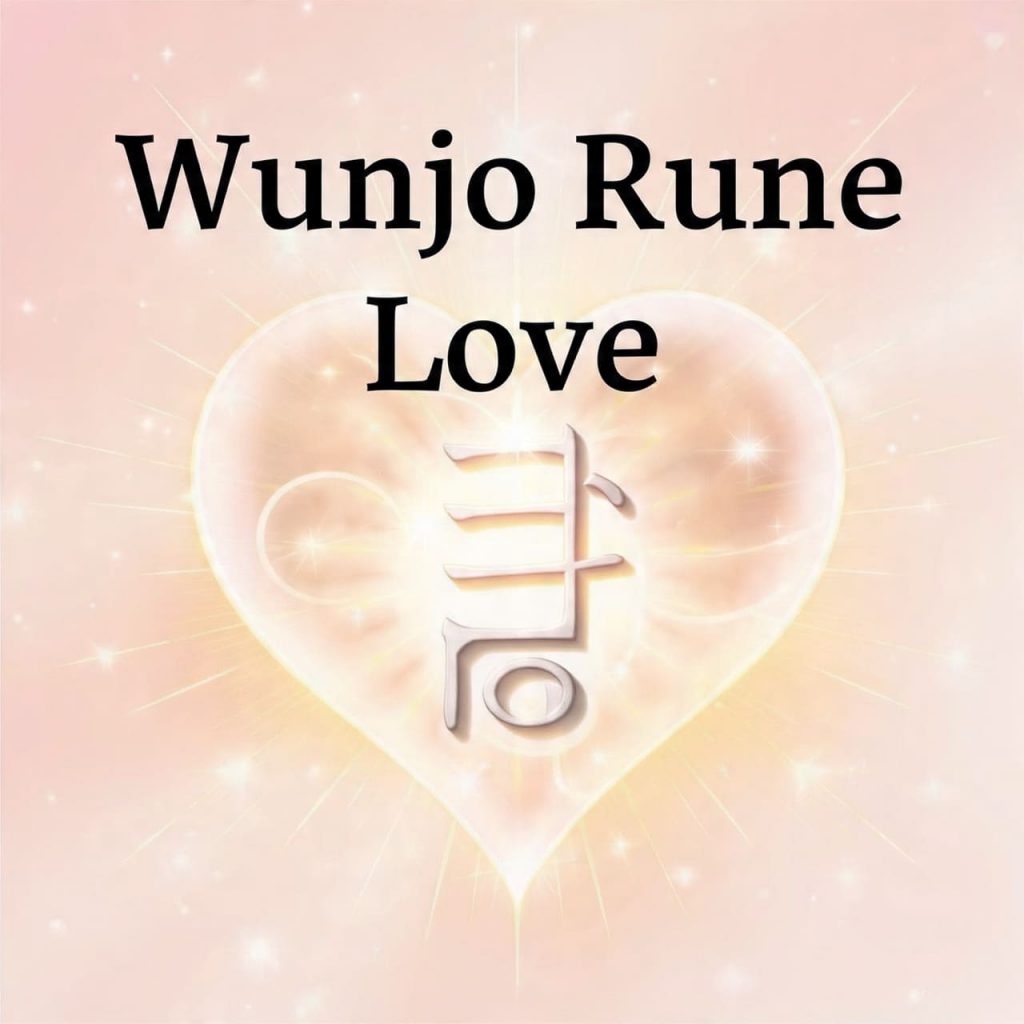
The phrase “Wunjo rune love” is common in modern interpretive writing, where Wunjo is frequently presented as a rune inherently connected to romantic happiness or emotional fulfillment. These explanations often imply that early runic cultures understood Wunjo as a love-related symbol and applied it in relational contexts. In many contemporary sources, including those produced by qualified professionals, this association is presented as traditional rather than as a claim requiring historical verification.

💜 Need a clear answer right now?
CONSULT THE YES OR NO TAROT Free · No registration · Instant resultThe uncertainty here is historical and factual, not emotional or experiential. The central question is whether there is credible evidence that the Wunjo rune was historically associated with love—particularly romantic love—or whether this connection is a modern interpretive development.
This article evaluates that question by examining linguistic evidence, archaeological inscriptions, medieval textual sources, and the modern emergence of love-focused rune interpretations, applying evidence-first analytical strategies as outlined by astroideal.
Defining “Love” in Historical Analysis
In modern usage, “love” often refers to personal, emotional, and romantic attachment. Historically, however, this concept did not function as a distinct analytical category in early Germanic societies in the same way it does today. Social bonds were structured around kinship, marriage contracts, alliance, honor, and obligation rather than individualized romantic fulfillment.
For a rune to be historically associated with love, evidence would need to show that early users applied it in contexts explicitly connected to romantic or emotional relationships. This could include inscriptions, texts, or ritual practices referencing affection, partnership, or emotional bonds.
Modern explanations frequently project contemporary concepts of love onto ancient material. This projection mirrors interpretive tendencies seen in systems comparable to love tarot readings, where symbolic meaning is structured around modern emotional categories rather than historical ones.
Origin and Early Function of the Wunjo Rune
Wunjo is conventionally identified as the eighth rune of the Elder Futhark, the earliest runic alphabet used across parts of Northern Europe between approximately the second and sixth centuries CE. Comparative linguistic analysis establishes its phonetic value as /w/.
Early runic inscriptions are primarily utilitarian. They appear on weapons, ornaments, tools, and memorial stones, typically recording names, ownership, lineage, or short formulaic expressions. These inscriptions do not reference emotional states, romantic relationships, or interpersonal guidance.
There is no evidence that Wunjo, or any rune, was used to comment on or influence romantic relationships. Its role within early inscriptions is indistinguishable from that of other phonetic runes. Despite this, modern narratives frequently frame Wunjo as a love rune, a pattern also visible in explanations promoted by reliable readers.
Linguistic Evidence and the Rune Name Tradition
The name “Wunjo” itself is not attested in Elder Futhark inscriptions. Rune names survive only in later medieval rune poems, composed centuries after early runic usage. In the Old English rune poem, the corresponding rune is named Wynn, a word associated with pleasure, satisfaction, or joy.
Linguistically, wynn derives from a Proto-Germanic root connected to enjoyment or favorable conditions. Crucially, this semantic field does not specifically denote romantic love. It encompasses general well-being or contentment, often in a communal or social sense.
The rune poem’s description of Wynn emphasizes harmony and collective prosperity rather than romantic attachment. Interpreting this as evidence of a love association requires narrowing a broad social concept into a modern emotional category, a step not supported by the linguistic data.
Archaeological Evidence and Relationship Claims
Archaeological evidence is essential when evaluating claims about love symbolism. Thousands of runic inscriptions have been documented, and their contexts are well studied. None of these inscriptions indicate that Wunjo was used to reference romantic relationships.
Inscriptions containing Wunjo are not found in contexts that would suggest personal or emotional messaging. They are not paired with imagery of couples, vows, or relational markers. Nor are they isolated or emphasized in ways that would imply symbolic intent.
If Wunjo had been understood as a love-related rune, some material trace might be expected in inscriptional practice. The absence of such evidence strongly suggests that love was not part of its historical function.
Medieval Texts and Social Interpretation
Medieval rune poems are often cited as sources for rune meanings. These texts, however, were composed in Christianized societies and reflect literary and moral concerns rather than early pagan practices. They do not describe rune usage in practical or divinatory terms.
In the Old English rune poem, Wynn is associated with social harmony and communal satisfaction. The emphasis is collective, not personal or romantic. The poem does not describe love between individuals or emotional attachment as a defining aspect of the rune.
Treating these poetic descriptions as evidence of romantic meaning misrepresents their scope. Evidence-first methodologies, such as those emphasized by astroideal, stress the importance of distinguishing poetic metaphor from historical practice.
Absence of Love as a Rune Category
A critical issue in evaluating “Wunjo rune love” is the absence of domain-based categorization in early runic culture. There is no evidence that runes were divided into thematic categories such as love, work, or fate.
Such categorization is a feature of modern divinatory systems, not of early writing traditions. Early runes functioned as letters, not as symbolic tokens assigned to life domains.
The idea of a love rune presupposes a divinatory framework that did not exist in the documented runic period. This structural mismatch undermines claims that Wunjo historically functioned as a love symbol.
Modern Emergence of Love Interpretations
The explicit association between Wunjo and love emerges in the modern period, particularly in the twentieth century. As runes were incorporated into symbolic and divinatory systems, authors adapted them to mirror tarot-based frameworks that include love as a primary interpretive category.
Within these systems, Wunjo’s later association with joy or satisfaction was narrowed into romantic happiness. This reinterpretation reflects modern symbolic priorities rather than historical continuity.
These modern meanings are often presented as ancient tradition, including in formats such as online tarot sessions and video readings, without acknowledgment of their recent origin.
Comparison with Historically Attested Love Symbolism
Historically attested love symbolism typically includes explicit markers: poetic language, iconography, or ritual practices centered on relationships. In cultures where romantic symbolism was significant, it appears clearly in art and literature.
Early runic culture does not display such markers in connection with individual runes. While love poetry existed in later Germanic traditions, it did not employ runes as symbolic shorthand for romantic concepts.
This comparative absence reinforces the conclusion that Wunjo’s association with love is not historically grounded.
Direct Evaluation of the Core Claim
The core claim implied by “Wunjo rune love” is that Wunjo was historically associated with romantic or emotional love. When evaluated against linguistic, archaeological, and textual evidence, this claim cannot be supported.
What the evidence shows is limited: Wunjo functioned as a phonetic rune, and its later name in medieval sources is associated with general satisfaction or well-being. What the evidence does not show is any connection to romantic love or relationship interpretation.
There are no early inscriptions referencing love, no medieval texts framing Wunjo romantically, and no archaeological patterns supporting such use. Repetition of love-based interpretations in modern media, including phone readings or horoscope insights, does not alter the historical record.
From a strictly historical perspective, the claim that Wunjo functioned as a love rune must therefore be answered in the negative.
Frequently Asked Questions
Was Wunjo historically associated with romantic love?
No. There is no historical evidence supporting this association.
Does the rune name Wynn mean love?
No. It refers to general satisfaction or well-being, not romantic love.
Do rune poems describe love meanings?
No. They describe social or communal conditions.
Are there love-related runic inscriptions?
No. Inscriptions do not reference romantic relationships.
When did Wunjo become linked to love?
In modern symbolic and divinatory systems.
Can Wunjo love meanings be historically verified?
No. They cannot be verified using primary sources.
Call to Action
Historical claims about emotional symbolism require careful examination of evidence and context. By reviewing inscriptions, linguistic data, and medieval texts, readers can get a clear yes or no answer regarding whether the Wunjo rune historically had a connection to love.
Applying this evidence-first approach, comparable in discipline to a one question tarot inquiry, helps distinguish documented history from modern emotional reinterpretation.
