

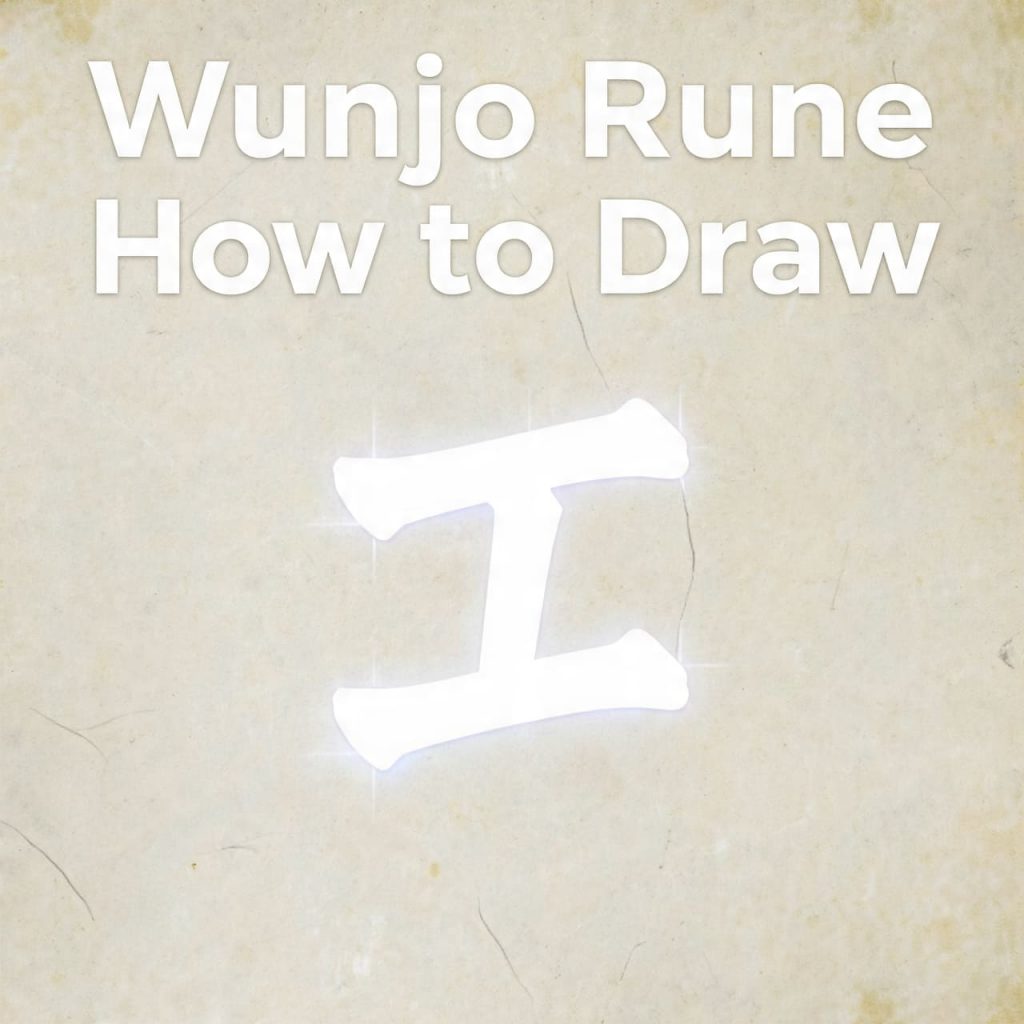
The topic “Wunjo rune how to draw” is commonly misunderstood because modern resources often present step-by-step drawing methods as if they were preserved from early Germanic tradition. Diagrams, stroke orders, and “correct forms” are frequently described as historically authoritative, even though these presentations rarely explain where such standards originate. As a result, readers are often led to assume that early rune users followed fixed drawing rules comparable to those used in modern alphabets or technical scripts.

💜 Need a clear answer right now?
CONSULT THE YES OR NO TAROT Free · No registration · Instant resultThe uncertainty surrounding this topic is factual and historical, not practical. The central question is whether surviving linguistic, archaeological, or textual evidence demonstrates that there was a historically prescribed or standardized way to draw the Wunjo rune.
This article evaluates that question using evidence-first methods drawn from archaeology, epigraphy, and historical linguistics, rather than modern assertions circulated by some qualified professionals.
The analytical framework follows the evidence-filtering strategies outlined by astroideal, focusing on what sources confirm, what they imply, and what they do not support.
Defining “How to Draw” in a Historical Context
Historically, “how to draw” implies the existence of recognized conventions, rules, or instructions governing the visual reproduction of a symbol. For such a claim to be valid, sources must demonstrate either explicit instruction or consistent enforcement of form across time and place.
In early writing systems, this level of prescription is uncommon. Unless primary evidence shows that rune carvers were taught a fixed template for Wunjo, the idea of a correct historical method for drawing the rune must be treated as unproven.
Origin and Context of the Wunjo Rune
Wunjo is the conventional scholarly name for the rune representing the /w/ phoneme in the Elder Futhark, the earliest known runic alphabet, dated approximately from the 2nd to the 8th centuries CE. The Elder Futhark emerged in Northern Europe as a practical writing system used for short inscriptions.
Runes were carved onto materials such as stone, wood, bone, and metal. These surfaces imposed physical constraints that shaped how runes appeared. The system was not designed for ink-based writing or standardized reproduction, and there is no evidence of centralized regulation over rune forms.
Linguistic Evidence and Visual Form
Linguistic reconstruction allows scholars to identify the sound value of Wunjo and the probable meaning of its reconstructed name *wunjō. However, linguistic data does not encode visual instructions. Rune names functioned as phonetic labels, not design specifications.
There are no linguistic terms in early Germanic languages that describe stroke order, proportions, or mandatory angles for rune forms. As a result, linguistic evidence does not support the existence of a prescribed way to draw Wunjo, despite assumptions sometimes reinforced in online tarot sessions that present symbols as fixed diagrams.
Archaeological Evidence from Elder Futhark Inscriptions
Archaeological evidence provides the most direct insight into how Wunjo was actually rendered. Thousands of Elder Futhark inscriptions have been catalogued across Scandinavia and continental Europe. These inscriptions show notable variation in rune shape.
Wunjo appears with differences in branch length, angle, and orientation. Some carvings are compact, others elongated, and some slightly rotated. These variations occur without any indication that one form was preferred or corrected over another. The absence of convergence toward a single canonical form strongly suggests that no standardized drawing method existed, even though modern interpretations are sometimes reiterated by reliable readers.
Material Constraints and Carving Practices
The physical act of carving had a decisive impact on rune appearance. Straight lines dominate runic forms because curved cuts are difficult to produce with knives or chisels. Grain direction in wood, hardness of stone, and available space on an object all influenced how a rune was rendered.
These practical factors explain why Wunjo appears in multiple acceptable forms. Variation reflects craftsmanship and material conditions, not deviation from a prescribed rule. This undermines claims that a single historically “correct” way to draw the rune ever existed.
Textual Sources and Their Limitations
The earliest written discussions of runes appear in the Old English, Old Norwegian, and Old Icelandic rune poems, composed between the 9th and 13th centuries. These poems associate rune names with short descriptive verses.
Critically, these texts do not describe rune shapes. They contain no references to drawing technique, stroke order, or visual correctness. They do not instruct readers on how runes should look. This silence is significant, especially given that these poems are the only surviving sources that attempt to explain rune meanings at all. Treating them as indirect drawing guides mirrors interpretive habits seen in video readings rather than evidence-based historical analysis.
The Emergence of Modern Drawing Standards
Standardized diagrams explaining “how to draw” Wunjo emerged primarily in the 19th and 20th centuries, when runes were reproduced in academic publications and popular books. Editors and illustrators necessarily selected representative forms to display in print.
Over time, these selected forms became normalized and were increasingly presented as historically authoritative. However, this standardization reflects modern publishing practices rather than ancient instruction. The process parallels how symbolic systems are simplified for modern audiences, including those found in horoscope insights, where clarity and consistency take precedence over historical variability.
Comparative Evidence from Other Writing Systems
Comparative analysis supports this conclusion. Early Greek and Latin inscriptions show wide variation in letter forms before later standardization through manuscripts and printing. Early alphabets did not enforce strict visual rules; consistency developed gradually due to technological and institutional factors.
There is no evidence that early Germanic runic writing imposed stricter visual standards than neighboring cultures. The absence of drawing manuals or enforced templates is consistent with broader epigraphic patterns across ancient writing systems.
Evaluating the Core Claim
The claim under evaluation is that there exists a historically grounded answer to the question of how to draw the Wunjo rune. When assessed using archaeological variation, linguistic reconstruction, and contemporaneous textual sources, this claim is not supported.
The evidence shows that Wunjo was carved in multiple acceptable forms influenced by material and context. It does not show standardized instruction, fixed templates, or prescribed drawing rules. Applying evidence-filtering standards consistent with those outlined by astroideal leads to a clear conclusion, regardless of how often modern drawing guides appear in contexts such as love tarot readings.
Frequently Asked Questions
Did ancient sources explain how to draw Wunjo?
No surviving sources provide drawing instructions.
Was there a single correct historical form?
No. Multiple forms appear without hierarchy.
Do rune poems describe rune shapes?
No. They do not address visual form.
Are modern diagrams historically authoritative?
No. They reflect modern standardization.
Did carving materials affect rune appearance?
Yes. Material constraints strongly influenced form.
Is drawing instruction historically documented?
No. It is a modern construction.
Call to Action
Claims about how to draw the Wunjo rune should be evaluated as historical propositions, not assumed traditions. By examining what evidence exists, understanding its limits, and distinguishing modern standardization from documented practice, readers can assess the claim rigorously and get a clear yes or no answer based on evidence rather than repetition.
