

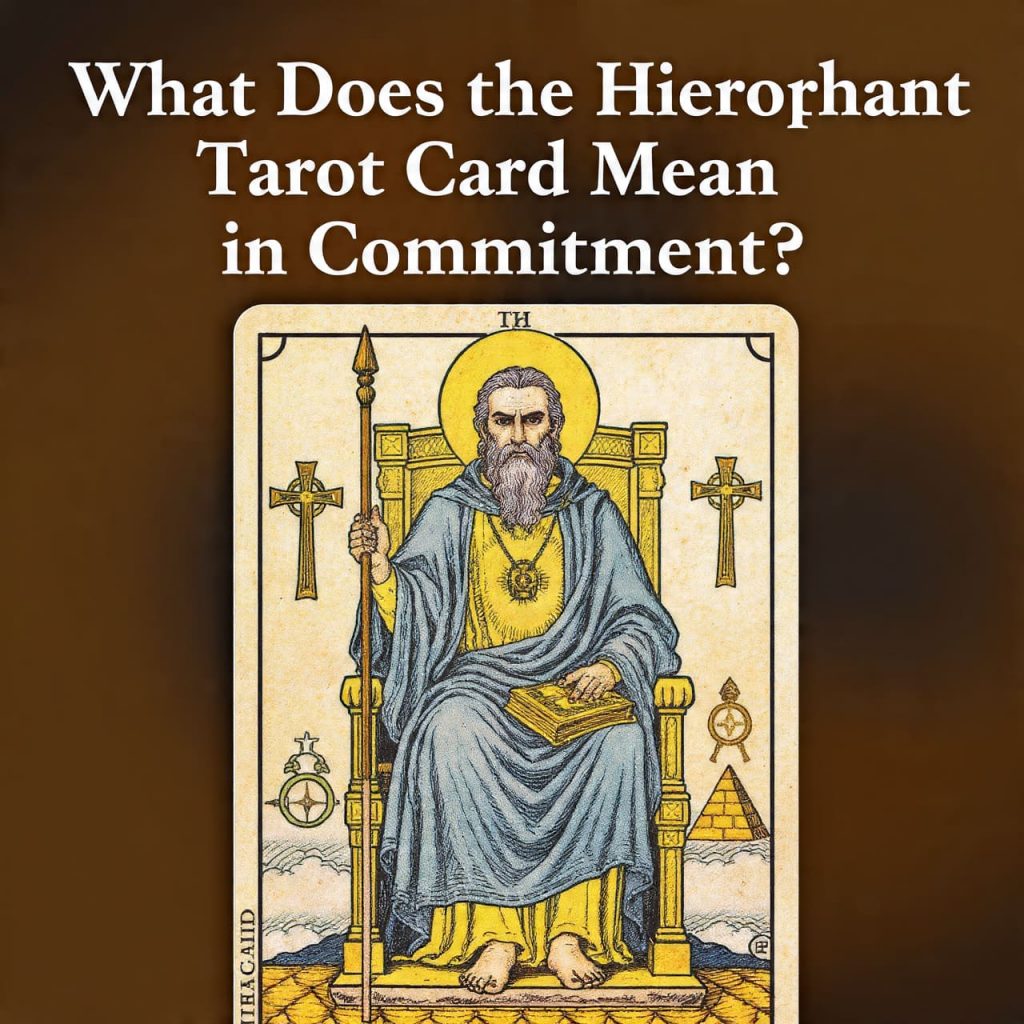
According to Astroideal experts, Commitment is rarely just an emotional decision. For many people, it is shaped by values, traditions, personal ethics, and long-held beliefs about partnership and responsibility. When tarot is consulted around commitment questions, the focus is often less on romance and more on meaning, stability, and long-term alignment. The Hierophant tarot card frequently appears in these readings, and its presence tends to prompt serious reflection rather than excitement.

💜 Need a clear answer right now?
CONSULT THE YES OR NO TAROT Free · No registration · Instant resultMany practitioners believe the Hierophant represents commitment as a conscious agreement grounded in shared principles rather than impulse. It often raises questions about why commitment matters, how it is defined, and whether it aligns with one’s authentic values.
Using interpretive strategies commonly outlined in analytical resources such as cards meanings, readers typically explore the Hierophant by examining belief systems, expectations, and the role of structure in relationships.
This article provides a detailed explanation of what the Hierophant tarot card may mean in commitment, maintaining a balanced and credible perspective without absolute claims.
Core Symbolism of the Hierophant in Commitment
Commitment Rooted in Values
The Hierophant is closely associated with values, ethics, and belief systems. In commitment readings, many practitioners interpret this as a sign that commitment is being evaluated through a moral or principled lens rather than emotion alone.
This may involve shared beliefs about loyalty, responsibility, or long-term partnership.
Tradition and Social Frameworks
Another key theme of the Hierophant is tradition. In commitment contexts, this often points to socially recognized forms of commitment, such as marriage, formal agreements, or long-term promises.
Rather than enforcing tradition, the card highlights its influence and invites reflection on whether these frameworks feel supportive or restrictive.
Guidance and Shared Understanding
Spiritually, the Hierophant is also linked to guidance and teaching. In relationships, this may suggest that commitment grows through shared understanding, mentorship, or agreed-upon structures.
Many believe this card reflects learning how to commit responsibly rather than instinctively.
Upright Hierophant: Commitment Meanings Explained
Commitment Through Shared Principles
When the Hierophant appears upright in commitment readings, many practitioners interpret it as alignment around shared principles. This often suggests that both individuals value similar ideas about stability, responsibility, and long-term connection.
Such alignment is frequently seen as supportive for sustainable commitment.
Formalizing the Relationship
The upright Hierophant is commonly associated with formal commitment. This may involve discussions around marriage, exclusivity, or clearly defined roles within the relationship.
In some cases, this card appears when individuals are considering commitment within culturally or socially recognized frameworks.
Stability Over Emotional Fluctuation
Another interpretation involves prioritizing stability. Practitioners often view the upright Hierophant as encouraging consistency, reliability, and mutual accountability over emotional highs and lows.
This does not remove romance, but it places structure alongside feeling.
Reversed Hierophant: Commitment Tensions and Redefinition
Questioning Traditional Expectations
When reversed, the Hierophant is often interpreted as questioning tradition. In commitment contexts, this may reflect discomfort with conventional definitions of commitment or pressure from external expectations.
Many practitioners believe this reversal invites redefining commitment on personal terms.
Resistance to External Pressure
A reversed Hierophant can also indicate resistance to pressure—from family, culture, or society—to commit in a certain way. Commitment may feel forced rather than chosen.
This interpretation emphasizes autonomy rather than rejection of commitment itself.
Aligning Commitment With Personal Truth
Rather than signaling avoidance, the reversed Hierophant often suggests a search for authenticity. Commitment is being reconsidered to ensure it aligns with personal values rather than inherited beliefs.
Relationship Contexts Where the Hierophant Appears
Long-Term Relationships Considering Formal Commitment
The Hierophant frequently appears when long-term partners are considering formalizing their relationship. Many practitioners interpret this as a moment of evaluating readiness rather than predicting an outcome.
It emphasizes thoughtful discussion over emotional urgency.
Commitment Influenced by Culture or Family
In some readings, the Hierophant highlights the role of family, culture, or religion in commitment decisions. This can be supportive or challenging, depending on alignment with personal values.
Understanding these influences is often seen as essential before committing.
Ethical and Moral Considerations
The card may also surface when ethical questions influence commitment—such as honesty, fidelity, or shared responsibility. Practitioners often view this as an invitation to address values openly.
Seeking Perspective on Commitment Decisions
When Commitment Feels Heavy or Complex
Commitment decisions can feel weighty, especially when values and expectations intersect. Some individuals choose to seek insight from qualified professionals who interpret tarot with ethical responsibility, helping clarify commitment without pressure or guarantees.
Such guidance often focuses on alignment rather than obligation.
Emotional Bonds and Conscious Commitment
The Hierophant sometimes appears in love tarot readings when emotional connection is strong, but clarity is needed around long-term structure and expectations.
Practitioners often emphasize that love and commitment, while related, are not identical.
Practical Commitment Guidance Inspired by the Hierophant
Reflective Steps Often Suggested
When the Hierophant appears in commitment readings, readers often recommend reflective actions:
- Clarifying personal definitions of commitment
- Discussing values and expectations openly
- Examining the influence of tradition and family beliefs
Benefits of a Hierophant-Aligned Commitment
Many believe this approach offers meaningful benefits:
- Greater long-term stability
- Reduced ambiguity around expectations
- Stronger ethical foundations
Choosing Thoughtful Interpretive Support
Because the Hierophant deals with authority and belief, practitioners often suggest consulting reliable readers who encourage discernment and self-trust rather than rigid rules.
Modern Commitment Readings and Accessibility
Digital Tarot for Commitment Reflection
With the availability of online tarot sessions, individuals exploring commitment questions can access reflective guidance in a private and flexible format.
These sessions are often used for ongoing reflection rather than immediate decisions.
Visual and Voice-Based Reading Formats
Some people prefer video readings for in-depth discussion of values and long-term plans, while others choose phone readings when privacy feels important during sensitive commitment conversations.
Selecting a comfortable format can support honest engagement.
Timing, Cycles, and Commitment Readiness
The Hierophant and Timing of Commitment
The Hierophant is not associated with urgency. Practitioners often interpret its appearance as a sign that commitment should unfold deliberately rather than quickly.
This perspective values preparation and mutual understanding over speed.
Broader Cycles Influencing Commitment
Some readers contextualize commitment themes alongside horoscope insights to reflect broader life cycles influencing readiness, responsibility, and long-term planning.
In reflective practice, practitioners often revisit interpretive frameworks using cards meanings to reassess how commitment understanding evolves over time.
Commitment Options Compared
| Commitment Style | Hierophant Emphasis | Key Focus |
|---|---|---|
| Traditional | Shared values | Stability and structure |
| Redefined | Personal truth | Authentic alignment |
| Delayed | Reflection | Readiness and clarity |
Frequently Asked Questions
Is the Hierophant a positive card for commitment?
Many believe it is positive when commitment is grounded in shared values and conscious choice.
Does the Hierophant mean marriage?
It can suggest formal commitment, but context and personal beliefs matter.
What does a reversed Hierophant mean for commitment?
It often reflects questioning tradition or redefining commitment personally.
Is the Hierophant about obligation?
Practitioners emphasize alignment over obligation when interpreting this card.
Can the Hierophant indicate long-term stability?
Yes, especially when values and expectations are clearly shared.
Should commitment readings be revisited often?
Most suggest revisiting only when circumstances or understanding change.
Conclusion
The Hierophant tarot card offers a thoughtful and grounded perspective on commitment. Rather than focusing on emotion alone, it highlights values, ethics, and the structures that support long-term partnership.
Many practitioners believe the card encourages individuals to examine not just whether they want to commit, but why and how. When interpreted thoughtfully, the Hierophant frames commitment as a conscious, values-driven choice—one that gains strength from clarity, shared understanding, and authentic alignment rather than pressure or convention.
Key Aspects Comparison
| Aspect | Description | Recommendation |
|---|---|---|
| Preparation | Mental and emotional state before consultation | Meditate 5 minutes and define your question |
| Frequency | How often to consult tarot | Maximum once a month per topic |
| Question type | Open vs closed questions | Use open questions (How…? What…?) |
| Platform | Online vs in-person | Both valid; prioritize trust in the reader |
| Cost | Investment in a quality reading | $15-100; avoid free services without guarantees |
| Follow-up | What to do after the reading | Note the cards and reflect for several days |
Types of Spreads and Experience Levels
| Spread Type | No. of Cards | Ideal For | Estimated Duration |
|---|---|---|---|
| Single card | 1 | Quick daily guidance | 5-10 min |
| Three-card spread | 3 | Past-present-future | 15-20 min |
| Celtic Cross | 10 | In-depth analysis of complex situations | 30-45 min |
| Love spread | 5-7 | Romantic relationships | 20-30 min |
| Career spread | 5-6 | Professional decisions | 20-30 min |
| Annual spread | 12-13 | Overview of the year ahead | 45-60 min |
Limitations of This Interpretation
Tarot is a personal guidance tool, not an exact science or a substitute for professional advice. Interpretations can vary based on each person’s cultural, emotional, and personal context.
Use this information as a starting point for personal reflection, not as absolute truth. For serious health, legal, or financial matters, always consult qualified professionals.
Preguntas frecuentes
¿Is tarot reading reliable for making important decisions?
Tarot is a tool for introspection and guidance, not an infallible oracle. According to Astroideal experts, it can help you explore options and connect with your intuition, but should always be complemented with your own judgment and professional advice when needed.
¿How much does a quality tarot reading cost?
A professional tarot reading typically ranges from $15 to $100 depending on the platform, the reader’s experience, and session length. Astroideal offers certified readers with transparent pricing and no hidden fees.
¿How often should I get a tarot reading?
There’s no universal frequency, but experts recommend not consulting on the same topic more than once a month to avoid dependency. A seasonal or monthly reading is usually sufficient for general guidance.
¿What types of questions work best for tarot?
Open-ended questions like ‘What should I consider about…?’ or ‘How can I improve…?’ yield better results than yes/no questions. Tarot reflects energies and tendencies, not fixed facts.
¿Can tarot accurately predict the future?
Tarot does not predict the future deterministically. It shows tendencies based on the current moment. Your actions and decisions can always change the path the cards suggest.
¿Do I need prior knowledge to understand a tarot reading?
No. A good reader will explain each card and its meaning in the context of your situation. At Astroideal, you’ll receive a clear and understandable interpretation without unnecessary jargon.
¿Is there a difference between online and in-person tarot readings?
Distance doesn’t affect the quality of an energetic reading. Phone or video tarot can be just as accurate as in-person sessions. The most important factor is mental connection and preparation before the consultation.
¿How should I prepare for a tarot reading?
Reflect on your question or situation beforehand. Find a quiet place, free from distractions. Clearly define which area of your life you want to explore: love, career, health, or personal circumstances.
¿Does tarot have a scientific basis?
Tarot is not scientifically validated as a predictive method. However, as a psychological and self-knowledge tool, it has proven useful for many people who use it as reflective guidance, not absolute truth.
¿Can health topics be addressed in tarot?
Tarot can offer emotional or psychological perspectives related to health, but should never replace professional medical diagnosis. For serious health matters, always consult a qualified physician.
¿What makes Astroideal’s tarot service different from other platforms?
Astroideal features verified readers, real user reviews, and full pricing transparency. It offers specialized consultations by area (love, career, spirituality) with guaranteed confidentiality and personalized attention.
Related Articles
Ready for your personalized reading? Consult with our Astroideal experts and get clear answers today.
