

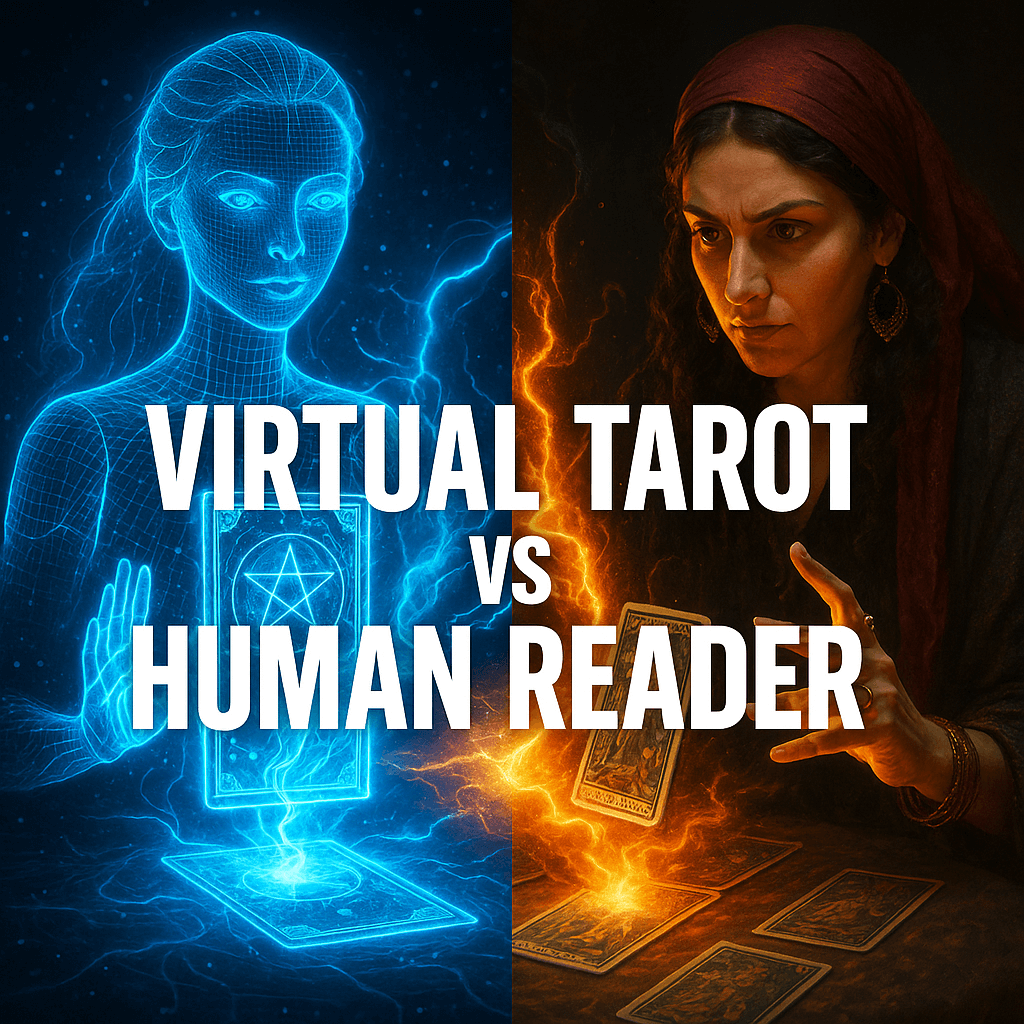
Tarot has always adapted to the way people live. What began as a face-to-face practice with cards on a table has expanded into phone readings, video sessions, mobile apps, and now fully automated virtual tarot systems. Today, many people find themselves choosing between a virtual tarot reading and a session with a human tarot reader—sometimes switching between both depending on their needs.

💜 Need a clear answer right now?
CONSULT THE YES OR NO TAROT Free · No registration · Instant resultThis comparison is not about choosing a “better” option. Both approaches serve different emotional purposes. A virtual tarot system offers speed, privacy, and structure. A human reader brings emotional judgment, lived experience, and interactive intuition. Understanding how each works in real life helps people choose the right form of reflection at the right time.
Time Awareness, Personal Cycles, and the Search for Meaning
People often turn to tarot during moments of transition—career shifts, relationship changes, health worries, or emotional uncertainty. Alongside tarot, some reflect on these changes through symbolic timing systems such as horoscope insights, using them as emotional reference points rather than strict predictions.
Both virtual tarot and human readers operate in this same reflective space. They don’t define what will happen, but help explore how someone might emotionally experience what is happening.
Why People Seek Tarot During Change
- To clarify emotional uncertainty
- To slow impulsive decision-making
- To reflect on patterns and habits
- To regain a sense of meaning during instability
The difference lies in how insight is delivered.
How Virtual Tarot Works in Practice
Virtual tarot includes automated apps, websites, and AI-driven systems that generate card draws and interpretations instantly. These tools rely on large symbolic databases and algorithmic processes. Many users find that clarity improves when they approach these systems using focused questioning methods, such as those explained in instant tarot, which encourage precise emotional inquiry rather than vague curiosity.
What Virtual Tarot Actually Provides
- Automated card selection
- Pre-written symbolic interpretations
- Pattern tracking across multiple readings
- Quick emotional prompts
Where Virtual Tarot Works Best
- Daily emotional check-ins
- Personal journaling
- Quiet self-reflection
- Habit-building
Virtual tarot offers structure—but it does not listen, interpret tone, or adjust meanings through conversation.
What a Human Tarot Reader Brings to the Experience
A human reader interprets symbolism through voice, intuition, context, and emotional presence. Rather than pulling from a fixed database, they adjust meanings based on:
- The person’s emotional cues
- The specific situation being discussed
- Subtle shifts in language and energy
Human readers do not simply “read the cards”—they interpret emotional stories.
Many people who use virtual tools alone eventually try a human session when emotions become more layered, especially after learning how to form clearer questions using approaches like those explained in instant tarot.
What Human Readers Offer That Technology Cannot
- Emotional attunement
- Real-time adjustment of interpretation
- Clarifying follow-up questions
- Empathy and relational presence
Virtual Tarot vs Human Reader: A Practical Comparison
| Aspect | Virtual Tarot | Human Tarot Reader |
|---|---|---|
| Speed | Instant | Scheduled |
| Emotional Dialogue | None | Present |
| Interpretation Style | Fixed text | Dynamic |
| Privacy Level | Very high | Moderate |
| Adaptability | Limited | High |
| Personal Context | Minimal | Deep |
This comparison shows that the decision is rarely about “which is better.” It is about which fits the moment.
Digital Access and Changing Tarot Habits
Many people now begin their tarot journey through online tarot sessions, which bridge the gap between full automation and human interaction. These sessions allow real-time communication without physical presence, blending digital convenience with emotional dialogue.
Virtual tarot tools often act as the entry point. Human readers become more relevant as emotional complexity grows.
Visual Presence and Emotional Depth
For some individuals, emotional clarity comes through visual communication—seeing facial expression, hearing voice, and sensing pauses. That is why video readings continue to feel powerful even in an age of automation.
When Visual Readings Are Often Chosen
- During relationship conflict
- After sudden loss or shock
- While making complex life decisions
- When emotional reassurance is needed
Virtual tarot is quiet and solitary. Visual sessions feel relational.
Privacy, Anonymity, and Quiet Reflection
Virtual tarot offers almost complete anonymity. There is no voice, no face, and no emotional exposure. This mirrors why many people also feel comfortable with phone readings, which remove visual vulnerability while preserving human interaction.
Who Often Prefers Virtual Tarot
- Introverted individuals
- People processing sensitive topics
- Users seeking emotional autonomy
- Those unsure about speaking openly
Privacy feels safe—but it can also limit emotional feedback.
Relationship Questions: Automation vs Human Interpretation
Relationship matters are among the most common reasons people turn to tarot. Virtual tarot can highlight emotional patterns, but many people eventually seek deeper clarity through love tarot readings, where human intuition and emotional nuance become more important.
What Virtual Tarot Can Reveal About Relationships
- Emotional confusion
- Attachment anxiety
- Communication tension
- Curiosity about reconnection
What Human Readers Add
- Empathy during emotional vulnerability
- Clarification during mixed signals
- Support during grief or separation
Ethics, Responsibility, and the Human Factor
Automation does not remove emotional responsibility. Virtual systems can unintentionally reinforce fear or over-reliance if not used carefully. For this reason, many people eventually seek grounded interpretation from qualified professionals or turn to reliable readers for balanced, ethical support.
Why Ethics Matter More With Automation
- Algorithms cannot detect emotional distress
- Automated systems cannot redirect harmful dependency
- Fear-based looping can go unnoticed
Human readers can recognize when reflection needs grounding.
Benefits of Virtual Tarot
- Instant access at any time
- Complete privacy
- Helpful for daily reflection
- No scheduling required
- Low emotional exposure
Benefits of Human Tarot Readers
- Emotional attunement and presence
- Dynamic interpretation
- Clarifying questions
- Context-aware guidance
- Relational support
Frequently Asked Questions
Is virtual tarot as accurate as a human reader?
Virtual tarot generates symbolic interpretations, while human readers interpret through emotional context and intuition. They function differently rather than competitively.
Can virtual tarot replace human readers completely?
For daily reflection, virtual tarot may be sufficient. For emotional complexity, many people prefer human interaction.
Is it unhealthy to rely only on virtual tarot?
It depends on intention. Reflection is healthy; emotional dependency on automation may not be.
Do human readers always give better guidance?
Human readers offer emotional dialogue, but the quality still depends on the individual reader’s ethics and experience.
Can people switch between both?
Yes. Many people move between virtual and human readings depending on personal needs and emotional depth.
Conclusion
The choice between Virtual Tarot and a Human Reader is not a question of superiority—it is a question of emotional purpose. Virtual tarot offers privacy, speed, and structure. Human tarot offers relationship, intuition, and emotional interpretation.
When used thoughtfully, both can coexist as complementary tools. Virtual tarot supports quiet self-reflection. Human readers support emotional dialogue. The healthiest approach recognizes when to be alone with symbols—and when to speak with another human being.
