

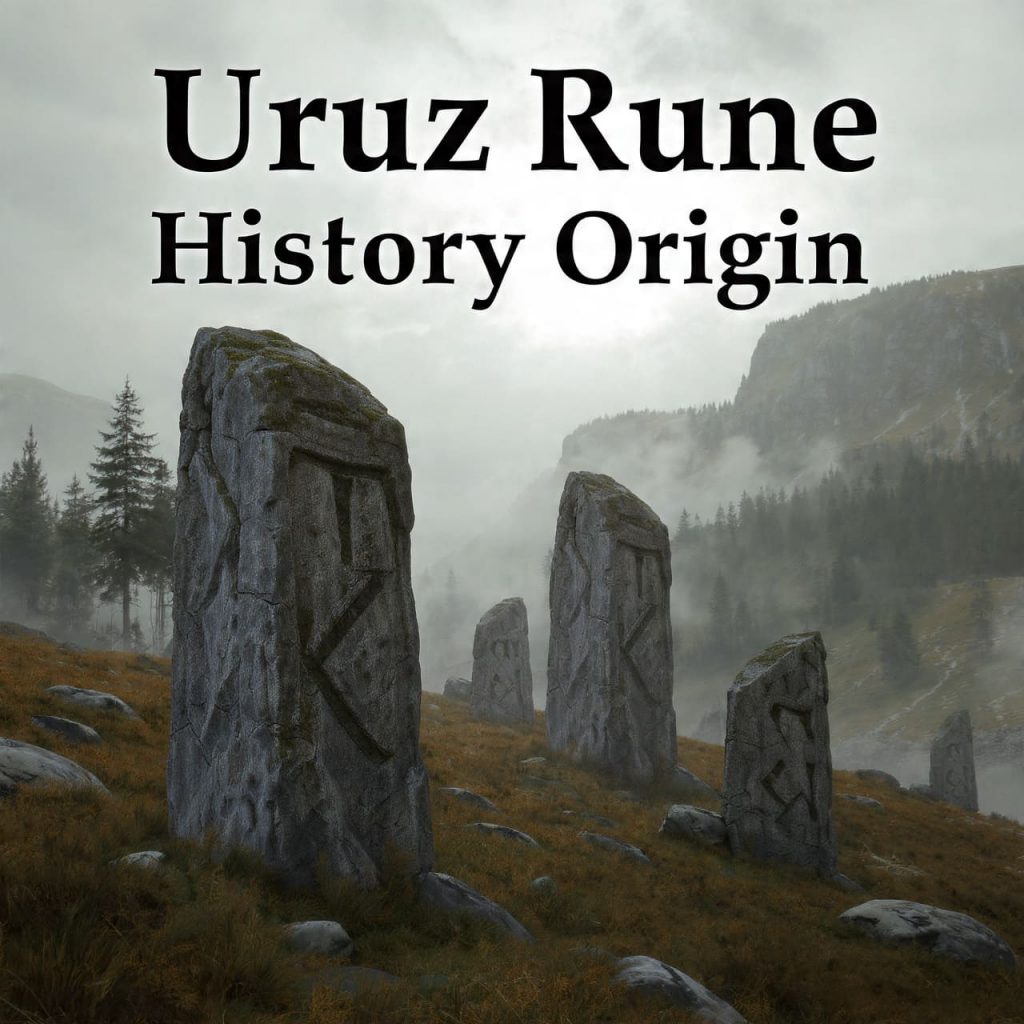
Understanding the Uruz rune history origin is not difficult because the rune is obscure, but because early Germanic writing left very little direct explanation behind. There are no surviving manuals, no contemporary authors describing rune creation, and no fixed timeline written by the people who used them. Instead, knowledge comes from archaeology, comparative linguistics, and patterns observed across inscriptions.

💜 Need a clear answer right now?
CONSULT THE YES OR NO TAROT Free · No registration · Instant resultThis creates a specific kind of hesitation: not emotional confusion, but uncertainty about whether the available evidence is strong enough to accept a clear historical origin.
Historians often face this same moment when working with early European material culture, and qualified professionals typically resolve it by deciding whether the evidence has crossed the threshold from “suggestive” to “sufficient.” Focus-based evaluation methods, including those explained on astroideal, help keep this decision grounded and narrow rather than speculative.
Why a Yes or No Tarot Helps Here
In this context, a yes-or-no framework does not attempt to determine historical truth. Archaeology and linguistics do that. Instead, it helps the reader make a clear decision about confidence: is the origin of the Uruz rune established well enough to be accepted, or does uncertainty still outweigh clarity?
Without this framing, readers often continue reading indefinitely, hoping for absolute proof that does not exist for most early writing systems. A yes-or-no structure limits overanalysis and keeps attention on the actual question being asked.
This same clarity principle is used in structured formats such as love tarot readings, where limiting scope prevents confusion. Applied carefully, it supports critical thinking rather than replacing it.
Encouraging One Clear Question
Historical confusion increases when multiple questions are merged. Asking about origin, symbolism, later mythological meaning, and cultural use at the same time prevents resolution.
To stay focused, the question must address origin only.
Clear examples include:
- “Is the historical origin of the Uruz rune sufficiently supported by evidence?”
- “Can Uruz be confidently placed within the earliest runic system?”
- “Is the scholarly consensus on Uruz’s origin clear enough to accept?”
These questions do not seek belief or validation. They help the reader decide whether the available material justifies confidence. This disciplined approach mirrors how reliable readers maintain clarity by avoiding layered inquiries.
The Emergence of Runic Writing in Northern Europe
The Uruz rune cannot be understood in isolation. It emerged as part of the earliest runic writing system used by Germanic-speaking communities in Northern Europe. Most scholars date the appearance of runes to roughly the 2nd century CE, although precursors may be slightly earlier.
Runes were carved into hard materials such as stone, bone, wood, and metal. This practical context influenced their angular shapes and limited variations. The writing system was functional, not decorative, intended for names, ownership marks, short messages, and memorial inscriptions.
Uruz appears within this earliest phase, indicating that it was not a later innovation but part of the system’s foundation.
Uruz Within the Elder Futhark
The earliest complete runic alphabet is known as the Elder Futhark, consisting of twenty-four characters. Uruz holds the second position in this sequence. This placement is significant because early inscriptions tend to preserve the same rune order, suggesting early standardization.
Runes that appear consistently across early inscriptions and in stable positions are generally considered original elements of the system. Uruz meets both criteria. Its consistent form and placement argue strongly against it being a regional or experimental addition.
This structural evidence is one of the strongest indicators of Uruz’s early origin.
Linguistic Foundations of the Uruz Rune
From a linguistic perspective, Uruz corresponds to a phoneme reconstructed in Proto-Germanic, the ancestral language of later Germanic tongues. Early runes were designed to represent sounds, not ideas.
Comparative linguistics shows a close alignment between the sounds represented by early runes and reconstructed Proto-Germanic phonology. Uruz fits cleanly into this system, supporting the view that it was created to meet linguistic needs rather than symbolic ones.
This functional alignment reinforces the conclusion that Uruz originated as part of a coherent writing system, not as an isolated symbol.
Archaeological Evidence and Physical Inscriptions
Archaeological findings provide concrete support for Uruz’s origin. Inscriptions containing the rune have been discovered on weapons, jewelry, tools, and memorial stones across Scandinavia and parts of continental Europe.
These artifacts date primarily from the early centuries CE. Importantly, the form of Uruz remains recognizable and consistent across these finds. Such consistency suggests shared knowledge rather than independent invention.
This convergence of physical evidence is similar to validation methods used in online tarot sessions, where alignment across multiple inputs strengthens clarity without speculation.
Geographic Distribution and Cultural Transmission
The wide geographic distribution of Uruz inscriptions indicates that the rune was used across multiple Germanic communities. This suggests cultural transmission rather than local experimentation.
Knowledge of runes was likely passed orally and through practice rather than formal instruction. Despite this, Uruz maintained a stable form, implying that it was already well established when surviving inscriptions were created.
This stability supports the conclusion that its origin predates the earliest surviving artifacts.
Distinguishing Origin From Later Meaning
One of the most common sources of confusion is mixing historical origin with later interpretation. Symbolic meanings associated with runes developed centuries after their creation and do not explain why the runes were originally designed.
Historically, Uruz functioned as a phonetic character. Later cultural narratives do not alter its origin. Separating these layers is essential for clarity.
This boundary-keeping resembles the focus discipline used in phone readings, where clarity depends on not blending unrelated contexts.
Assessing the Evidence Without Overreach
Absolute certainty is rare in early European history. What matters is whether multiple independent lines of evidence converge. In the case of Uruz, linguistic reconstruction, archaeological consistency, geographic spread, and structural placement all point in the same direction.
While precise dates and individual creators remain unknown, the origin framework is coherent and supported. This allows the reader to move from uncertainty to informed acceptance.
Final Context Before Deciding
In summary, Uruz appears in the earliest runic alphabet, aligns with Proto-Germanic phonology, is archaeologically attested across regions, and shows early standardization. These factors collectively support a clear historical origin.
This concise review mirrors the confirmation process often seen in horoscope insights, where clarity comes from synthesis rather than expansion. At this stage, revisiting focus strategies from astroideal helps finalize the decision without reopening doubt.
Frequently Asked Questions
Is the Uruz rune historically real?
Yes. Its existence is confirmed through archaeological inscriptions.
Do we know who created the rune?
No individual creator is known.
Can its exact date of origin be identified?
Only approximately, within the early centuries CE.
Was Uruz part of the first runic system?
Yes, it appears in the Elder Futhark.
Does later symbolism affect its origin?
No. Symbolism developed long after its creation.
Is scholarly consensus strong?
Yes, regarding its placement and early use.
Call to Action
If you want to resolve uncertainty responsibly, now is the time to get a clear yes or no answer. Use a one question tarot mindset to decide whether the historical evidence behind the Uruz rune’s origin is sufficient for you—based on facts, not speculation.
