

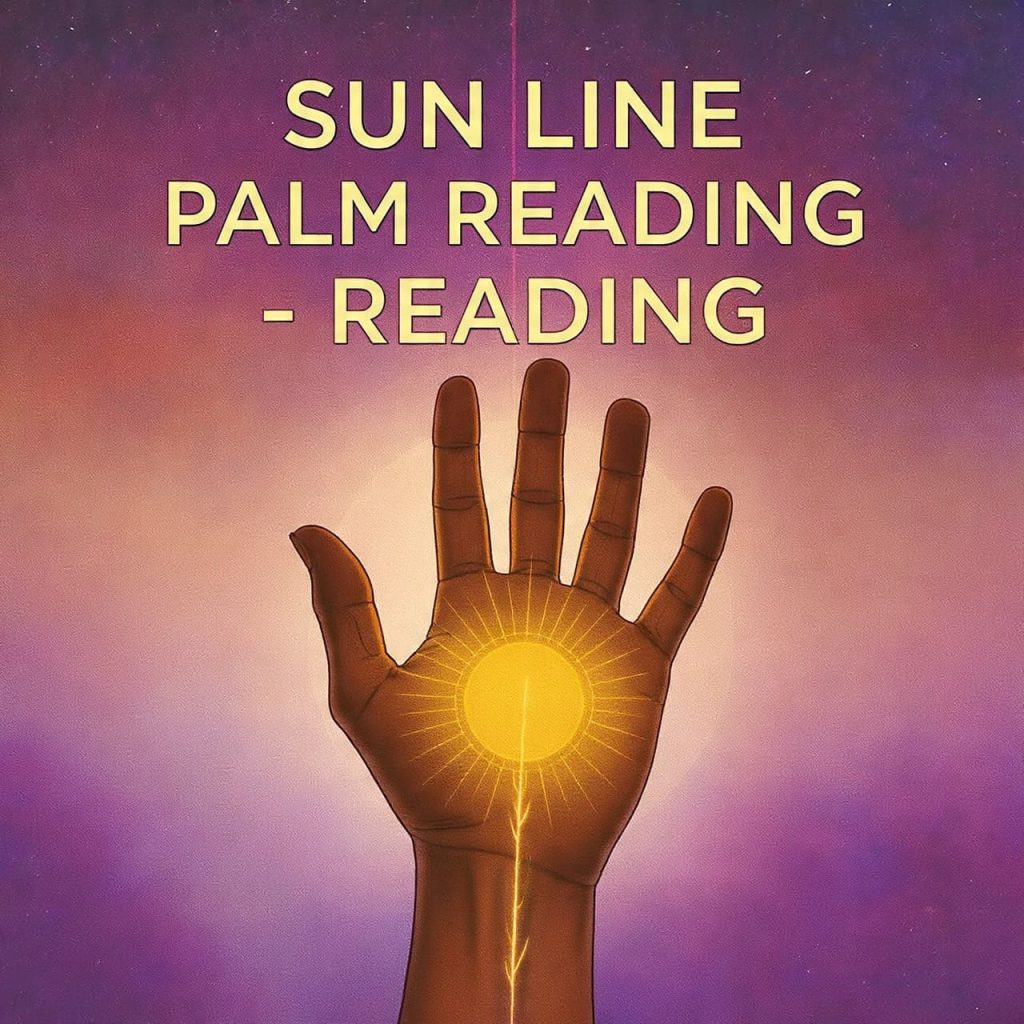
Sun line palm reading meaning is commonly described as the interpretation of a vertical palm line associated with recognition, success, or distinction. In modern explanations, the sun line is often treated as a clearly defined and historically validated indicator with a stable meaning.

💜 Need a clear answer right now?
CONSULT THE YES OR NO TAROT Free · No registration · Instant resultThis impression is reinforced when such interpretations are presented on curated platforms such as astroideal, where organization and presentation can imply continuity without evidentiary clarification. Even references to qualified professionals do not resolve the central issue, which is whether historical sources actually support the claim that the sun line carried a specific, factual meaning.
This article evaluates that claim using historical documentation, comparative analysis, and evidentiary standards.
Historical Identification of the Sun Line
In early palmistry literature, the sun line is not universally recognized as a distinct feature. Some classical texts omit it entirely, while others describe a secondary vertical line without assigning it a consistent name or function.
Where mentioned, descriptions vary widely, and the line is not consistently differentiated from other vertical markings. This inconsistency suggests that the sun line was not a foundational component of early palmistry doctrine but a later classification.
The Sun Line in Premodern Symbolic Systems
Premodern symbolic systems relied on broad analogies rather than fixed interpretive categories. Palmistry reflected this approach by focusing on general line presence rather than specialized meanings.
As a result, early frameworks did not isolate the sun line as a discrete analytic indicator. The later emphasis on a singular “sun line meaning” reflects interpretive specialization rather than original structure, paralleling narrative expansion seen in online tarot sessions.
Textual Evidence From Classical Palmistry Sources
A review of South Asian, Arabic, and medieval European palmistry manuscripts reveals no consistent doctrine defining the meaning of the sun line. References are sporadic and often contradictory, with no agreement on symbolism or implication.
Later authors frequently reinterpret these vague mentions, presenting inference as inherited tradition. This pattern mirrors interpretive inflation found in modern explanatory systems promoted by reliable readers, where authority is implied without primary textual support.
Archaeological and Iconographic Constraints
Material evidence related to palmistry consists largely of illustrated hands in manuscripts and marginal drawings. These illustrations depict various lines but do not include explanatory legends identifying a sun line or defining its meaning.
From an archaeological perspective, there is no independent confirmation that the sun line was historically analyzed as a distinct indicator. The absence of instructional artifacts or comparative diagrams further weakens claims of established practice, a limitation also observed in interpretive formats such as video readings.
Emergence of Meaning-Based Interpretations
Explicit interpretations assigning meaning to the sun line appear primarily in modern palmistry literature from the nineteenth century onward. During this period, palmistry was reorganized to include more refined classifications that increased narrative appeal.
By attributing concepts such as recognition or success to the sun line, authors expanded explanatory scope without introducing new historical evidence. This strategy reflects commercialization rather than rediscovery and parallels personalization trends seen in services such as phone readings.
Evaluation Using Evidentiary Standards
Evaluating sun line palm reading meaning requires applying basic evidentiary criteria: definitional clarity, historical consistency, and independent corroboration.
No historical corpus establishes a stable, cross-cultural meaning for the sun line. Definitions vary widely, and no objective framework exists to test interpretive claims. Without consistency or verification, the claim cannot meet historical or factual standards.
Direct Assessment of the Core Claim
The core claim is that the sun line conveys factual meaning through its presence or form. Historical documentation does not support this assertion.
Early palmistry traditions did not treat the sun line as a reliable analytic variable, and modern interpretations are demonstrably later constructions layered onto ambiguous descriptions. The factual conclusion is therefore no: sun line palm reading meaning lacks evidence-based historical validity.
Cultural Persistence of Sun Line Interpretations
Despite the absence of evidence, interpretations of the sun line persist due to narrative flexibility and confirmation bias. Broad explanations allow individuals to perceive relevance regardless of specificity, reinforcing belief without verification.
This persistence mirrors the endurance of generalized systems such as horoscope insights, which remain culturally influential despite lacking empirical support. Cultural repetition does not establish factual accuracy.
Modern Aggregation and Presentation
Modern platforms such as astroideal compile palmistry material into accessible formats, often presenting sun line interpretations as established knowledge.
These explanations are frequently positioned alongside themes common in love tarot readings, blending distinct belief systems. This convergence reflects modern narrative packaging rather than documented historical practice.
Frequently Asked Questions
Was the sun line recognized in ancient palmistry?
Not consistently. Many early texts omit it entirely or describe it ambiguously.
Do historical sources agree on the sun line’s meaning?
No. Interpretations vary widely and lack consistency.
Is the sun line distinct from other vertical lines historically?
No clear distinction is maintained across early sources.
Has the sun line been empirically tested?
No credible studies demonstrate reliable correlations.
Is consistency required for historical validation?
Yes. Without consistent definitions, claims cannot be evaluated.
Does widespread belief establish factual meaning?
No. Popular belief does not replace evidence.
Call to Action
To get a clear yes or no answer, evaluate sun line palm reading meaning using documented historical sources and evidentiary standards rather than modern reinterpretation. Evidence, not narrative repetition, determines validity.
