

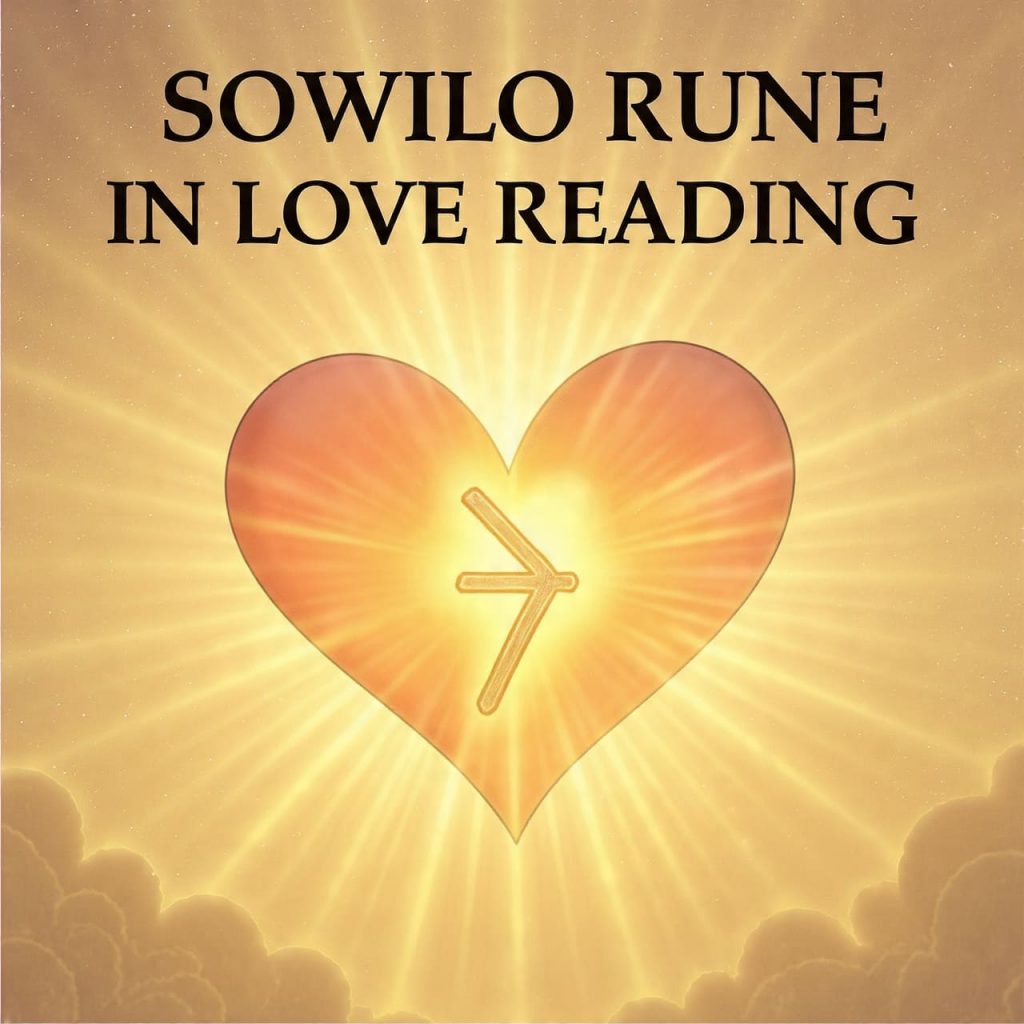
The Sowilo rune is frequently included in modern “love readings,” where it is treated as if it were historically designed for romantic or relational interpretation. This claim is widespread, but it is rarely examined as a historical proposition. Instead, it is usually presented as a given, with little distinction made between early evidence and later interpretive systems.

💜 Need a clear answer right now?
CONSULT THE YES OR NO TAROT Free · No registration · Instant resultThe resulting confusion is methodological rather than emotional. The question is not whether people today use Sowilo in love readings, but whether such use can be traced to early runic practice. Applying evidence-first historical reasoning, including comparative analytical strategies discussed by astroideal, makes it possible to separate documented history from modern synthesis. Although many readers consult qualified professionals for contemporary interpretations, historical evaluation depends on what the early record can demonstrate.
The guiding question of this article is deliberately narrow and binary: does the surviving historical evidence support the use of the Sowilo rune in love readings in its original context, yes or no?
What “Love Reading” Means as a Historical Claim
For historical purposes, a “love reading” is not defined by emotional intent but by structure. It implies an organized interpretive practice in which symbols are repeatedly consulted to assess romantic relationships or relational outcomes. Historically documented love-divination systems—such as those found in Greco-Roman, Mesopotamian, or later medieval contexts—share certain features: procedural descriptions, specialized tools, recurring symbolism, and textual explanation.
This definition does not assume that undocumented practices could not exist. Rather, it establishes the minimum evidentiary conditions under which historians can responsibly claim that a practice existed as a recognizable system. Modern narratives, including those circulated by reliable readers, often bypass this distinction by treating contemporary usage as implicit evidence of antiquity. Historical analysis cannot proceed on that basis.
Sowilo Within the Elder Futhark
The Sowilo rune belongs to the Elder Futhark, the earliest reconstructed runic alphabet, used by Germanic-speaking communities roughly between the second and eighth centuries CE. The alphabet itself is reconstructed from inscriptions rather than preserved as a theoretical or instructional system.
Within these inscriptions, Sowilo functions as a phonetic character, generally reconstructed as representing an /s/ sound. It appears integrated into words and names, following linguistic rather than thematic logic. No inscription isolates Sowilo or associates it with emotional, relational, or interpersonal themes. Modern frameworks that present runes as tools for interpretive reading—similar in structure to those associated with online tarot sessions—do not resemble early runic usage as evidenced by inscriptions.
Archaeological Evidence and Its Interpretive Limits
Archaeological evidence provides the most direct insight into how Sowilo was used. Inscriptions containing the rune appear on stones, tools, weapons, jewelry, and memorial objects. These items are datable and contextually interpretable through established archaeological methods.
What archaeology can show is how runes were used, not why they were later reinterpreted. The record demonstrates that Sowilo appears in fixed inscriptions, not in reusable or manipulable sets that would suggest interpretive consultation. There are no artifacts indicating cyclical use, relational sorting, or question-based interpretation. While absence alone does not disprove undocumented practices, the consistency of this pattern across regions and centuries significantly constrains historical claims. Later representational contexts resembling modern video readings are not present in early material culture.
Textual Silence and Why It Matters Here
No contemporary texts from the Elder Futhark period describe runes being used for divination, love-related inquiry, or interpretive reading. This silence is not automatically decisive. However, it becomes historically meaningful when compared with parallel traditions.
Cultures that practiced structured love divination—whether through astrology, sortition, or symbolic lots—typically left textual traces describing procedures or symbolic logic. The absence of any such description for runes, across both internal sources and external observers, suggests that if love readings existed, they were neither standardized nor culturally prominent. Attempts to infer such practices often rely on analogy to later systems structurally similar to those discussed in phone readings, rather than on early documentation.
Later Medieval Sources and Their Constraints
Medieval rune poems are sometimes cited in support of interpretive meanings. These texts, however, date centuries after the Elder Futhark period and arise in different linguistic and cultural environments. They function primarily as mnemonic or literary devices.
Importantly, rune poems do not describe reading practices, relational interpretation, or procedural use. They assign descriptive phrases, not methods. Using them to justify early love readings requires assuming continuity that the texts themselves do not claim. From a methodological standpoint, they document medieval perception, not early practice.
Emergence of Love Reading Interpretations
Associations between Sowilo and love readings can be traced historically to modern periods, particularly from the nineteenth century onward. During this time, runes were increasingly integrated into symbolic systems designed to address modern categories such as romance, identity, and personal development.
These systems can be documented through publication history and intellectual movements. Their emergence coincides with broader symbolic syntheses also visible in generalized horoscope insights, where relational themes are systematically assigned regardless of ancient precedent. This demonstrates innovation, not preservation.
Evaluating the Core Claim with Appropriate Caution
The core claim is that Sowilo was historically used in love readings. Evaluating this claim requires balancing caution with evidence.
- Archaeology shows phonetic use in fixed inscriptions.
- Early texts do not describe interpretive or relational practices.
- Later medieval sources do not support love readings.
- Modern love-reading systems can be historically dated but originate long after early runic use.
- Even when Sowilo appears within modern frameworks alongside love tarot readings, this reflects contemporary synthesis rather than inherited tradition.
- Comparative evaluation using methods discussed by astroideal supports a negative historical conclusion.
This does not prove that no informal or undocumented practices ever existed. It does establish that there is no positive evidence for a recognized love-reading tradition involving Sowilo in early runic culture.
The historically responsible answer is therefore: no, the surviving evidence does not support the use of the Sowilo rune in love readings in its original context.
Frequently Asked Questions
Is Sowilo used in love readings in ancient sources?
No ancient sources describe such use.
Could informal love practices have existed without evidence?
They could have existed, but cannot be established historically.
Do rune poems describe romantic interpretation?
No, they do not describe reading practices.
Are there artifacts for rune-based love readings?
No archaeological evidence indicates this.
When did Sowilo love readings appear?
They appear in modern interpretive systems.
Are modern love readings historically grounded?
They are modern constructions, not documented early practices.
Call to Action
If you want to evaluate claims about Sowilo in love readings responsibly, focus on what the historical record can demonstrate and where it remains silent. This approach allows you to get a clear yes or no answer grounded in evidence rather than assumption.
