

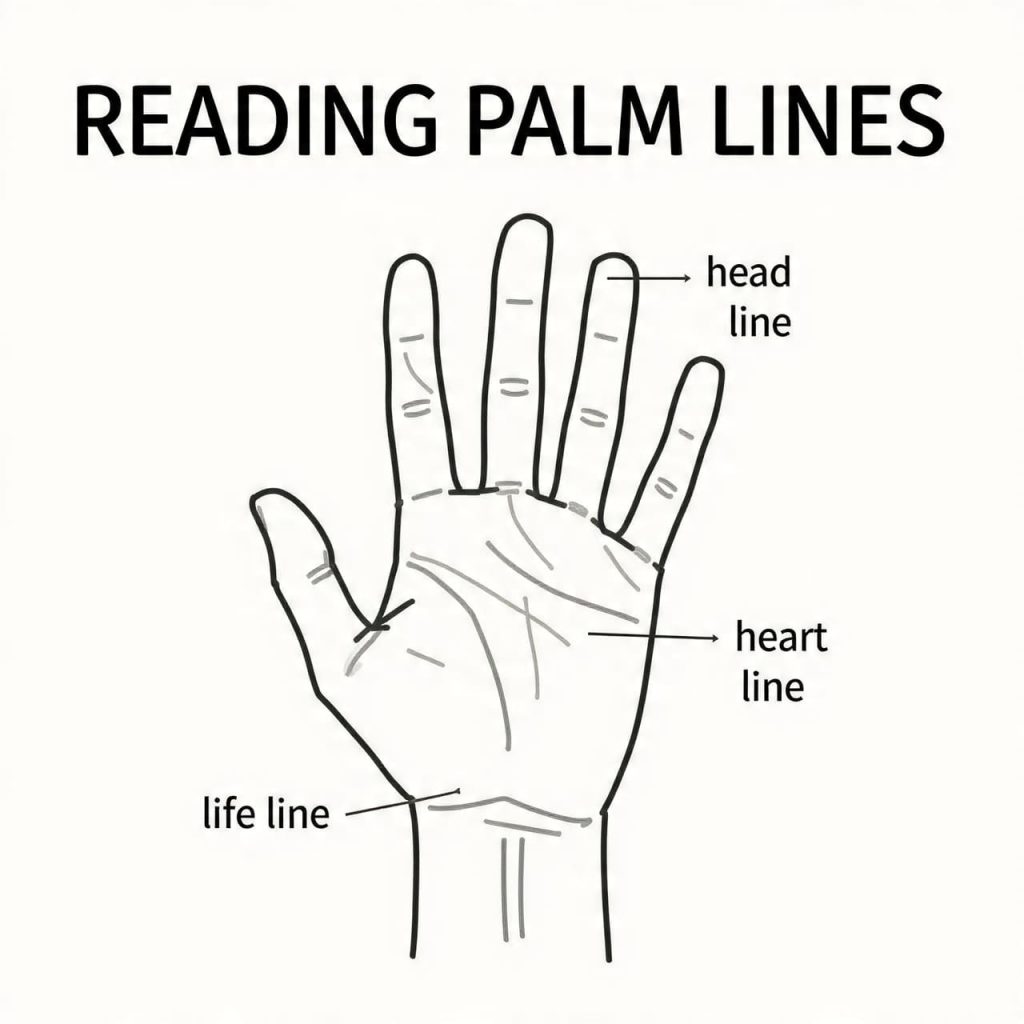
Reading palm lines is one of the most recognizable aspects of palmistry, a traditional practice that examines the hands to explore personality traits, emotional tendencies, and life patterns. For centuries, people have looked to the lines of the palm not as fixed predictions, but as symbolic indicators of how a person experiences life, love, and personal growth. Many believe palm lines reflect tendencies and potential rather than unchangeable fate.

💜 Need a clear answer right now?
CONSULT THE YES OR NO TAROT Free · No registration · Instant resultPractitioners suggest that learning how to read palm lines requires observation, patience, and context. A single line rarely tells a complete story. Instead, meaning emerges from how lines interact with one another, with hand shape, and with overall structure. When approached responsibly, palm reading becomes a reflective practice that supports self-awareness rather than certainty.
This article offers a comprehensive, informative guide to reading palm lines. It explains the major and minor lines, how they are interpreted, common misconceptions, benefits and limitations, and how to approach palmistry in a grounded, ethical way.
Understanding the Basics of Palm Lines
What palm lines represent
Palm lines are the natural creases formed by hand movement and development. In palmistry, these lines are interpreted symbolically to explore emotional expression, thinking patterns, vitality, and relationship tendencies. Many believe palm lines reflect how a person interacts with life rather than what will inevitably happen.
Practitioners emphasize that lines are read for quality, clarity, and interaction, not simply for length or number. A clear line may suggest focus or consistency, while faint or fragmented lines may point to change or adaptability.
Why palm lines vary between individuals
No two palms are exactly alike. Genetics, hand use, and life experience all influence line formation. Palmistry acknowledges this individuality, interpreting each hand as a unique combination of traits rather than a template.
This variation is why palm reading is often described as observational rather than predictive.
Dominant and non-dominant hands
Most practitioners read both hands. The non-dominant hand is often associated with inherited traits or early tendencies, while the dominant hand reflects current patterns and how those traits are being expressed.
Understanding which hand to read adds depth and balance to interpretation.
The Major Palm Lines Explained
The life line
The life line curves around the base of the thumb and is one of the most well-known palm lines. Contrary to popular belief, it does not predict lifespan. Instead, it is often associated with vitality, resilience, and how a person responds to life’s challenges.
A strong life line may suggest consistent energy, while variations or breaks are commonly interpreted as periods of transition or change rather than negative outcomes.
The head line
The head line runs horizontally across the palm and is associated with thinking style, decision-making, and mental focus. A straight head line is often linked with logical thinking, while a curved one may suggest creativity or intuition.
Practitioners stress that head line interpretation should consider its relationship with other lines, especially the heart line.
The heart (love) line
The heart line, located near the top of the palm, reflects emotional expression and relationship style. It is often examined in discussions about connection, affection, and emotional boundaries.
Rather than indicating specific relationship outcomes, the heart line is interpreted as showing how a person gives and receives love.
Minor Palm Lines and Their Meaning
The fate line
The fate line, if present, runs vertically toward the center of the palm. It is often associated with direction, responsibility, or external influences on life path. Not everyone has a clear fate line, and its absence is not considered negative.
Practitioners suggest the fate line reflects structure and commitment rather than destiny.
The sun (Apollo) line
The sun line is sometimes linked with creativity, fulfillment, or recognition. It is often interpreted cautiously, especially in free readings, as its presence and clarity vary widely.
This line is typically read in context with personal values rather than external success alone.
Relationship and influence lines
Short horizontal lines near the edge of the palm are sometimes called relationship or influence lines. These are often misunderstood as marriage indicators, but practitioners suggest they reflect significant emotional connections rather than formal status.
How Palm Lines Are Read Together
Interaction between lines
Palmistry emphasizes interaction. For example, how the heart and head lines relate can suggest how emotion and logic balance in decision-making. Overlapping or closely spaced lines may reflect integrated emotional and mental processes.
Meaning emerges from patterns rather than isolated features.
Depth, clarity, and texture
Line depth and texture are important. Deep, well-defined lines are often associated with strong focus, while lighter lines may indicate flexibility or evolving tendencies.
Breaks, chains, or branches are interpreted as transitions rather than fixed events.
Context over conclusions
Practitioners caution against drawing conclusions from a single feature. Reading palm lines responsibly means observing the whole hand, including shape, mounts, and finger proportions.
Learning to Read Palm Lines Step by Step
Observation before interpretation
Before assigning meaning, many practitioners recommend careful observation. Notice which lines are most prominent and how they relate spatially.
This step prevents rushed or biased interpretation.
Framing thoughtful intentions
Although palm reading relies on observation, intention still matters. Reflecting on what you want to understand helps guide focus.
Using strategies explained in palm reading for clearer questions can support more meaningful exploration of palm lines by aligning observation with purpose.
Recording and reflecting
Keeping notes or sketches of palm lines helps track changes over time. Reflection often reveals patterns that are not immediately obvious.
Reading Palm Lines in Free and Digital Formats
What free palm line readings include
Free palm line readings often focus on the three major lines and basic hand shape. These readings are usually introductory and educational rather than comprehensive.
Even qualified professionals may offer brief free explanations to help learners understand palmistry fundamentals.
Benefits of free palm line readings
Free readings make palmistry accessible. They allow individuals to explore concepts without pressure and build foundational knowledge.
Many people use free readings as learning tools rather than sources of certainty.
Limitations to consider
Because free readings are generalized, they lack full context. Practitioners suggest treating them as starting points rather than definitive interpretations.
Digital Access to Palm Line Reading
Online palm reading platforms
Many people explore palm line interpretation through online tarot sessions that also include palmistry tools. These platforms often provide guided explanations of major lines.
Digital access has expanded learning opportunities significantly.
Video-based palm reading education
Visual learners often benefit from video readings that demonstrate how to identify and interpret palm lines. Seeing line placement improves understanding.
Phone-based palm reading formats
Some prefer phone readings, where palm features are discussed verbally. This format emphasizes conceptual understanding and dialogue.
Palm Lines and Emotional Insight
Palm lines and relationships
The heart line is commonly examined for emotional tendencies. Practitioners suggest reading it as an indicator of how emotions are expressed rather than who someone will love.
Some people explore palmistry alongside love tarot readings to view emotional patterns from complementary perspectives.
Emotional responsibility in interpretation
Ethical palm reading avoids claims about another person’s intentions or actions. The focus remains on the individual’s emotional traits and choices.
Comparing Palm Line Reading With Other Practices
Palmistry versus tarot
Palmistry examines physical features, while tarot uses symbolic imagery. Palm reading is often perceived as more personal because it studies the individual directly.
Some people consult reliable readers across different systems to gain balanced perspective.
Palmistry and astrology
Astrology explores cycles and timing, while palmistry focuses on lived tendencies. Combining palm line reading with horoscope insights can add broader context without replacing palmistry’s focus.
Comparison table
| Practice | Focus | Method | Insight Type |
|---|---|---|---|
| Palm line reading | Personal tendencies | Hand observation | Self-awareness |
| Tarot | Situational themes | Symbolic cards | Contextual insight |
| Astrology | Cycles and timing | Birth data | Pattern awareness |
Common Misconceptions About Palm Lines
Palm lines predict exact events
One of the most common myths is that palm lines predict specific events. Practitioners widely reject this idea, emphasizing reflection over prediction.
Changes mean negative outcomes
Changes in palm lines are often associated with growth or transition, not misfortune. Lines can evolve as experiences and priorities change.
One line defines everything
No single line defines a person. Responsible palmistry considers the whole hand.
Developing Skill in Reading Palm Lines
Practice and patience
Learning palmistry takes time. Regular observation builds familiarity with patterns and variation.
Studying multiple hands
Comparing different hands helps develop perspective. Variation reinforces palmistry’s interpretive nature.
Continuing education
Books, courses, and guided sessions can deepen understanding beyond free resources.
Using strategies explained in palm reading for clearer questions can further support learning by helping practitioners focus interpretation responsibly.
Frequently Asked Questions
Can anyone learn to read palm lines?
Yes, basic palmistry concepts are accessible to beginners.
Do palm lines change over time?
They can change gradually, reflecting life experience.
Which hand is more important?
Most practitioners read both hands for balance.
Are palm line readings accurate?
Accuracy is subjective and often measured by relevance rather than prediction.
Is palmistry safe?
It is generally safe when used reflectively and without dependency.
Can palm lines show relationships?
They reflect emotional tendencies rather than specific outcomes.
How often should palm lines be read?
Occasionally, with time for reflection between readings.
Conclusion
Reading palm lines is a reflective practice rooted in observation, symbolism, and context. Rather than predicting fixed outcomes, palmistry explores tendencies, emotional patterns, and personal development through the natural features of the hand. Its value lies in awareness rather than certainty.
By understanding the major and minor lines, observing how they interact, and approaching interpretation responsibly, individuals can use palm line reading as a meaningful tool for self-reflection. When practiced with balance and realism, palmistry supports insight, growth, and a deeper understanding of personal patterns over time.
