

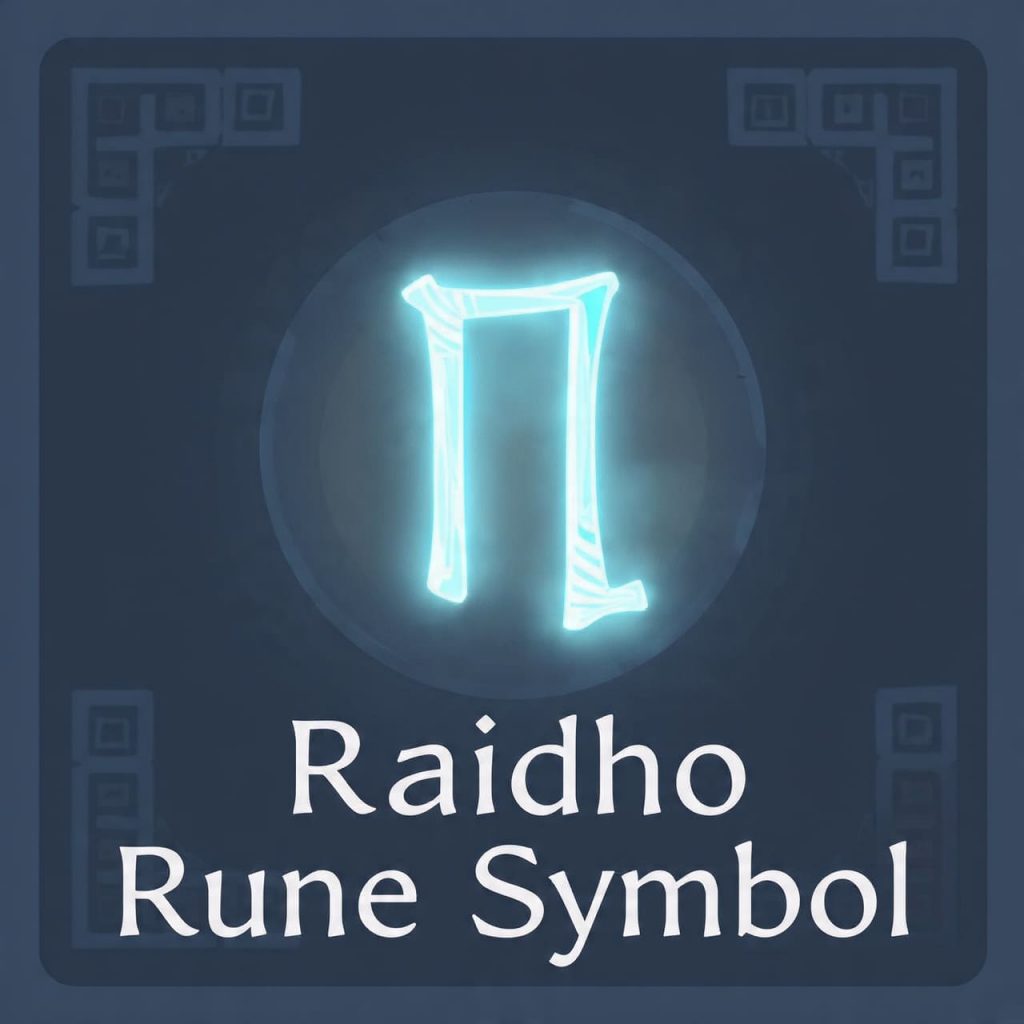
The Raidho rune symbol often appears simple at first glance, yet many people sense there is more behind its form than a basic line drawing. This creates uncertainty. You may recognize that it relates to movement or journey, but still feel unclear about what the symbol itself actually represents and why its structure matters. That hesitation is valid. With runes, meaning is carried not only by ideas but by form.

💜 Need a clear answer right now?
CONSULT THE YES OR NO TAROT Free · No registration · Instant resultThe Raidho rune symbol is not decorative and not abstract. It is a functional sign designed to express ordered movement within a system. Understanding it requires focusing on structure, orientation, and historical function rather than symbolic storytelling. When approached with clarity-first interpretive discipline, such as the frameworks discussed at astroideal, the Raidho symbol becomes precise rather than vague.
What a Rune Symbol Represents
Before focusing on Raidho specifically, it is important to understand what a rune symbol is. Runes originated as written characters. Their shapes were designed for clarity, repeatability, and carving, not artistic expression.
A rune symbol represents:
- A fixed form
- A specific function
- A recognizable identity
Meaning emerges from consistent structure, not personal interpretation. This is why understanding the symbol itself is essential before attaching ideas to it.
This foundational approach is consistently emphasized by qualified professionals, who treat rune symbols as defined signs rather than flexible imagery.
The Basic Shape of the Raidho Rune
The Raidho rune symbol consists of:
- One straight vertical line
- One curved or angled extension on the right side
The vertical line acts as the anchor. It represents stability, structure, and continuity. The extension represents movement that branches outward from that structure.
Together, these elements create a symbol of movement guided by form, not movement in isolation.
The shape is not symmetrical. This asymmetry is intentional and meaningful. It visually expresses direction rather than balance.
Why the Raidho Symbol Is Often Misunderstood
Raidho is frequently misunderstood because people focus on what it resembles rather than how it functions. Some see a wheel, a leg, or a path. These visual associations can be helpful descriptively, but they are not definitions.
The symbol does not depict an object. It depicts a relationship between stability and motion.
Misunderstanding occurs when the symbol is treated as a picture rather than a sign.
Orientation and Identity of the Raidho Symbol
Orientation is critical for the Raidho rune symbol. Unlike abstract designs, runes are directional.
When drawn upright, Raidho expresses aligned movement. When mirrored or rotated unintentionally, it no longer represents the same rune.
This is not symbolic interpretation. It is structural fact. A rotated Raidho is visually and functionally different.
For this reason, accuracy in orientation matters more than artistic variation.
People who want to verify correct orientation often seek neutral confirmation from reliable readers to avoid unintentionally changing the rune’s identity.
Raidho as a Symbol of Ordered Movement
The defining concept expressed by the Raidho symbol is order in motion.
This does not mean speed. It does not mean distance. It means movement that follows:
- A route
- A sequence
- An established framework
The symbol visually reinforces this by showing motion emerging from structure rather than breaking away from it.
This makes Raidho distinct from symbols that represent chaos, spontaneity, or disruption.
Symbol Versus Meaning
A crucial distinction must be made between the Raidho symbol and later interpretations of Raidho meaning.
Historically, the symbol functioned as a phonetic character. Its meaning developed later through usage and cultural association.
The symbol itself does not explain meaning. It supports recognition. Meaning is applied through context, not embedded visually.
This separation prevents projecting modern ideas backward into historical symbols.
The same separation of form and interpretation is maintained in structured practices such as focused love tarot readings, where visual elements are not confused with outcomes.
Structural Consistency Across Time
One of the strongest features of the Raidho symbol is its consistency. Across Elder Futhark inscriptions, its basic structure remains stable.
This consistency confirms that the symbol was not decorative or intuitive. It was standardized.
Standardization supports readability. In early Germanic societies, clarity mattered more than expression.
Understanding this reinforces why modern stylization must be approached cautiously.
The Symbol’s Relationship to Process
Visually, Raidho communicates process. The symbol does not suggest a destination point. There is no “end” depicted.
Instead, the form suggests continuation. Movement flows outward, but remains connected to its origin.
This reflects the rune’s broader function: highlighting how things move, not where they end.
Common Symbolic Errors With Raidho
Several errors commonly appear when people work with the Raidho symbol:
- Treating it as a travel icon
- Rotating it for aesthetic balance
- Combining it with unrelated symbols
- Over-stylizing curves
Each of these can weaken or change the symbol’s identity.
The Raidho rune symbol is not flexible by design. Its clarity comes from restraint.
Raidho Symbol in Modern Use
In modern contexts, the Raidho symbol appears in education, art, tattoos, and personal study. While these uses are contemporary, the symbol’s structure remains fixed.
Modern use does not change original form. It changes context only.
This distinction helps avoid claims that modern uses replicate ancient intent exactly.
Educational formats such as online tarot sessions often emphasize this difference between historical form and modern application to maintain clarity.
Why Minimalism Supports the Raidho Symbol
Minimalism works especially well with the Raidho symbol because excess detail obscures function.
The symbol communicates through proportion and direction. Additional decoration distracts from this relationship.
Minimal presentation preserves legibility and respect for origin.
This same principle is applied in many clarity-based systems where simplicity enhances understanding rather than limiting it.
Symbol Recognition Versus Interpretation
Recognizing the Raidho symbol should be immediate. Interpretation comes later.
If recognition is difficult, the symbol has likely been altered too much.
A correct Raidho symbol should be identifiable without explanation. That recognizability is intentional.
Relationship Between Symbol and Reversal
When reversed intentionally within a structured system, the Raidho symbol can indicate misalignment. However, this only applies when reversal is conscious and contextual.
Unintentional reversal is not interpretation; it is inaccuracy.
This distinction matters because visual symbols communicate instantly, without explanation.
Symbol Integrity Across Mediums
The Raidho symbol maintains its identity across materials: stone, wood, ink, digital design.
The medium does not change the symbol. Structure does.
Understanding this prevents the assumption that digital or artistic versions are somehow less “authentic.”
Visual demonstrations through video readings often help clarify line placement and proportion, while audio explanations similar to phone readings support conceptual understanding without visual distraction.
Context Without Symbol Inflation
Some people attempt to inflate the Raidho symbol with layered systems. While contextual frameworks can help explanation, they should not redefine the symbol itself.
Light reference to broader symbolic timing systems, such as general horoscope insights, may help situate personal reflection, but astrology does not contribute to the rune’s structure or origin.
The symbol remains independent.
What the Raidho Symbol Is Not
The Raidho rune symbol is not:
- A decorative logo
- A prediction device
- A personality marker
- A guarantee of progress
It is a sign of structured movement, nothing more.
Understanding what it is not preserves its clarity.
Ethical Use of the Raidho Symbol
Using rune symbols responsibly includes accuracy, honesty about origin, and restraint in claims.
Presenting the Raidho symbol as a source of power or authority misrepresents its role.
Ethical use respects form, context, and limitation.
Educational approaches like those discussed at astroideal reinforce this responsibility by emphasizing understanding over mystique.
Long-Term Understanding of the Symbol
Over time, familiarity with the Raidho symbol deepens recognition. The form becomes immediately associated with alignment and process.
This recognition does not require belief. It requires consistency.
The symbol’s strength lies in its simplicity and stability.
Frequently Asked Questions
Is the Raidho symbol decorative?
No. It is a functional sign with defined structure.
Can the symbol be rotated?
No. Rotation changes identity.
Does the symbol represent travel?
It represents ordered movement, not physical travel specifically.
Is stylization acceptable?
Only if structure and orientation remain intact.
Does the symbol change meaning over time?
The form remains stable; interpretation varies.
Is the symbol predictive?
No. It describes structure, not outcome.
Call to Action
Understanding the Raidho rune symbol begins with respecting form before assigning meaning. When structure is clear, interpretation becomes grounded rather than speculative. If you want to get a clear yes or no answer about whether a symbol truly represents Raidho, or prefer a disciplined one question tarot approach to symbolic clarity, focusing on orientation, proportion, and historical function is the most reliable way to work with this rune.
