

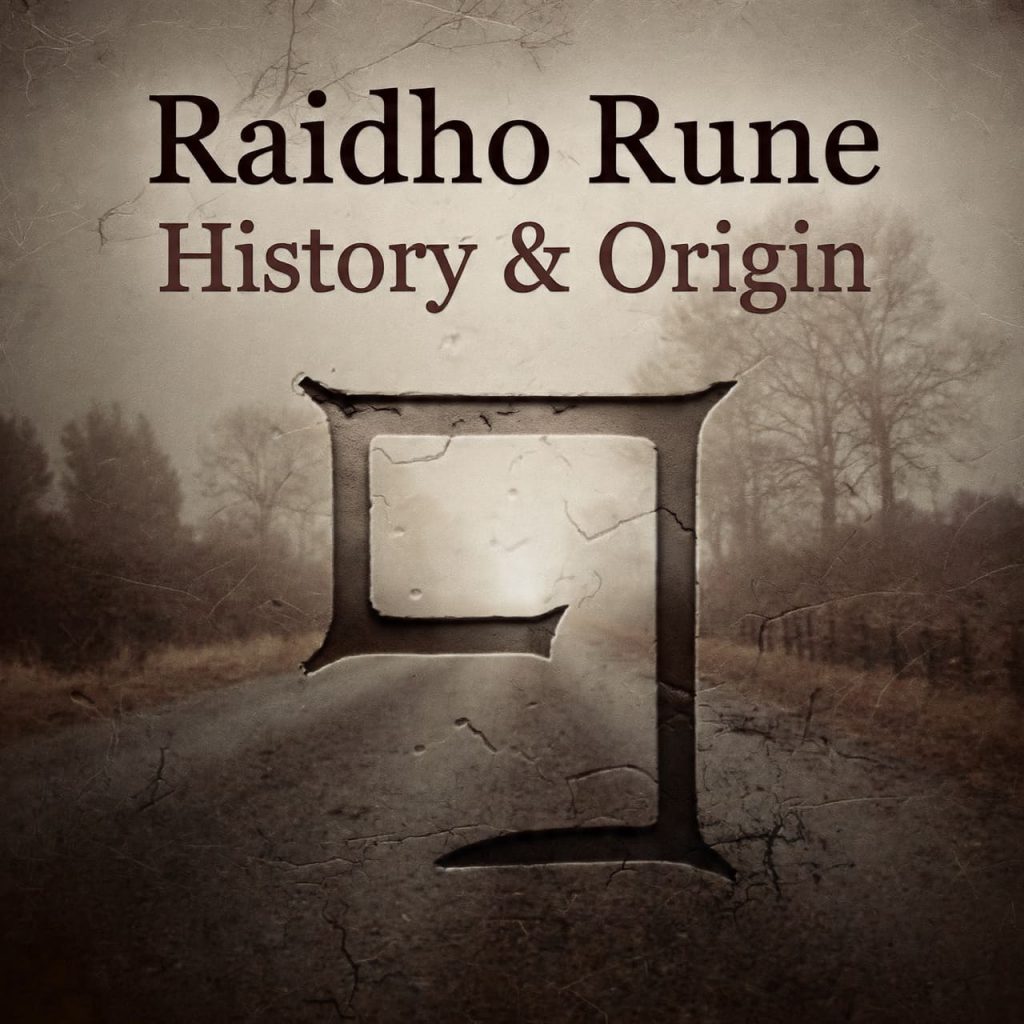
The history and origin of the Raidho rune often become blurred by modern interpretation. Many articles mix symbolism, spirituality, and later esoteric meanings into what should be a clear historical explanation. This creates confusion, especially for readers who want to understand where Raidho actually comes from, not what it has been adapted to mean centuries later.

💜 Need a clear answer right now?
CONSULT THE YES OR NO TAROT Free · No registration · Instant resultA high-quality discussion of Raidho’s origin requires discipline. It must separate linguistic evidence from symbolic reinterpretation and focus on what can be reasonably supported by historical sources. When approached using evidence-first research principles such as those outlined at astroideal, the Raidho rune emerges as a practical element of early writing systems rather than a mystical invention.
What “Origin” Means in Rune History
When discussing the origin of a rune, it is important to clarify what is meant by origin. For Raidho, origin refers to:
- Its place within early runic alphabets
- Its phonetic function
- Its historical usage in inscriptions
It does not refer to later spiritual systems or modern symbolic frameworks. Those developments occurred long after the rune was already established.
This distinction is consistently emphasized by qualified professionals, who separate historical evidence from interpretive tradition.
The Elder Futhark Context
Raidho originates in the Elder Futhark, the oldest known runic alphabet. The Elder Futhark dates roughly from the 2nd to the 8th centuries CE and consists of 24 runes.
Raidho appears as the fifth rune in this system. Its position is not random. Early alphabets were ordered intentionally, often reflecting phonetic relationships rather than symbolic narratives.
The Elder Futhark was used across a wide geographic area, including parts of Scandinavia, northern Germany, and regions influenced by Germanic culture.
Linguistic Origins of the Raidho Rune
Linguistically, Raidho represents a sound related to “r” followed by a dental fricative, reconstructed as something close to raiþō. This places it firmly within the Indo-European language family.
Scholars generally agree that the runic alphabet, including Raidho, was influenced by older Mediterranean writing systems, likely derived from a combination of Latin and North Italic scripts. Raidho’s form shows similarities to characters used in these earlier alphabets.
This confirms that Raidho was designed as a functional letter, not as a symbolic image.
From Sound to Symbol (Historically)
Originally, Raidho was not a “symbol” in the modern sense. It was a phonetic marker. When carved into objects, stones, or tools, it represented sound within words.
Only later did runes begin to accumulate associative meanings based on language, poetry, and cultural use. These meanings were secondary developments, not part of the rune’s origin.
Understanding this timeline prevents the common error of projecting later symbolism backward into early history.
Archaeological Evidence of Raidho
Raidho appears in numerous inscriptions found on:
- Stone monuments
- Weapons
- Personal objects
- Memorial markers
These inscriptions demonstrate that Raidho was used in everyday communication, ownership marking, and memorialization. There is no evidence that it was used exclusively or primarily for ritual or divination during its early history.
This practical usage reinforces its identity as a writing character rather than a spiritual emblem.
Readers seeking grounded interpretation often rely on historically cautious perspectives from reliable readers who avoid overstating symbolic claims.
Evolution Into the Younger Futhark
As Germanic languages evolved, the runic alphabet adapted. Around the 8th century, the Elder Futhark gradually transitioned into the Younger Futhark, which reduced the number of runes.
During this transition, Raidho’s role shifted slightly, but its phonetic lineage remained recognizable. The simplification of the alphabet reflects linguistic change, not loss of meaning.
This evolution highlights that runes were practical tools responding to spoken language changes, not static sacred symbols.
Raidho in Anglo-Saxon Rune Traditions
In Anglo-Saxon England, the runic system expanded rather than contracted, forming the Anglo-Saxon Futhorc. Raidho appears here as well, often under the name Rad.
This demonstrates the adaptability of the rune across regions and dialects. While pronunciation and spelling varied, the underlying function remained consistent.
Again, this supports the idea that Raidho’s origin is linguistic and cultural, not mystical.
The Name “Raidho” and Its Meaning
The name “Raidho” itself comes from reconstructed Proto-Germanic roots related to riding, journeying, or movement. Importantly, this meaning originally described action, not symbolism.
Words associated with Raidho referred to physical movement along a route or path. This practical association later influenced symbolic interpretation, but it did not originate as metaphor.
Understanding this root helps explain how later meanings developed without confusing them with original intent.
When Symbolic Interpretation Began
Symbolic interpretations of Raidho emerged much later, particularly during medieval and post-medieval periods when runes were no longer a primary writing system.
As literacy shifted toward the Latin alphabet, runes took on a secondary cultural role. This created space for poetic, symbolic, and eventually esoteric interpretations.
These interpretations are historically interesting, but they are not evidence of origin.
This distinction mirrors the analytical separation used in structured love tarot readings, where historical function is not confused with later narrative meaning.
Modern Revival and Misconceptions
Modern interest in runes often blends history with spirituality. While this revival has renewed attention to runes like Raidho, it has also created misconceptions.
One common misconception is that Raidho was always intended as a spiritual symbol of destiny or guidance. There is no historical evidence for this claim.
The rune’s original purpose was communication, not divination.
Academic Caution in Rune History
Serious rune scholarship is cautious by necessity. Many claims about rune origins cannot be verified due to limited surviving material.
Responsible historical writing avoids phrases like “ancient people believed” unless supported by sources. It focuses on inscriptions, linguistic comparison, and archaeological context.
Educational approaches similar to those discussed at astroideal emphasize this caution by prioritizing evidence over narrative appeal.
Why History Matters for Modern Readers
Understanding the true origin of Raidho protects modern readers from misinterpretation. When history is respected, modern use becomes a conscious adaptation rather than an assumed continuation.
This clarity allows readers to engage with runes responsibly, without claiming false authority or ancient endorsement.
Separating History From Application
History explains where Raidho comes from. It does not dictate how people must use it today.
Modern applications—artistic, reflective, or symbolic—are valid as long as they are acknowledged as modern.
Confusing application with origin undermines both.
This boundary is also emphasized in disciplined contexts such as online tarot sessions, where historical systems are not misrepresented as predictive tools.
Visual and Audio Education on Rune History
Some learners benefit from visual or spoken explanations of rune history. Educational formats like video readings can illustrate inscriptions and timelines, while audio-based explanations similar to phone readings can help explain linguistic shifts.
These formats can support learning, but they do not replace primary historical evidence.
Context Without Astrological Overlay
Rune history is independent of astrology. While some modern frameworks attempt to align runes with zodiac systems, this has no historical basis.
General horoscope insights may be useful for personal reflection, but they do not contribute to understanding Raidho’s origin.
Keeping these systems separate preserves accuracy.
What the History of Raidho Does Not Show
The historical record does not show that Raidho was:
- A divination tool
- A protective talisman
- A spiritual initiation symbol
- A predictor of outcomes
These ideas developed later and should not be projected backward.
Long-Term Value of Historical Accuracy
Accurate history builds trust. It allows readers to explore modern interpretations without confusion or false claims.
Understanding Raidho’s origin as a writing character within a living language gives it depth without distortion.
This foundation supports both academic study and informed personal interest.
Frequently Asked Questions
How old is the Raidho rune?
It dates back to at least the 2nd century CE.
Was Raidho always symbolic?
No. It was originally phonetic.
Did ancient people use Raidho for divination?
There is no evidence that they did.
Is Raidho connected to Latin letters?
Yes, indirectly through shared alphabetic ancestry.
Did the rune change over time?
Its usage adapted as languages evolved.
Is modern symbolism historically accurate?
Modern symbolism is interpretive, not historical.
Call to Action
Understanding the history and origin of the Raidho rune begins with separating evidence from interpretation. When history is respected, clarity replaces assumption. If you want to get a clear yes or no answer about whether a claim about Raidho’s origin is historically grounded, or prefer a disciplined one question tarot approach to evaluating symbolic claims, focusing on linguistic evidence and archaeological context is the most reliable path to genuine understanding.