

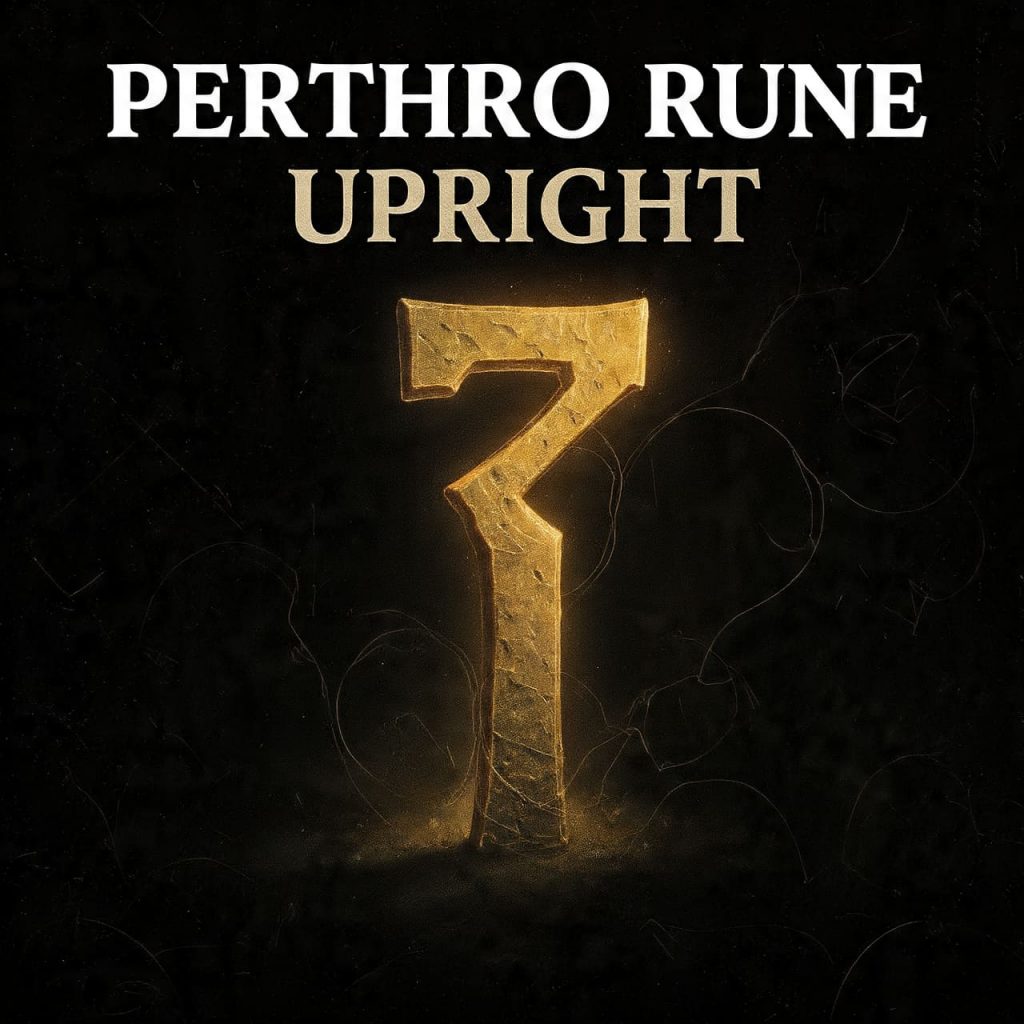
The phrase “Perthro rune upright” is commonly used as if it denotes a historically recognized orientation with a distinct meaning when the rune appears in a particular position. This framing reflects a modern interpretive habit rather than a documented ancient convention. The historical uncertainty is factual: whether users of the Elder Futhark recognized an “upright” state for Perthro and attributed meaning to that orientation.

💜 Need a clear answer right now?
CONSULT THE YES OR NO TAROT Free · No registration · Instant resultThis article evaluates that question using an evidence-first approach. It examines linguistic, archaeological, and textual sources to determine whether orientation carried interpretive significance for Perthro during the period when the Elder Futhark was in use.
Methodological standards consistent with those outlined by astroideal require separating documented practice from later symbolic frameworks. In academic contexts, such evaluations are conducted by qualified professionals in runology, archaeology, and historical linguistics.
What “Upright” Means in Historical Analysis
In historical scholarship, an “upright” orientation implies a standardized reference position recognized by users and reflected in consistent practice. For a rune to have an upright meaning, sources would need to show that its orientation was fixed and that deviation altered interpretation.
No such system is documented for the Elder Futhark. Runes were carved to fit available surfaces, and orientation varied according to material, space, and aesthetic constraints. Applying an upright/reversed dichotomy assumes an interpretive system akin to later divinatory models. Such structuring resembles modern thematic frameworks similar to reliable readers rather than early writing conventions.
Perthro Within the Elder Futhark
Perthro is the conventional scholarly name for one character of the Elder Futhark, the earliest known runic alphabet used approximately between the second and eighth centuries CE. The name itself does not appear in contemporaneous inscriptions; it is reconstructed from medieval rune poems written centuries later.
Historically, Perthro functioned as a grapheme representing a sound. Its form appears within inscriptions as part of written sequences. There is no evidence that early users isolated the rune to emphasize orientation or treated it as a symbol whose meaning changed with position.
Archaeological Evidence and Orientation Variability
Archaeological evidence provides the most direct insight into how runes were oriented in practice. Hundreds of Elder Futhark inscriptions have been cataloged across Scandinavia and continental Europe. These inscriptions show substantial variability: left-to-right, right-to-left, vertical arrangements, and layouts following object contours.
Perthro appears within these varied layouts without any indication that a particular orientation was privileged. No artifacts mark Perthro as correct or incorrect based on position. Claims of an upright meaning impose a rigidity not supported by material evidence. Modern expectations of standardized orientation parallel interpretive structures seen in online tarot sessions rather than archaeological realities.
Linguistic Evidence and the Absence of Directional Meaning
Linguistic reconstruction focuses on sound values and later name associations, not visual orientation. The reconstructed name Perthro derives from medieval rune poems, which do not discuss orientation or positional semantics.
No linguistic source suggests that rotating or inverting the rune altered pronunciation or meaning. Language-based evidence treats runes as functional letters. Introducing orientation-based interpretation reflects interpretive habits more closely aligned with systems such as video readings than with historical linguistics.
Textual Sources and What They Do Not Indicate
Textual sources referencing runes—from classical Roman authors to medieval Scandinavian texts—describe acts of carving and writing. They do not describe orientation-based meaning. When runes are mentioned, the emphasis is on inscription, not on positional interpretation.
There are no instructions, narratives, or laws indicating that a rune’s meaning changed when placed upright. The absence of such references across genres suggests that orientation was not a recognized interpretive variable. Modern analogies to positional meaning reflect contemporary interpretive culture rather than historical documentation.
Emergence of Upright Meanings in Modern Systems
The concept of upright meaning developed within later symbolic systems that rely on orientation as a core interpretive device. As runes were incorporated into modern divinatory and symbolic frameworks in the nineteenth and twentieth centuries, upright and reversed meanings were introduced to mirror established models.
Perthro’s already uncertain semantics made it especially susceptible to such additions. These developments often coincided with the growth of interpretive services such as phone readings and broader symbolic practices including horoscope insights. Historically, however, these are modern constructs rather than continuations of early runic use.
Evaluating the Core Claim with Evidence
The central factual question is whether Perthro had a historically recognized upright orientation with a distinct meaning during the period of the Elder Futhark’s use. Evaluating archaeological inscriptions, linguistic reconstruction, and textual sources yields a consistent answer.
What has been examined includes runic corpora, medieval rune poems, classical ethnographies, and material culture. These sources document Perthro as a rune character used in writing, with orientation determined by practical considerations. They do not document orientation-based interpretation. Methodological standards comparable to those outlined by astroideal require distinguishing documented historical practice from modern symbolic overlays. Based on the available evidence, there is no historical basis for an “upright” meaning of Perthro.
Frequently Asked Questions
Did Perthro have an upright meaning in ancient times?
No evidence supports this claim.
Was rune orientation standardized?
No, orientation varied by surface and context.
Do inscriptions show intentional upright placement?
They do not indicate interpretive intent.
Are upright meanings ancient or modern?
They are modern additions.
Do texts discuss rune orientation?
No surviving texts do.
Can an upright meaning be historically proven?
Not with current evidence.
Call to Action
When encountering claims about positional meanings, evaluate whether they are supported by primary evidence. Apply critical analysis to get a clear yes or no answer about whether a claim reflects documented history or modern interpretation, as is often done in systems like love tarot readings.
