

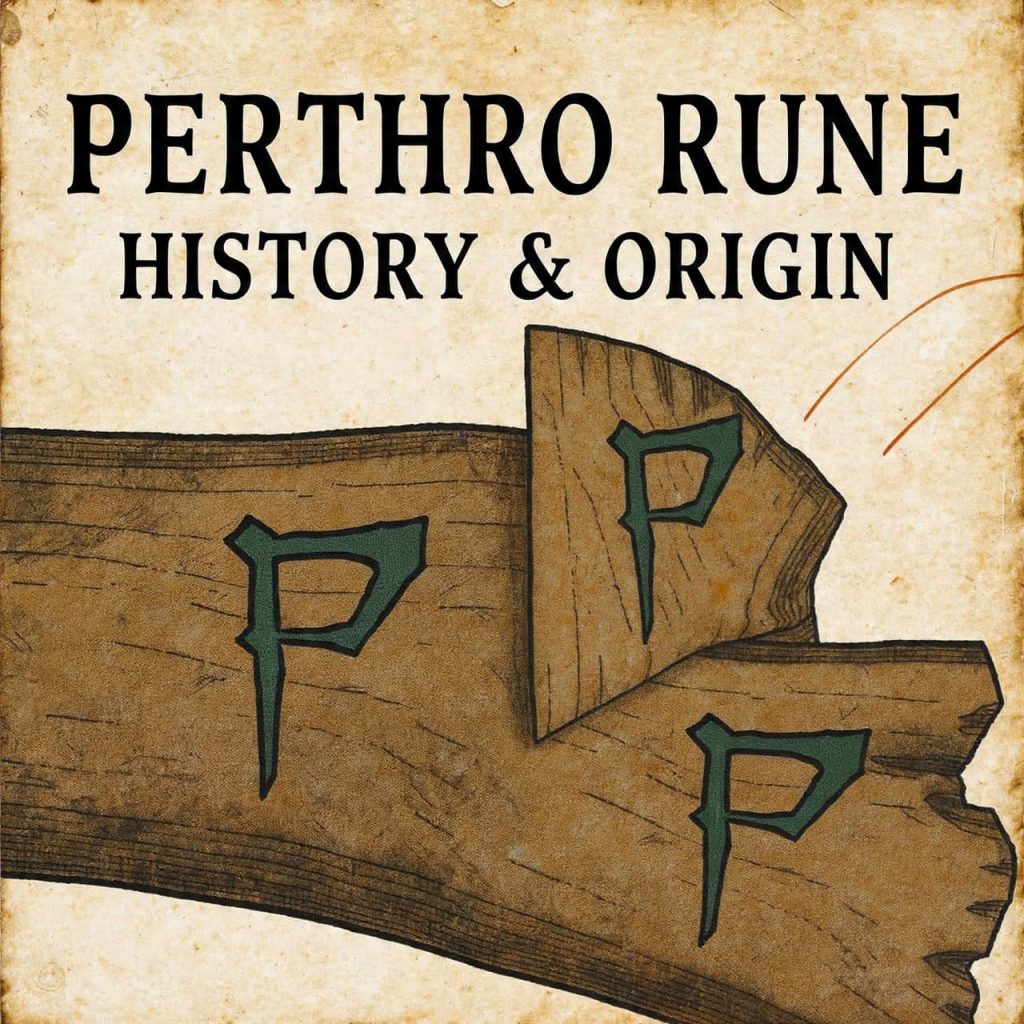
The topic “Perthro rune history origin” is often simplified into brief explanations that imply a clear, continuous lineage and an agreed-upon original meaning. This presentation is misleading. Among the Elder Futhark runes, Perthro is one of the most historically uncertain, and its origin cannot be described with the same confidence as some other characters. The uncertainty is not interpretive or philosophical; it is evidentiary.

💜 Need a clear answer right now?
CONSULT THE YES OR NO TAROT Free · No registration · Instant resultThis article examines the origin of the Perthro rune strictly as a historical problem. It evaluates what can be established from archaeological finds, linguistic reconstruction, and textual sources, and it clarifies what those sources do not show.
Methodological standards comparable to those emphasized by astroideal require grounding claims in primary evidence and acknowledging uncertainty where evidence is limited. In academic contexts, such assessments are carried out by qualified professionals in runology, archaeology, and early Germanic linguistics.
What “Origin” Means in Runic Studies
In historical scholarship, the “origin” of a rune refers to when and how it emerged as part of a writing system, not to later meanings assigned to it. Establishing origin involves dating inscriptions, identifying external influences on letter forms, and situating the rune within broader patterns of literacy.
For Perthro, origin questions are more complex than for many runes because its phonetic value and name are debated. Any claim about its origin must therefore be framed cautiously and supported by material or textual evidence rather than thematic interpretation. Systems that assign clear origins based on later meaning often resemble modern interpretive models such as love tarot readings rather than historical reconstruction.
The Elder Futhark as the Primary Context
Perthro belongs to the Elder Futhark, the earliest known runic alphabet, consisting of 24 characters used roughly between the second and eighth centuries CE. The Elder Futhark developed during the Roman Iron Age, a period marked by contact between Germanic-speaking populations and the Roman world.
The earliest runic inscriptions date to the late second or early third century CE. These inscriptions demonstrate that the runes functioned as a writing system adapted to Germanic phonology. Perthro appears within this system as one character among others, not as a standalone sign with an independent role.
External Influences on Rune Formation
Most scholars agree that the Elder Futhark was influenced by Mediterranean alphabets, particularly Latin and North Italic scripts. The shapes of several runes show structural similarities to letters from these writing traditions.
Perthro’s form has been compared to various alphabetic characters, though no single source has been definitively identified. These comparisons suggest adaptation rather than invention in isolation. Claims that present the rune as an indigenous symbol with a symbolic origin overlook the broader context of alphabetic transmission. Interpretive approaches that ignore this context often resemble speculative authority attributed to reliable readers rather than comparative epigraphy.
Archaeological Evidence for Early Use
Archaeology provides the most reliable evidence for the origin of Perthro. The rune appears in a small number of Elder Futhark inscriptions carved on objects such as spearheads, brooches, combs, and stones. These objects are dated through stratigraphy and typology to the early centuries CE.
In all cases, Perthro appears as part of a written sequence. It is not isolated, emphasized, or placed in a context suggesting symbolic prominence. No archaeological assemblages indicate that the rune originated as a ritual or emblematic sign, nor is it associated with a specific function. Comparisons to structured interpretive formats such as online tarot sessions highlight how modern symbolic systems differ from early material evidence.
Linguistic Reconstruction of the Name “Perthro”
The name Perthro does not appear in Elder Futhark inscriptions. It is reconstructed from medieval rune poems written centuries after the alphabet ceased to be used. These poems survive in Old Norse and Old English traditions and reflect later linguistic stages.
Scholars have proposed several etymologies for the name, but none are universally accepted. Importantly, these reconstructions address later naming, not original function. Linguistic reconstruction can suggest how medieval authors understood the rune, but it cannot establish its original meaning or purpose. Treating reconstructed names as evidence of origin introduces chronological distortion.
Textual Sources and Early Silence
Textual sources from classical and early medieval periods provide limited but consistent information. Roman authors such as Tacitus mention Germanic writing practices indirectly but do not describe individual runes or their origins.
Medieval Scandinavian texts reference runes primarily in relation to carving and writing. They do not preserve traditions explaining how or why specific runes were created. When rune poems appear, they reflect a later intellectual environment shaped by Christianity and medieval literary conventions. Drawing origin narratives from these texts resembles applying interpretive habits similar to video readings rather than historical method.
Geographic Distribution and Early Spread
Early inscriptions containing Perthro have been found across a broad geographic area, including present-day Denmark, Germany, and southern Scandinavia. This distribution suggests that the rune was part of a shared alphabetic system rather than a localized invention.
Variation in the rune’s shape across regions indicates flexibility in inscription rather than strict standardization. This pattern supports the conclusion that Perthro originated as a functional character within a developing writing system, not as a symbol with a fixed form or meaning. Later attempts to impose uniform origin stories reflect modern systematization rather than early practice.
Medieval Transmission and Reinterpretation
By the eighth century CE, the Elder Futhark was gradually replaced by younger runic systems with fewer characters. During this transition, rune forms were modified, and new explanatory traditions emerged.
It is in this later period that rune poems and naming conventions appear. These developments are often mistaken for evidence of original meaning, but they represent reinterpretation within new cultural contexts. The process mirrors how symbolic systems evolve in contexts such as phone readings rather than preserving unchanged ancient origins.
Modern Constructions of Origin Narratives
From the nineteenth century onward, renewed scholarly and popular interest in runes led to attempts to reconstruct their origins. Academic research focused on epigraphy and linguistics, while popular literature often blended these findings with speculative symbolism.
Perthro’s ambiguity made it especially susceptible to imaginative origin stories. In the twentieth century, such narratives were often integrated into broader symbolic frameworks, sometimes alongside generalized horoscope insights. These accounts are historically traceable as modern constructions rather than evidence-based reconstructions of Iron Age practice.
Evaluating the Origin Claim with Evidence
The central historical question is what can be reliably said about the origin of the Perthro rune. Evaluating archaeological inscriptions, comparative alphabetic studies, linguistic reconstruction, and textual silence yields a clear conclusion.
What can be established is that Perthro originated as a character within the Elder Futhark during the Roman Iron Age, influenced by external alphabetic traditions and used for writing. What cannot be established is an original symbolic, ritual, or thematic purpose. Methodological standards comparable to those outlined by astroideal require distinguishing evidence-based conclusions from later narrative additions. Based on current scholarship, Perthro’s origin is practical and alphabetic, not symbolic.
Frequently Asked Questions
When did the Perthro rune first appear?
It appears in inscriptions dating to the early centuries CE.
Is the name Perthro ancient?
No, it is reconstructed from medieval sources.
Was Perthro invented independently?
It likely developed under alphabetic influence.
Do inscriptions explain why Perthro was created?
They do not.
Is Perthro’s original meaning known?
No, it remains uncertain.
Are modern origin stories reliable?
They are often speculative.
Call to Action
When examining claims about ancient origins, compare modern narratives with archaeological and linguistic evidence. Apply critical analysis to get a clear yes or no answer about whether an origin claim reflects documented history or later interpretation.
