

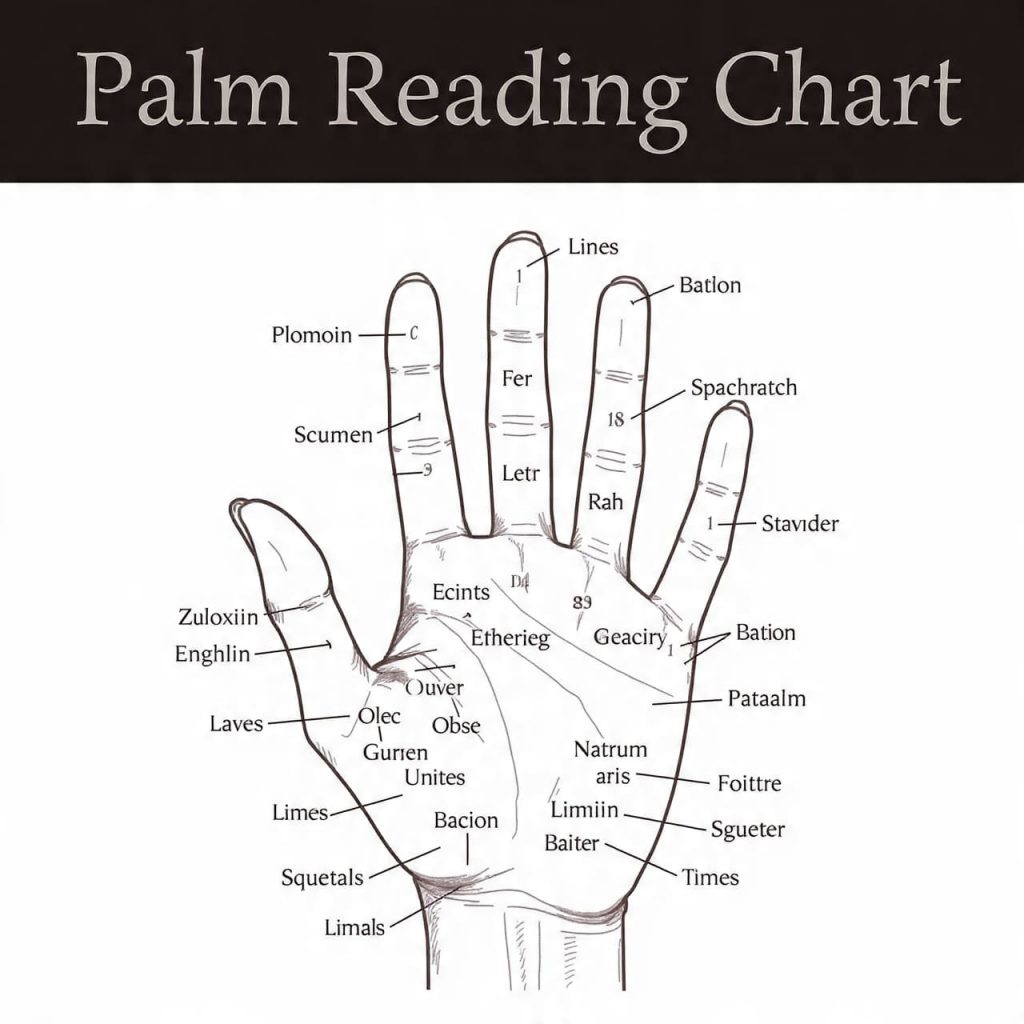
A Palm Reading Chart functions as a visual roadmap that organizes the structures, lines, mounts, zones, and symbolic regions of the hand. It is used by modern practitioners to interpret personality traits, emotional expression, cognitive tendencies, developmental patterns, stress behaviors, and life themes. Unlike older approaches that treated the palm chart as a predictive diagram, contemporary palmistry views it as a living, evolving representation of a person’s internal world.

💜 Need a clear answer right now?
CONSULT THE YES OR NO TAROT Free · No registration · Instant resultA chart provides clarity by breaking the palm into identifiable areas—each representing a psychological or symbolic function. When paired with intentional question-setting, often supported by reflective strategies like using strategies explained in palm reading, palm charts help individuals understand how different regions of their hands work together to reveal emotional processing, resilience patterns, and personal direction.
The Structure of a Palm Reading Chart
The foundation of a palm reading chart is built on five interconnected elements: hand shape, major lines, minor lines, mounts, and finger structures. Many individuals compare palm charts with symbolic resources such as horoscope insights to gain complementary understanding of personality cycles and emotional tendencies.
A chart is divided into:
- Quadrants, representing cognitive, emotional, physical, and expressive zones
- Mounts, offering insight into motivation and temperament
- Lines, revealing patterns of processing and resilience
- Fingers, showing communication, structure, creativity, and agency
- Thumb, which provides insight into willpower and self-management
Why This Format Matters
A visual chart helps practitioners:
- Identify symbolic imbalance
- Understand how different features reinforce one another
- Detect emotional or cognitive stress
- Recognize patterns of compensatory behavior
- Decode internal conflicts or strengths
Practitioner Insight
Dr. Liora Vance, modern palmistry researcher and behavioral specialist, shares:
“The chart is not a prediction tool. It’s a psychological atlas. Every region reflects a way the person experiences and processes life—emotionally, mentally, socially, and behaviorally.”
Using a Palm Chart During Online Readings
Digital palmistry through online tarot sessions has made palm charts increasingly standardized. Clients submit high-quality images, enabling practitioners to overlay or annotate the palm chart digitally.
Online-based palm chart interpretation includes:
- Mapping the life, head, and heart lines with digital overlays
- Identifying mount prominence through lighting and contour
- Comparing finger proportions to standardized chart markers
- Assessing symmetry between hands
- Highlighting zones that correspond to emotional or mental patterns
Case Study
Client: 20-year-old seeking clarity on life direction.
Palm Chart Findings:
- Strong Jupiter Mount: leadership tendencies
- Straight, grounded Head Line: practical decision-making
- Deep Life Line: stable resilience
Outcome:
Client gained understanding of their structured strengths and leadership potential, providing direction for academic planning.
Video-Based Palm Chart Interpretation
Live video analysis through video readings gives practitioners access to movement-based interpretation. Many palm features only fully reveal themselves when the hand is observed from multiple angles.
Practitioners use video sessions to examine:
- Flexibility along chart zones
- Line depth changes under pressure
- Thumb movement (volition and emotional initiative)
- Mount elasticity (motivation patterns)
- Tension distribution across quadrants
Practitioner Perspective
Helena Osorio, palmistry educator, explains:
“Movement aligns the static chart with real behavior. A person may have a strong Fate Line on paper, but if their hand collapses during certain topics, the psychological narrative changes.”
Case Example
Client: recovering from social anxiety.
Palm Chart Observations:
- Weak Mercury Mount movement → communication hesitancy
- Strengthening Heart Line region → emotional openness evolving
- Thumb angle widening → improved confidence
Phone Interpretations and Verbal Palm Chart Mapping
Phone-based sessions via phone readings rely on the client’s description of their palm chart. Surprisingly, many clients become more introspective when describing their own features.
Phone palm charting helps clients articulate:
- How they perceive their emotional patterns
- What line features stand out to them
- Which regions they identify as “dominant” or “weak”
- How their current life stressors correlate with chart zones
This reflective process often brings hidden awareness to the surface.
The Heart Line on the Palm Chart: Emotional Symbolism
The Heart Line, displayed clearly on any palm reading chart, reveals emotional expression, relational boundaries, attachment tendencies, and how someone processes interpersonal connection. These themes intersect with symbolic tools like love tarot readings when individuals seek insight into emotional habits.
Heart Line chart indicators:
- Deep curvature → intuitive and expressive emotional processing
- Straight path → rational, steady emotional presence
- Forked ending → emotional balance and perspective
- Fragmentation → periods of emotional complexity
Case Example
Client: difficulty trusting new partners.
Chart Patterns:
- Subtle breaks across Heart Line
- Declining depth near adolescent section
Interpretation:
Emotional caution rooted in earlier experiences—not predictive, but psychologically revealing.
The Life Line on the Palm Chart: Stability and Resilience
The Life Line on the chart does not indicate lifespan. Modern palmists—especially those certified among qualified professionals—focus on grounding, resilience, lifestyle tendencies, and adaptation patterns.
Life Line chart markers:
- Long and deep lines signal sustained emotional grounding
- Short but strong lines indicate efficiency rather than weakness
- Breaks or forks reflect transitional periods
- Wide arcs show expansive, adventurous tendencies
- Narrow arcs reveal routine-based comfort zones
Practitioner Insight
Dr. Vance explains,
“A Life Line chart shows how individuals psychologically stabilize themselves, not how long they live. It reflects resilience strategies and adaptability.”
The Head Line on the Palm Chart: Cognitive Styles
The Head Line represents mental clarity, decision-making processes, problem-solving styles, and learning patterns. Many individuals seek nuanced interpretations from practitioners verified as reliable readers.
Head Line chart markers:
- Straight line → structured, analytical thinking
- Curved line → creative or intuitive reasoning
- Downward slope → introspection or imagination
- Upward tilt → ambition or confident decision-making
- Breaks → periods of cognitive overload
Case Study
Client: determining whether to pursue creative or academic paths.
Chart signs:
- Gracefully curved Head Line
- Supporting Sun Line
Interpretation:
Creative cognition was strong, though not prescriptive.
Advanced Techniques for Interpreting a Palm Reading Chart
Experienced practitioners use layered interpretive frameworks.
Symbolic Quadrant Analysis
Divides the palm into:
- Emotional Quadrant
- Cognitive Quadrant
- Physical Quadrant
- Expressive Quadrant
These quadrants help identify internal imbalances or strengths.
Three-Line Synthesis Method
Cross-references:
- Life Line grounding
- Head Line decision style
- Heart Line emotional pattern
Mount & Finger Integration
Evaluates each mount’s size, tone, and proportion in relation to the fingers above it.
Stress Indicator Mapping
Identifies bar lines, cross lines, islands, and fragmentation in relation to chart zones.
Purpose Arc Interpretation
Evaluates Fate Line alignment with Jupiter and Saturn mounts.
Habit Reflection Technique
Connects palm zones to habitual behaviors.
Case Study #1: The Evolving Chart of a Young Adult
Client: student experiencing identity transition.
Chart Findings:
- Strengthened Head Line mid-section
- Expanding Heart Line curvature
- Newly branching Fate Line
Interpretation:
Indicated cognitive clarity emerging, paired with developing emotional openness.
Case Study #2: Rebalancing Emotional and Cognitive Zones
Client: young adult balancing school pressures and relationships.
Chart Findings:
- Overactive cognitive quadrant
- Underdeveloped expressive quadrant
Interpretation:
Suggested that self-expression and communication needed nurturing.
Case Study #3: Stress Markers on the Chart
Client: teen navigating family tension.
Chart Observations:
- Multiple bar lines crossing Head Line
- Tight thumb angle
Interpretation:
Symbolic indicators of accumulated stress and effort to maintain control.
Misconceptions About Palm Reading Charts
Many assumptions distort palmistry’s purpose.
“Palm charts predict the future.”
Charts interpret patterns, not outcomes.
“Short Life Line means a short life.”
No scientific or symbolic validity.
“Lines never change.”
Lines evolve with emotional development and life experiences.
“Palm reading is mystical or dangerous.”
It is a symbolic, reflective system.
“All interpretations must match old books.”
Modern palmistry uses psychological frameworks.
Table: Palm Chart Sections and Meanings
| Chart Section | Symbolizes | Interpretation Focus |
|---|---|---|
| Life Line | Resilience | Adaptation & grounding |
| Head Line | Cognition | Thinking & decisions |
| Heart Line | Emotion | Relationship patterns |
| Fate Line | Purpose | Direction & structure |
| Mounts | Motivation | Emotional drivers |
| Fingers | Expression | Communication, creativity, logic |
| Thumb | Agency | Willpower & boundaries |
Final Guidance for Using a Palm Reading Chart
A palm reading chart becomes truly meaningful when paired with intentional self-inquiry. Many practitioners encourage clients to develop focused questions inspired by using strategies explained in palm reading to align their exploration with deeper emotional and cognitive insight. When approached thoughtfully, the palm chart becomes a practical, non-predictive tool for understanding personal growth and internal patterns.
Frequently Asked Questions
Does a palm chart predict anything about my future?
No. It reflects psychological tendencies and developmental patterns.
Why do different readers interpret charts differently?
Interpretive styles vary, but modern palmistry emphasizes self-awareness over prediction.
Do both hands matter?
Yes. Dominant hand shows active self; nondominant shows underlying potential.
Why are my lines different from my family’s?
Palm lines reflect personal experience and adaptation, not genetics.
Can stress change my palm lines?
Chronic stress may create symbolic changes such as breaks or bar lines.
Is palmistry scientific?
It is symbolic rather than scientific, but can be meaningful in reflective practice.
Can a palm chart help with decision-making?
It can clarify internal patterns, but decisions remain yours.
Conclusion
A palm reading chart is a comprehensive symbolic map of the hand—revealing emotional tendencies, cognitive patterns, resilience strategies, personal motivations, and developmental markers. Modern palmistry uses the chart as a tool for introspection, not prediction. By interpreting lines, mounts, quadrants, and movement patterns with psychological understanding, practitioners and individuals alike can uncover powerful insights about identity, growth, and personal direction.
