

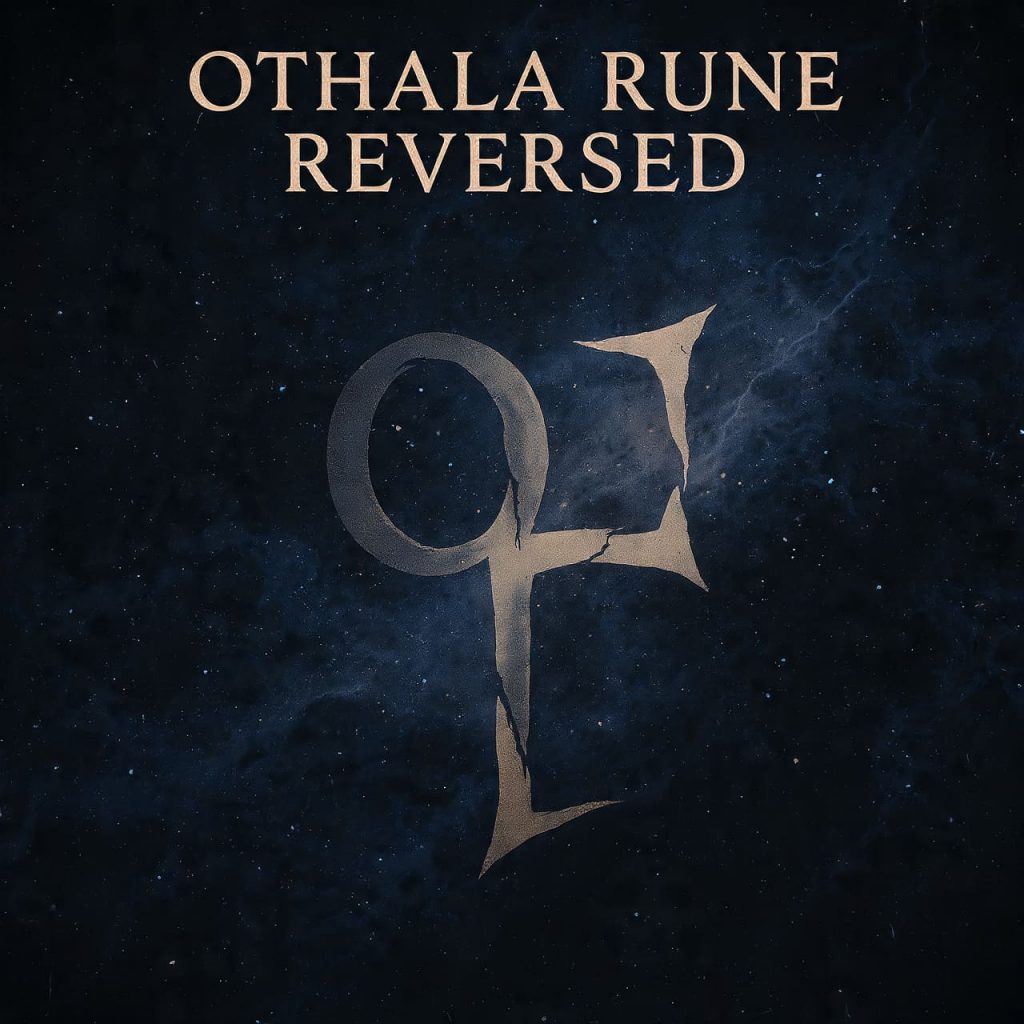
The phrase “Othala rune reversed” appears frequently in modern rune interpretations, where the rune is said to take on a different or opposite meaning when inverted. This framing is widespread but historically uncertain. It assumes that runes were originally used within a system that assigned semantic value to orientation, a premise that requires direct historical support.

💜 Need a clear answer right now?
CONSULT THE YES OR NO TAROT Free · No registration · Instant resultModern explanatory material, including summaries published on astroideal, often presents reversed runes alongside divinatory systems and may direct readers to qualified professionals for interpretive clarity. However, such associations do not constitute historical evidence. The precise question examined in this article is factual and limited: did the Othala rune historically have a meaningful “reversed” form?
Defining “Reversed” in Historical Context
In modern symbolic systems, “reversed” typically refers to an item being upside down and therefore carrying a modified meaning. This concept presupposes a fixed upright orientation and an interpretive framework that treats inversion as significant.
For runes, this assumption must be tested historically. Early Germanic writing did not operate with standardized page layouts or fixed vertical orientation. Runes were carved on stone, wood, bone, and metal, often following the shape of the object rather than a canonical direction. Any claim that reversal changed meaning must therefore be supported by contemporaneous evidence, not later interpretive models or the assertions of reliable readers.
Othala Within the Elder Futhark System
Othala is the twenty-fourth and final rune of the Elder Futhark, the earliest runic alphabet used approximately between the second and eighth centuries CE. Its established phonetic value is a vowel sound commonly reconstructed as /oː/ or a related phoneme.
The rune’s name is reconstructed as Ōþalan or Othala, derived from a Proto-Germanic root associated with inherited property or ancestral land. This name is not attested in Elder Futhark inscriptions themselves but inferred from later Germanic languages.
The Elder Futhark functioned as a writing system. Its structure does not indicate that runes were assigned dual meanings based on orientation. This sharply contrasts with modern interpretive systems, such as those used in online tarot sessions, where reversal is an intentional design feature.
Archaeological Evidence and Orientation
Archaeological inscriptions provide the strongest evidence for how Othala was used. Surviving inscriptions show significant variation in rune orientation. Runes may be carved left-to-right, right-to-left, vertically, or along curved surfaces.
Importantly, archaeologists do not distinguish “upright” from “reversed” Othala in cataloguing inscriptions. Orientation varies according to available space and carving technique, not semantic intent. No artifact marks an inverted Othala as unusual or meaningful.
In some cases, Othala appears rotated or mirrored due to surface constraints, yet the surrounding inscription remains readable and consistent. This strongly indicates that orientation did not alter meaning. Claims that inversion mattered resemble modern interpretive frameworks more than archaeological conclusions, similar in structure to assumptions seen in video readings.
Textual Sources and Rune Poems
Textual evidence for rune interpretation comes primarily from medieval rune poems composed centuries after the Elder Futhark fell out of use. The Anglo-Saxon rune poem includes a stanza for ēþel, the rune corresponding to Othala, describing inherited land as valued by all.
This poem does not reference orientation, inversion, or dual meanings. Scandinavian rune poems omit Othala entirely. No medieval manuscript documents the idea that runes could be reversed to alter meaning.
Interpreting poetic description as evidence for reversal practices imposes modern interpretive logic on texts that do not support it, a method more closely aligned with phone readings than with historical scholarship.
What the Historical Record Does Not Support
A comprehensive review of archaeological inscriptions, medieval texts, and linguistic studies shows no evidence that Othala had a reversed form with distinct meaning.
Specifically, the historical record does not demonstrate that:
- Othala had a fixed upright orientation
- Inversion was intentional or meaningful
- Reversed runes were treated differently
- Orientation affected phonetic or semantic value
When orientation mattered in ancient scripts, it was usually documented or visually standardized. The lack of such evidence for runes indicates that reversal was not conceptually significant. Assigning reversed meanings reflects modern categorization habits similar to those used in horoscope insights rather than evidence-based historical practice.
The Emergence of Reversed Rune Interpretations
The idea of reversed runes originates in modern interpretive literature, particularly in the twentieth century. As runes were adapted into divinatory systems inspired by tarot, authors borrowed the concept of reversal to create interpretive contrast.
This borrowing is historically traceable and culturally specific. It does not arise from new archaeological discoveries or reanalysis of early inscriptions. Instead, it reflects the influence of tarot conventions on rune interpretation.
Reversed Othala meanings are often presented alongside symbolic systems comparable to love tarot readings and framed using analytical approaches discussed on astroideal. These contexts highlight their modern origin rather than historical continuity.
Evaluating the Core Claim with Evidence
The claim under examination is precise: did the Othala rune historically have a reversed meaning?
Based on archaeological evidence, medieval textual sources, and linguistic analysis, the answer is no. Othala functioned as a phonetic rune within a writing system. There is no historical evidence that inversion or reversal altered its meaning.
Modern reversed interpretations are later cultural overlays. While they may be meaningful within contemporary symbolic systems, they do not reflect historical usage. From an evidence-first perspective, Othala had no reversed form in its original context.
Frequently Asked Questions
Was Othala ever intentionally reversed in ancient inscriptions?
There is no evidence supporting intentional reversal.
Do inscriptions show inverted Othala with different meaning?
No. Orientation varies without semantic distinction.
Do rune poems mention reversed meanings?
No. Rune poems do not discuss orientation.
When did reversed Othala interpretations appear?
They appeared in modern interpretive literature.
Do scholars accept reversed meanings for Othala?
No. Academic consensus does not support this claim.
Is Othala unique in this reinterpretation?
No. Many runes have acquired modern reversed meanings.
Call to Action
To evaluate claims about reversed runes accurately, consult archaeological inscriptions and dated textual sources directly to get a clear yes or no answer, distinguishing documented historical usage from later interpretive systems or one question tarot–style frameworks.
