

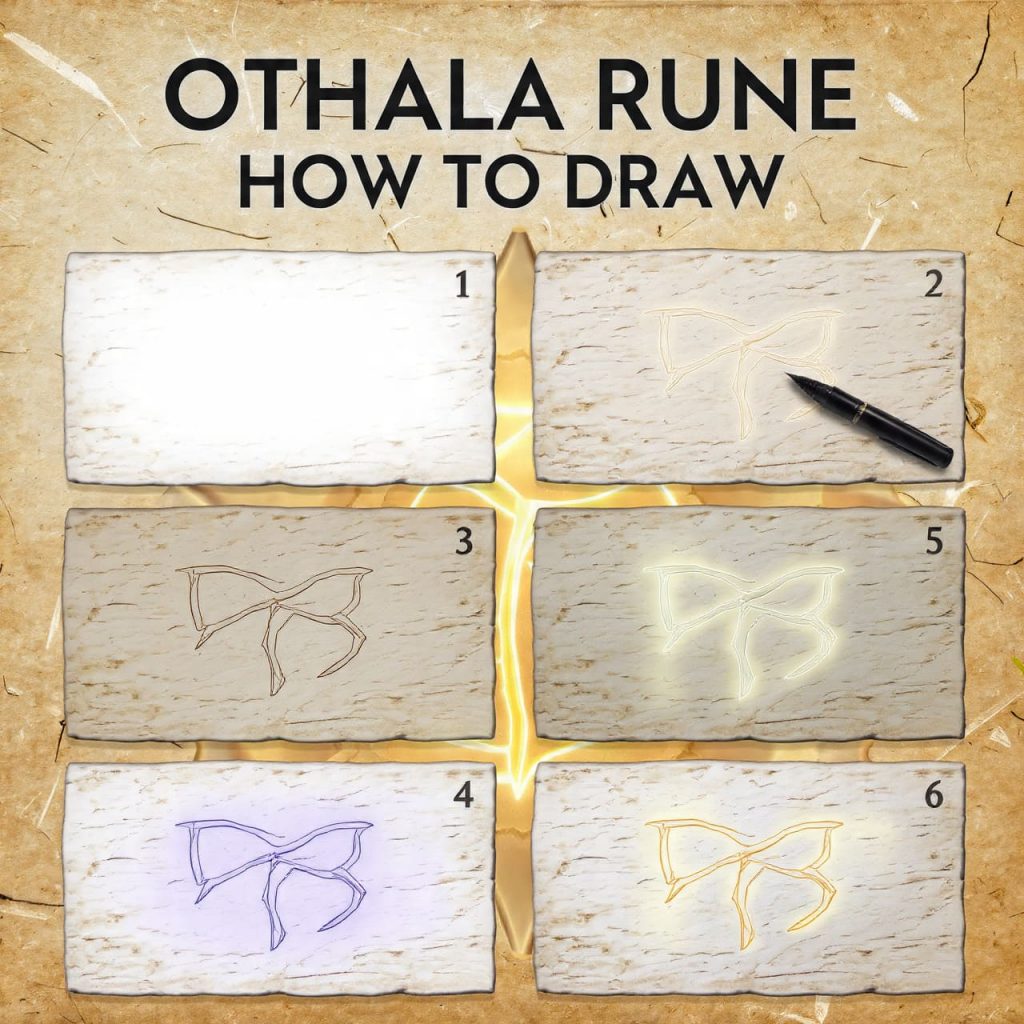
The phrase “Othala rune how to draw” is common in modern rune guides, where readers are often given step-by-step instructions for rendering the rune correctly. This framing is historically problematic. It assumes that ancient users of the rune followed standardized drawing instructions or that a correct method of drawing was formally defined.

💜 Need a clear answer right now?
CONSULT THE YES OR NO TAROT Free · No registration · Instant resultModern explanatory material, including summaries published on astroideal, often treats runes as visual symbols with prescribed forms and may direct readers to qualified professionals for clarification. Such framing does not establish historical precedent. The precise question examined here is factual and limited: did the Othala rune historically have documented instructions or a single correct method for drawing it?
What “How to Draw” Means in Historical Context
In historical terms, “how to draw” implies the existence of formalized instruction, standardized stroke order, or authoritative models that define correctness. Writing systems that require precise drawing methods usually preserve manuals, exemplars, or teaching texts.
For early runic writing, no such instructional material survives. Runes were carved, scratched, or engraved rather than drawn on paper. Any claim that Othala had a specific drawing method must therefore be supported by archaeological or textual evidence, not later instructional frameworks or the assumptions of reliable readers.
Othala in the Elder Futhark Writing System
Othala is the twenty-fourth and final rune of the Elder Futhark, the earliest known runic alphabet, used approximately between the second and eighth centuries CE. Its phonetic value is generally reconstructed as a long vowel sound, often /oː/.
The rune’s name is reconstructed as Ōþalan or Othala, derived from a Proto-Germanic root associated with inherited property or ancestral land. Importantly, this name is not preserved in Elder Futhark inscriptions themselves but inferred from later Germanic languages.
The Elder Futhark functioned as a writing system, not as a calligraphic or symbolic art form. Runes were shaped to suit carving into hard surfaces. There is no evidence that users followed formal drawing rules comparable to those found in modern interpretive systems such as online tarot sessions.
Archaeological Evidence and Rune Form Variation
Archaeological evidence provides the strongest insight into how Othala was rendered historically. Surviving inscriptions show that the shape of Othala varies noticeably across regions, materials, and time periods.
Some inscriptions show straight, angular lines adapted to stone carving. Others display asymmetry or simplified forms due to space constraints or material hardness. Archaeologists treat these variations as normal features of early writing, not as errors or deviations.
Crucially, no inscription is accompanied by instructional markings indicating correct or incorrect drawing. Archaeologists do not classify Othala forms by adherence to a standard model. Claims that there is one correct way to draw Othala resemble modern instructional assumptions rather than conclusions drawn from material evidence, similar in structure to frameworks seen in video readings.
Textual Sources and the Absence of Drawing Instructions
Textual evidence related to runes consists primarily of medieval rune poems and grammatical texts written centuries after the Elder Futhark period. These sources preserve rune names and phonetic associations but do not include instructions on how to draw individual runes.
The Anglo-Saxon rune poem includes a stanza for ēþel, the rune corresponding to Othala, describing inherited land. This poem served as a mnemonic aid, not a manual for writing technique. Scandinavian rune poems omit Othala entirely.
No medieval manuscript describes stroke order, proportions, or correct rendering for Othala. Treating later poetic sources as implicit drawing guides imposes modern expectations onto texts that do not support them, an approach closer to phone readings than to disciplined historical analysis.
What the Historical Record Does Not Support
A systematic review of archaeological inscriptions, medieval texts, and comparative studies shows no evidence that Othala had a prescribed method of drawing.
Specifically, the historical record does not demonstrate that:
- Othala had a fixed canonical shape
- Users followed step-by-step drawing instructions
- Variations were treated as incorrect
- A teaching system defined how it must be drawn
When historical writing systems required precision, they preserved teaching tools or consistent forms. The absence of such evidence for Othala indicates that flexibility, not standardization, was the norm. Assigning drawing instructions reflects modern categorization habits similar to those used in horoscope insights rather than evidence-based historical practice.
The Emergence of Modern Drawing Guides
Modern guides explaining how to draw Othala emerge primarily in the twentieth century, when runes were adapted into symbolic, educational, and decorative contexts. Authors standardized rune shapes to ensure visual consistency across books, charts, and teaching materials.
These standardized forms are modern conventions. They do not reflect newly discovered archaeological evidence or revised interpretations of early inscriptions. Instead, they serve contemporary needs for clarity and uniformity.
Such drawing guides are often presented alongside interpretive frameworks comparable to love tarot readings and are discussed using analytical approaches described on astroideal. Their consistency reflects modern agreement, not ancient prescription.
Evaluating the Core Claim with Evidence
The claim under examination is precise: did the Othala rune historically have documented instructions explaining how to draw it?
Based on archaeological evidence, medieval textual analysis, and the nature of early writing systems, the answer is no. Othala was carved in varied forms according to material, space, and individual practice. There is no historical evidence of a single correct method or instructional tradition for drawing it.
Modern drawing instructions are later cultural overlays. While they may be useful for contemporary representation, they do not reflect historically demonstrable practice.
Frequently Asked Questions
Did ancient sources explain how to draw Othala?
No. No such instructions survive.
Do inscriptions show one consistent shape?
No. Forms vary widely.
Were variations considered mistakes?
There is no evidence of this.
When did standardized drawings appear?
In modern academic and popular literature.
Do historians support fixed drawing methods?
No. Scholarly consensus does not support this claim.
Is Othala unique in this variation?
No. Many runes show similar variability.
Call to Action
To evaluate claims about how runes were drawn responsibly, examine archaeological inscriptions and dated textual sources directly to get a clear yes or no answer, distinguishing documented historical practice from later instructional systems or one question tarot–style explanations.
