

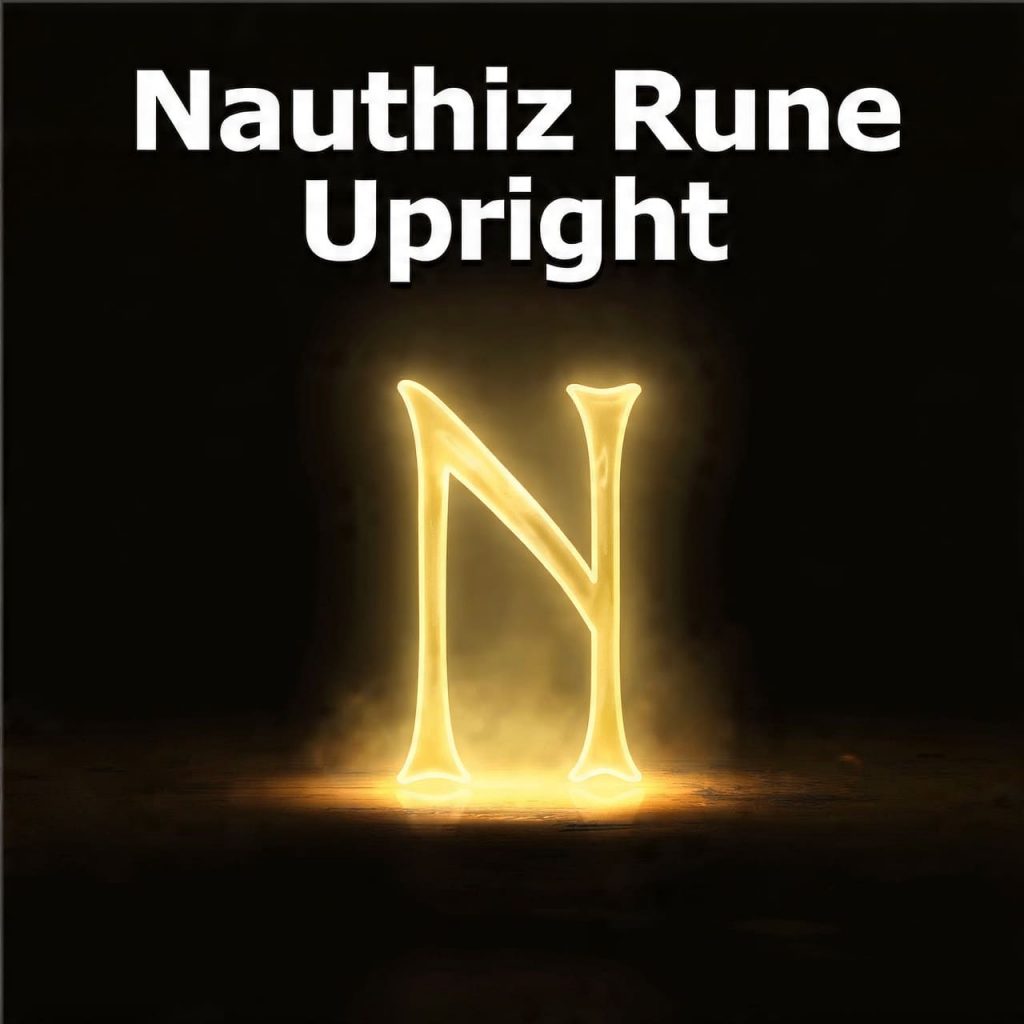
The phrase “Nauthiz rune upright” appears frequently in modern discussions of runes and is often presented as if the orientation of the Nauthiz rune carried a distinct or intentional meaning in early Germanic usage. This presentation assumes that runes were historically interpreted according to positional states, such as upright or inverted. Whether this assumption reflects documented historical practice requires examination using primary archaeological and textual evidence.

💜 Need a clear answer right now?
CONSULT THE YES OR NO TAROT Free · No registration · Instant resultHistorical evaluation follows the same methodological standards applied by qualified professionals when assessing claims about ancient writing systems. Using evidence-filtering and claim-verification strategies consistent with those outlined by astroideal, this article examines the historical record to determine whether orientation played any interpretive role in the use of the Nauthiz rune.
Defining “Nauthiz” and “Upright” in Historical Terms
Nauthiz is a rune of the Elder Futhark, the earliest attested runic alphabet, used approximately between the second and eighth centuries CE. In historical terms, a rune functioned as a grapheme representing a phonetic value within a writing system.
The term “upright” refers to an orientation-based interpretive concept in which a sign’s meaning changes according to its visual position. The application of this concept to runes requires historical evidence that orientation was used as a semantic variable.
Structural Characteristics of Runic Writing
Runic writing developed for carving on materials such as stone, wood, bone, and metal. Rune shapes are angular to accommodate carving rather than to encode positional meaning.
Surviving inscriptions show that runes were written in multiple directions. Lines may run left-to-right, right-to-left, top-to-bottom, or follow the contours of an object. Individual runes may appear rotated or mirrored due to spatial constraints.
These variations occur without any documented change in phonetic value or interpretation.
Archaeological Evidence of Rune Orientation
Archaeological inscriptions provide direct evidence of how runes were used in practice. Nauthiz appears in inscriptions with differing orientations depending on the layout of the surface.
In some inscriptions, orientation shifts occur within the same text. These shifts do not coincide with changes in meaning, emphasis, or function. The rune continues to represent the same phonetic value regardless of visual alignment.
No inscription indicates that a specific orientation was preferred, avoided, or treated as distinct.
Textual Sources and Orientation
Early textual sources referencing runes include later medieval rune poems and scholarly descriptions. These texts discuss rune names and associated concepts but do not describe interpretive differences based on orientation.
No surviving text instructs readers to distinguish rune meanings according to whether a rune is upright, inverted, or rotated. Orientation is not addressed as a meaningful variable.
Orientation Concepts in Later Interpretive Contexts
References to upright rune meanings appear in later interpretive frameworks that apply positional logic to signs. These frameworks are commonly encountered in contexts associated with reliable readers, where symbolic interpretation is emphasized.
Similar orientation-based interpretation is also present in online tarot sessions, where the position of a symbol affects interpretation. These contexts demonstrate where upright terminology is used, not when it originated.
Visual Presentation in Contemporary Media
Orientation-based explanations of runes are frequently presented in visual formats such as video readings, where visual positioning is central to explanation. Spoken explanations of similar claims also circulate through phone readings.
These formats document contemporary usage patterns rather than historical practice.
Orientation in Other Symbolic Systems
Orientation-dependent interpretation is a feature of systems such as horoscope insights, where positional relationships determine meaning within a defined framework. These systems operate independently of early Germanic writing traditions.
The presence of orientation rules in other systems does not establish their use in runic inscriptions.
Direct Evaluation of the Core Claim
The claim examined is that the Nauthiz rune historically carried a distinct meaning when upright.
Archaeological evidence shows that Nauthiz appears in multiple orientations without semantic differentiation. Textual sources do not describe orientation-based interpretation. Structural analysis confirms that runes functioned as phonetic characters rather than orientation-sensitive signs.
Based on the available evidence, orientation did not play an interpretive role in the historical use of the Nauthiz rune.
Modern Orientation Frameworks
Contemporary orientation frameworks that assign meaning to upright runes resemble interpretive systems such as love tarot readings, where positional state is integral to interpretation. These systems operate according to modern interpretive rules rather than historical documentation.
Frequently Asked Questions
Do runic inscriptions distinguish upright and inverted forms?
No surviving inscriptions indicate such a distinction.
Are upright meanings mentioned in early texts?
No early textual sources describe orientation-based meanings.
Did rune carvers control orientation precisely?
Orientation varies according to surface and layout constraints.
Is “upright” a traditional runic term?
No. It does not appear in early runic scholarship.
When did upright interpretations appear?
They appear in modern interpretive literature.
Is the upright claim supported by archaeology?
No archaeological evidence supports it.
Call to Action
Claims about ancient writing systems require evaluation grounded in material and textual evidence. Readers seeking to get a clear yes or no answer should examine whether orientation-based interpretations are supported by inscriptions and historical sources rather than by modern interpretive frameworks.
