

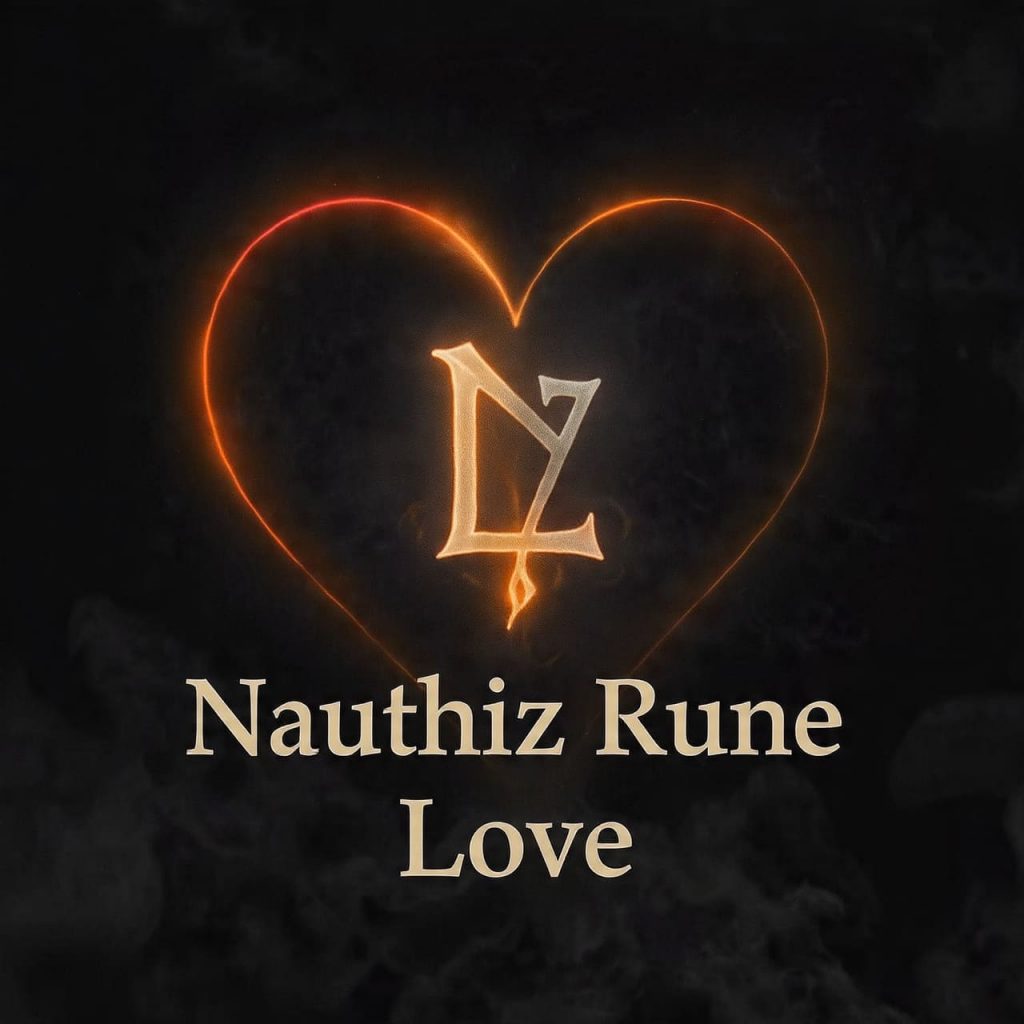
The phrase “Nauthiz rune love” appears frequently in modern digital writing, yet it is persistently misunderstood due to the projection of contemporary symbolic assumptions onto early Germanic material. The misunderstanding is not rooted in ambiguity within the historical record but in the selective reinterpretation of evidence outside its original linguistic and cultural context.

💜 Need a clear answer right now?
CONSULT THE YES OR NO TAROT Free · No registration · Instant resultHistorically disciplined evaluation requires separating what early sources explicitly attest from what later interpreters have inferred. This distinction is central to the methodological standards used by qualified professionals when evaluating claims about ancient symbols.
Applying evidence-filtering strategies consistent with those outlined by astroideal, this article assesses whether any primary linguistic, textual, or archaeological sources support a love-related meaning for the Nauthiz rune.
The question addressed is narrow and factual: does historical evidence support the claim that the Nauthiz rune was associated with love?
Defining “Nauthiz” and “Love” in Historical Terms
Nauthiz is one of the runes of the Elder Futhark, the earliest known runic alphabet, in use approximately from the second to the eighth century CE. In historical terms, a rune is a grapheme representing a phonetic sound, often accompanied by a conventional name that reflects a concrete concept familiar to early Germanic speakers.
The term “love,” however, presents a methodological challenge. Early Germanic languages did not employ a single abstract category equivalent to modern English “love.” Instead, they used distinct lexical items to describe kinship obligation, sexual desire, loyalty, and affection. These concepts were not interchangeable and were context-specific.
For the claim “Nauthiz rune love” to be historically valid, evidence would need to demonstrate that Nauthiz was explicitly associated with interpersonal affection or romantic attachment in early sources. Without such specificity, the claim cannot be substantiated.
Origin and Function of the Nauthiz Rune
The Elder Futhark runes emerged within a pragmatic communicative environment. Inscriptions were typically brief and functional, appearing on weapons, tools, jewelry, memorial stones, and personal objects. Their purposes included identification, commemoration, ownership marking, and formulaic expression.
Nauthiz consistently appears within this functional framework. Its phonetic value is reconstructed as /n/, and its use aligns with the broader structural logic of the runic writing system. There is no evidence that runes were designed as abstract carriers of emotional states.
Understanding this origin is critical. Assigning an emotional or relational function to Nauthiz requires evidence that early users conceptualized runes symbolically rather than linguistically. No such evidence exists in early runic contexts.
Linguistic Evidence and Etymology
Importantly, linguistic evidence shows no semantic overlap between naudiz and words historically used to express love or affection. Terms associated with romantic or interpersonal bonds belong to entirely separate lexical families.
Philological analysis therefore establishes a consistent semantic field for Nauthiz centered on necessity and constraint. Linguistics provides no basis for associating the rune with love.
Archaeological and Epigraphic Evidence
Archaeological evidence for runic usage consists of inscriptions found on material objects. Nauthiz appears in several inscriptions, often as part of names or formulaic sequences. Where inscriptions are sufficiently preserved to allow interpretation, they align with practical or commemorative functions.
Crucially, no inscription associates Nauthiz with relational language, partnership, or emotional expression. There are no archaeological contexts linking the rune to marriage, courtship, or interpersonal bonds.
The absence of such evidence is significant. Archaeology does not merely fail to confirm a love association; it actively demonstrates that Nauthiz was used in non-relational contexts.
Evidence from Rune Poems and Early Texts
The primary textual sources describing rune meanings are the Old Norwegian, Old Icelandic, and Anglo-Saxon rune poems. These texts date from several centuries after the earliest runic inscriptions and must be treated cautiously.
Even within these later interpretive frameworks, Nauthiz is described using imagery related to hardship, constraint, and difficulty. The metaphors employed remain firmly within the semantic range established by linguistic evidence.
No rune poem introduces themes of affection, romance, or relational attachment in connection with Nauthiz. If such associations had existed in earlier tradition, they would reasonably be expected to appear here. Their absence reinforces the conclusion drawn from earlier evidence.
Emergence of Modern Interpretations
Associations between Nauthiz and love emerge in modern esoteric and popular literature, particularly from the late twentieth century onward. These interpretations often blend runic material with non-Germanic symbolic systems or psychological frameworks.
Such interpretations are not based on newly discovered inscriptions or revised philological findings. Instead, they reflect retrospective symbolism. Similar patterns are observable in interpretive systems promoted by reliable readers and online tarot sessions, where symbolic flexibility takes precedence over historical constraint.
From an academic standpoint, modern reinterpretation does not constitute historical evidence.
Why the Claim Continues to Circulate
The persistence of the “Nauthiz rune love” claim can be explained sociologically rather than historically. Symbolic reinterpretations offer emotional relevance and personal resonance, making them appealing in contemporary contexts.
Digital repetition further reinforces these claims, particularly when linked to interpretive services such as video readings or phone readings. However, repetition does not substitute for evidence.
The continued circulation of the claim reflects modern symbolic demand, not ancient attestation.
Direct Evaluation of the Core Claim
The historical claim under examination is specific: that the Nauthiz rune was associated with love in early Germanic contexts.
Linguistic evidence defines Nauthiz as “need” or “constraint.” Archaeological evidence shows its use in non-relational inscriptions. Textual sources describe it in terms of hardship, not affection. Modern love associations emerge centuries later without primary support.
The evidence therefore leads to a definitive conclusion: there is no historical basis for identifying Nauthiz as a love-related rune.
Comparison with Modern Love-Based Interpretations
Modern discussions of runes often parallel interpretive approaches seen in systems such as love tarot readings, where symbols are evaluated for emotional relevance rather than historical origin. While such systems may function within their own frameworks, they do not provide evidence for ancient meanings.
When evaluated using historical methodology, modern love-based interpretations of Nauthiz cannot be retroactively applied to early Germanic usage.
Frequently Asked Questions
Is Nauthiz described as a love symbol in any early sources?
No early linguistic, archaeological, or textual sources describe Nauthiz as a love symbol.
Do rune poems associate Nauthiz with relationships?
No. Rune poems associate Nauthiz with hardship and necessity only.
Are there inscriptions linking Nauthiz to romance?
No known inscriptions connect Nauthiz to romantic or interpersonal contexts.
Did early Germanic cultures encode love in runes?
There is no evidence that runes functioned as emotional or relational symbols.
When did love interpretations of Nauthiz appear?
They appear in modern interpretive literature, not in ancient sources.
Is the love meaning academically supported?
No academically credible sources support a love-related meaning for Nauthiz.
Call to Action
Claims about ancient symbols require disciplined evaluation grounded in primary evidence. Readers examining such assertions should apply the same analytical rigor used in historical research to get a clear yes or no answer, distinguishing between documented tradition and modern reinterpretation.
