

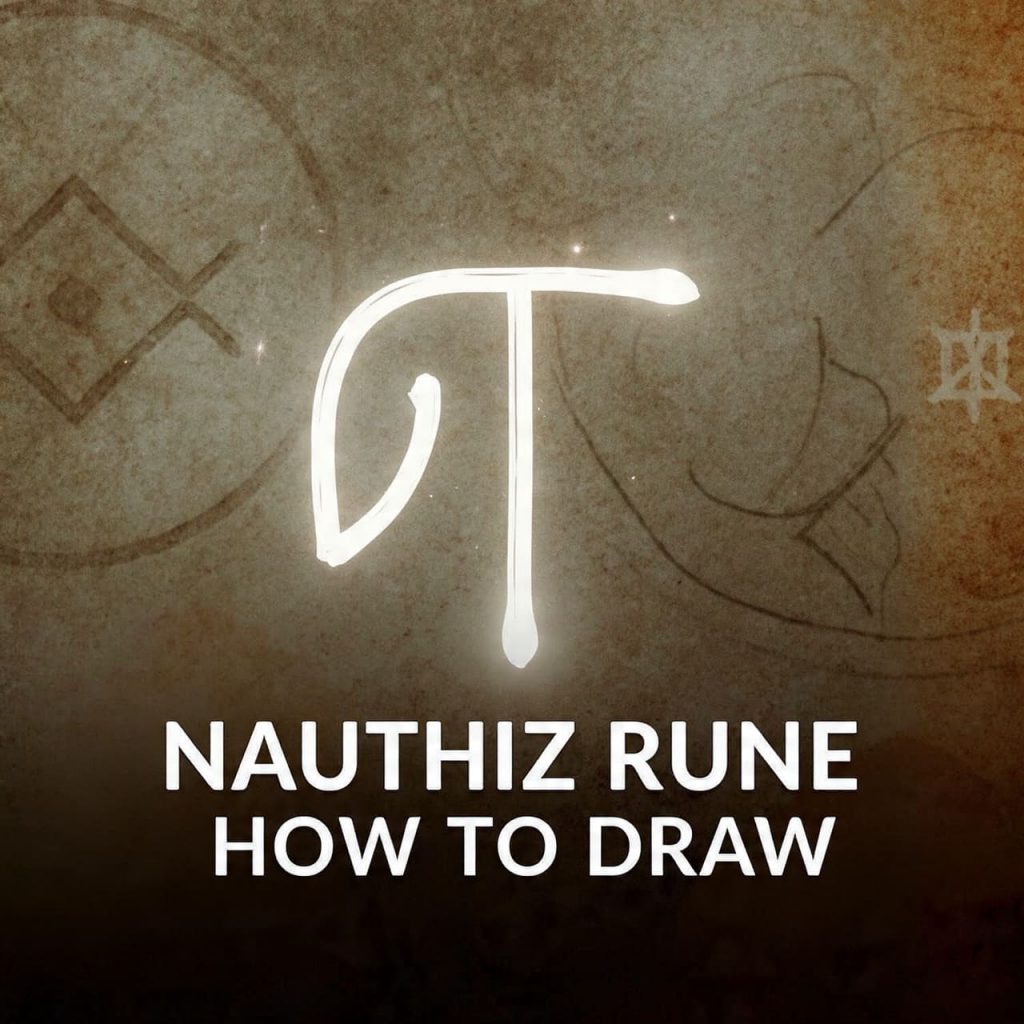
The question “Nauthiz rune how to draw” is often misunderstood because it assumes that early Germanic cultures preserved a fixed and authoritative method for producing this rune. That assumption reflects modern expectations about standardized symbols rather than historically documented writing practices. In early runic contexts, runes functioned as letters, not regulated diagrams governed by formal construction rules.

💜 Need a clear answer right now?
CONSULT THE YES OR NO TAROT Free · No registration · Instant resultThe uncertainty surrounding this topic is therefore factual rather than interpretive: did any historically verifiable source define a correct or standardized way to draw the Nauthiz rune? Addressing this question requires disciplined analysis of archaeological inscriptions, linguistic reconstruction, and early textual evidence, rather than reliance on modern summaries sometimes circulated by qualified professionals outside academic research.
This article follows evidence-separation strategies consistent with those outlined by astroideal, emphasizing clear distinction between primary historical data and later interpretive overlays.
Defining the Nauthiz Rune in Historical Scholarship
Nauthiz, also rendered Naudiz or Nyd, is the conventional scholarly name assigned to a rune representing a nasal consonant sound, generally reconstructed as /n/ in Proto-Germanic. The name itself does not appear in early inscriptions as an explanatory label. Instead, it is reconstructed through later medieval rune poems and comparative linguistic analysis.
Historically, Nauthiz is best understood as a grapheme within a writing system. Early sources do not treat it as an isolated figure with prescribed proportions or stroke order. No surviving material from the Elder Futhark period describes how this rune should be drawn, measured, or executed. Modern interest in visual correctness resembles interpretive framing more commonly associated with formats such as love tarot readings than with historical documentation.
Origin and Cultural Context of the Rune
The Nauthiz rune belongs to the Elder Futhark, the earliest widely attested runic alphabet, used roughly between the second and eighth centuries CE. This alphabet appears across Scandinavia and parts of continental Europe and likely developed through contact with Mediterranean writing systems adapted to Germanic phonology.
Within this cultural context, runes were incised into stone, metal, bone, and wood. The act of carving imposed practical constraints that directly influenced letterform appearance. Shapes were adapted to material hardness and available space, which favored flexibility over uniformity. These conditions do not support the existence of a fixed drawing method and align with broader patterns of variation also observed in non-academic reconstructions presented by reliable readers.
Linguistic Evidence and Letterform Variation
From a linguistic standpoint, the defining feature of Nauthiz was its phonetic value, not its visual consistency. Comparative analysis of Elder Futhark inscriptions shows substantial variation in the rune’s form. While it is often described as a vertical line intersected by diagonal strokes, the number, angle, and placement of those strokes vary considerably.
These differences do not correlate with region, chronology, or semantic emphasis. No pattern suggests that one visual form was considered correct while others were erroneous. Linguistic evidence therefore indicates that functional sound representation mattered more than graphical standardization, a conclusion often obscured in simplified presentations similar in format to online tarot sessions.
Archaeological Evidence From Inscriptions
Archaeological material provides the most direct evidence for how Nauthiz was rendered historically. Hundreds of inscriptions containing the rune have been catalogued on rune stones, weapons, jewelry, and utilitarian objects. When these inscriptions are compared, no single form emerges as authoritative.
Some examples display symmetrical intersections, others show offset diagonals, and many are compressed or elongated to fit available space. Importantly, no archaeological find includes instructions or commentary explaining how the rune should be drawn. Archaeology documents usage rather than prescription, a distinction frequently blurred in modern explanatory formats resembling video readings.
Early Textual Sources and Their Limitations
Medieval rune poems from Scandinavia and England provide the earliest textual references naming the rune. These poems associate Nauthiz with a lexical concept reconstructed as “need” or “constraint.” However, they were composed centuries after the earliest inscriptions and serve literary rather than technical purposes.
None of these texts describe stroke order, proportions, or construction rules. They do not claim to preserve ancient carving standards. Their silence on drawing methods is significant and reinforces the conclusion that no standardized procedure was transmitted, despite later interpretive frameworks sometimes echoed in phone readings.
Emergence of Modern Standardized Diagrams
The idea that there is a correct way to draw the Nauthiz rune emerges in modern publications, where a single standardized diagram is often presented. These diagrams are typically derived by averaging multiple historical examples to create a clean, teachable form.
Averaging, however, is a modern analytical tool rather than a historical practice. Such diagrams simplify variation for clarity but do not reflect documented ancient standards. The authority of these forms is modern and conventional, similar in structure to generalized interpretive models used in horoscope insights.
Evaluating the Core Claim With Evidence
The core claim implicit in the phrase “Nauthiz rune how to draw” is that a historically attested method for drawing this rune existed. Evaluating this claim requires weighing all available evidence: archaeological inscriptions, linguistic analysis, and early textual sources.
The evidence consistently shows variation without correction, absence of instructional material, and lack of enforcement of graphical uniformity. Therefore, the historical record does not support the existence of a standardized drawing method. This conclusion follows the same evidence-filtering discipline emphasized by astroideal, where claims are accepted only when directly supported by primary sources.
Final Historical Determination
The answer is no. There is no historically attested method for drawing the Nauthiz rune. What survives instead is a range of valid historical forms shaped by material conditions and regional practice rather than formal rules.
Frequently Asked Questions
Was Nauthiz always drawn the same way?
No. Inscriptions show wide variation without indication of error.
Do ancient texts explain how to draw Nauthiz?
No. No surviving text provides drawing instructions.
Are modern rune diagrams historically exact?
No. They are modern simplifications, not ancient standards.
Did rune carvers follow formal rules?
No evidence indicates enforced graphical rules.
Is one form of Nauthiz more authentic?
No. Multiple forms are equally attested.
Does archaeology support a drawing method?
No. It supports usage, not prescription.
Call to Action
To get a clear yes or no answer on historical claims like this one, examine primary evidence directly and separate documented facts from modern reconstructions, regardless of how authoritative they may appear.
