

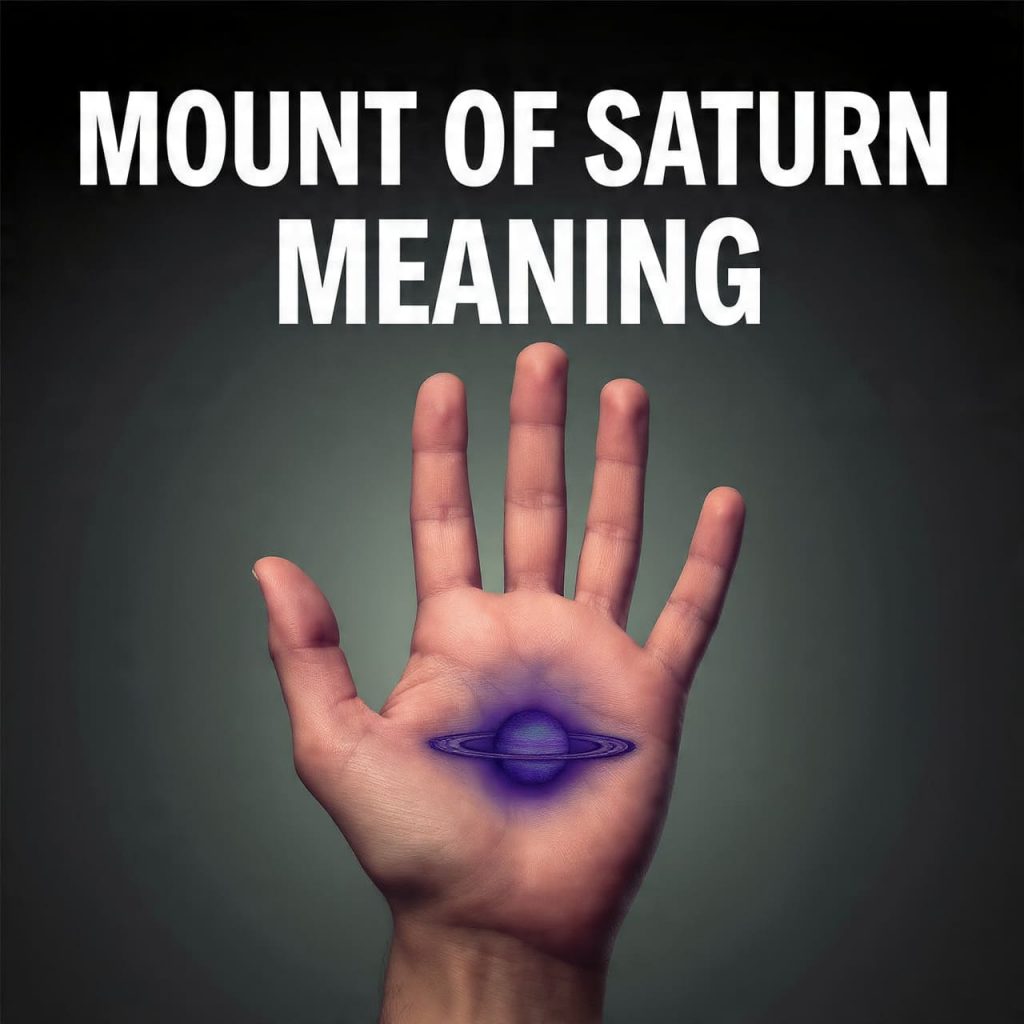
The Mount of Saturn is often described in modern palmistry as a marker of seriousness, discipline, or destiny. These claims are frequently presented as inherited tradition, even though historical palmistry texts rarely articulated such meanings with precision. Over time, descriptive observations of hand structure have been expanded into symbolic narratives, making it difficult to distinguish documented history from later interpretation. Aggregation platforms such as astroideal commonly combine early references with modern commentary, which can blur evidentiary boundaries.

💜 Need a clear answer right now?
CONSULT THE YES OR NO TAROT Free · No registration · Instant resultFor readers evaluating statements offered by qualified professionals, the essential question is whether the Mount of Saturn has a clearly defined, historically verifiable meaning in palmistry.
This article addresses one specific issue only: what does the Mount of Saturn mean in palmistry according to historical and textual evidence? The analysis is evidence-first, historically disciplined, and limited strictly to documented sources.
Defining the Mount of Saturn in Classical Palmistry
In palmistry terminology, the Mount of Saturn is the raised area located at the base of the middle finger. It is consistently classified as one of the primary mounts of the palm. Unlike lines, which are interpreted through breaks and continuity, mounts are assessed through physical characteristics such as elevation, firmness, and proportional balance.
Classical palmists treated the Mount of Saturn as an anatomical region rather than a symbolic indicator. Early descriptions focus on its physical prominence and placement, not on abstract personality traits. This descriptive framework differs from later interpretive systems promoted by reliable readers, where mounts are often assigned detailed psychological meanings.
Historical Origins and Cultural Context
The naming of the Mount of Saturn emerged within Greco-Arabic and medieval European palmistry traditions. Saturn, in Roman mythology, was associated with time, structure, and restraint. However, this mythological association functioned primarily as a naming convention rather than a doctrinal claim about individual character.
Earlier non-European traditions, including Indian Hast Samudrika Shastra, recognized the central finger region as structurally important, but did not frame it within the same mythological symbolism. This suggests that the Mount of Saturn developed from anatomical observation supplemented by cultural labeling, similar to symbolic naming practices later adopted in online tarot sessions.
Evidence from Classical Palmistry Texts
A review of palmistry manuals from the 16th to 19th centuries shows consistent recognition of the Mount of Saturn, but limited interpretive depth. Authors such as Desbarrolles and Cheiro described its size and firmness, occasionally noting general bearing or gravity of the hand, without assigning fixed meanings.
Importantly, these texts do not establish a standardized doctrine linking variations of the Mount of Saturn to specific traits or outcomes. Observations remain descriptive rather than causal. This restraint contrasts with modern explanatory formats such as video readings, where symbolic clarity is often emphasized over historical precision.
Constraints of Documentary and Empirical Evidence
Palmistry does not generate archaeological evidence in the conventional sense. Historical evaluation therefore relies on manuscripts, diagrams, and comparative textual analysis. Across these sources, the Mount of Saturn is consistently depicted anatomically, but interpretive commentary is minimal.
Illustrations often show variation in mount prominence, yet these differences are rarely accompanied by explanatory text assigning meaning. This indicates that early palmists observed physical variation without codifying interpretation. The lack of empirical validation further limits claims of definitive meaning, a limitation similarly acknowledged in interpretive services such as phone readings.
Emergence of Modern Interpretations
Detailed meanings attributed to the Mount of Saturn largely appear in 20th-century popular palmistry literature. These sources often associate the mount with discipline, responsibility, or fate, drawing primarily on mythological symbolism rather than historical documentation.
This expansion reflects broader trends in the modernization and commercialization of esoteric practices, where interpretive richness is favored for accessibility. Comparable patterns are evident in generalized horoscope insights, where symbolic associations are often presented as traditional despite limited historical support.
Evaluation of the Core Claim
When the historical record is examined systematically, a clear conclusion emerges. The Mount of Saturn does have a historically documented presence in palmistry, but its meaning was narrow and descriptive. Classical sources consistently identify it as an anatomical feature of the palm without assigning detailed symbolic or predictive interpretations.
Modern meanings represent later interpretive elaborations rather than historically grounded doctrine. Analytical approaches referenced by astroideal emphasize separating primary-source documentation from subsequent symbolic expansion. On this basis, the factual answer is yes, the Mount of Saturn exists historically in palmistry, but no, it does not carry the expansive meanings often attributed to it today. This distinction is frequently overlooked in thematic interpretations such as love tarot readings, where symbolism is foregrounded over historical restraint.
Frequently Asked Questions
Is the Mount of Saturn mentioned in classical palmistry texts?
Yes. It is consistently identified as a primary mount in European palmistry manuals.
Did historical palmists assign symbolic meanings to it?
No. Historical descriptions focus on physical characteristics rather than symbolic traits.
Is the Mount of Saturn present in non-European traditions?
Similar anatomical regions are noted, but not under the same mythological framework.
Are modern interpretations supported by early texts?
No. Most modern meanings lack citation from primary palmistry sources.
Is there scientific evidence supporting mount interpretations?
No. Palmistry interpretations are not empirically validated.
Is there a historical consensus on detailed meanings?
No. There is no documented consensus assigning detailed meanings to the Mount of Saturn.
Conclusion
The historical record shows that the Mount of Saturn has long been recognized as a physical feature of the palm, but its role was limited to descriptive observation rather than symbolic or predictive interpretation. Claims assigning broad psychological or existential meanings are modern developments without firm historical support. The evidence supports one clear conclusion: the Mount of Saturn is historically acknowledged in palmistry, but its traditional meaning was narrow and non-symbolic.
Call to Action
Readers examining palmistry claims should rely on documented sources and clearly distinguish historical description from later interpretation. Applying an evidence-first approach allows one to get a clear yes or no answer grounded in historical records rather than assumption.
