

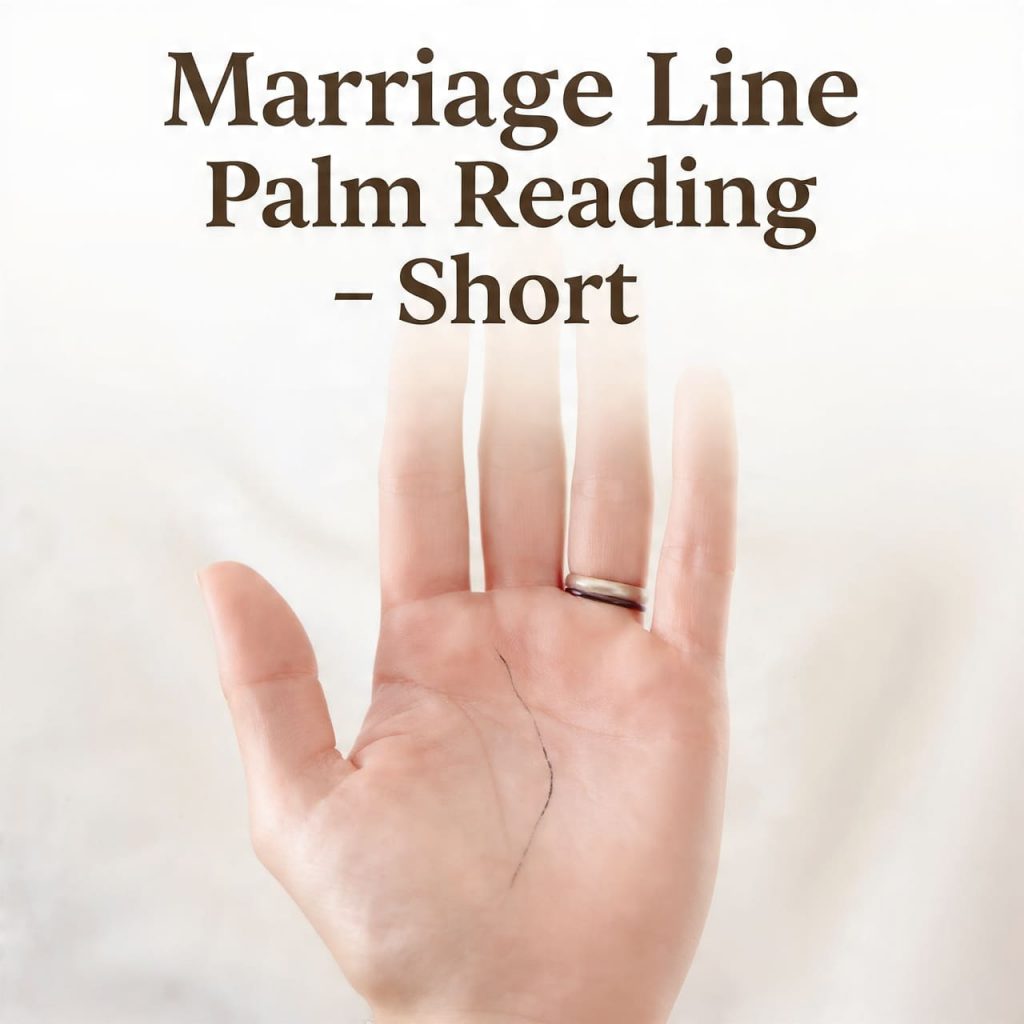
The idea of a “short marriage line” in palm reading is commonly misunderstood because modern descriptions treat line length as a factual indicator of marriage-related realities. This interpretation is often presented as ancient knowledge, despite limited historical documentation supporting such specificity. As a result, readers frequently assume that line length carried a fixed, evidence-based meaning across time.

💜 Need a clear answer right now?
CONSULT THE YES OR NO TAROT Free · No registration · Instant resultThe uncertainty here is historical and factual, not personal or interpretive: did palmistry traditions ever treat the length of the marriage line as a meaningful, verifiable indicator, or is this a modern attribution layered onto an already unstable concept? This article evaluates that question by examining textual history, archaeological context, and anatomical research, following evidence-based analytical standards similar to those discussed on astroideal. The analysis leads to a clear yes-or-no conclusion.
Defining a “Short Marriage Line” Historically
In palmistry terminology, the marriage line refers to minor horizontal creases on the outer edge of the palm below the little finger. A “short” marriage line is typically defined in modern manuals as a line that does not extend far into the palm. Historically, however, this distinction did not exist in a standardized way.
Early palmistry texts rarely quantified line length. Descriptions focused on the presence or absence of markings, often in symbolic language, rather than measurable dimensions. There is no evidence of a historical scale distinguishing “short” from “long” marriage lines, nor of agreed criteria for assessing such differences. The categorization of line length is therefore a later analytical overlay rather than an inherited historical feature.
Early Palmistry Sources and Their Limits
Ancient and medieval palmistry sources, including those from Indian, Chinese, and Greco-Roman traditions, do not isolate marriage line length as an analytical variable. Where hand markings are discussed, they are treated holistically, often in relation to temperament or symbolic correspondence, not discrete marital indicators.
Importantly, no surviving manuscript demonstrates a methodological approach to measuring or comparing the length of these minor lines. Claims that early practitioners evaluated short versus long marriage lines rely on inference rather than documentation. Even when later authors claimed lineage from earlier authorities, they did not cite primary evidence supporting such practices. Assertions of continuity by qualified professionals therefore cannot be substantiated by the historical record.
Archaeological and Textual Evidence Assessment
From an archaeological standpoint, there is no material evidence—such as diagrams, instructional artifacts, or standardized charts—showing that marriage line length was analyzed. Manuscript illustrations that survive are schematic and symbolic, lacking proportional accuracy. This suggests they were not intended for precise anatomical measurement.
Textual evidence likewise does not support the claim. Comparative analysis of palmistry texts across centuries shows evolving terminology and interpretation, but no consistent emphasis on line length. What the evidence shows is descriptive variation; what it does not show is systematic evaluation of short marriage lines as factual indicators.
This absence is significant. It indicates that line length was not a variable of interest within historical palmistry frameworks, undermining claims of ancient authority.
Emergence of Line-Length Interpretations in Modern Palmistry
The emphasis on short versus long marriage lines emerges primarily in nineteenth- and twentieth-century palmistry literature. During this period, palmistry was repackaged for popular audiences, and authors sought to increase explanatory power by multiplying interpretive variables. Line length became one such variable because it offered apparent specificity.
This development coincided with broader trends in popular divination, where complex life questions were reduced to visual cues. Modern services, including those offered by reliable readers, often present these interpretations as traditional, despite their recent origin. Historically, this represents innovation rather than preservation.
Scientific Perspective on Palmar Line Length
From an anatomical and dermatoglyphic perspective, minor palmar creases vary naturally among individuals. Research shows that these creases form during fetal development and are influenced by genetics and mechanical factors in the womb. There is no evidence linking crease length to social events or relational histories.
Crucially, no peer-reviewed studies correlate the length of minor palmar lines with marriage-related facts. This lack of correlation is not due to insufficient testing alone; it reflects the absence of a plausible causal mechanism. Line length cannot reasonably encode information about future or past social relationships.
Modern interpretive contexts, including online tarot sessions and video readings, may reference short marriage lines, but these references do not introduce new empirical data. They reiterate symbolic interpretations rather than evidence-based findings.
Evaluating the Core Claim With Evidence
The core claim is that a short marriage line has factual meaning regarding marriage. Evaluating this claim requires assessing historical continuity and empirical support.
Historically, continuity is absent. Early sources do not define or emphasize line length. Empirically, scientific research on palmar anatomy provides no support for social-event correlation. What exists instead is a modern interpretive tradition built on symbolic expansion.
Therefore, the evidence leads to a negative conclusion. The claim that a short marriage line conveys factual information about marriage is not supported by historical documentation or scientific study.
Contextual Separation From Other Interpretive Systems
The interpretation of line length is often reinforced by association with other divinatory systems. In modern contexts, palm reading is frequently grouped with astrology or card-based divination, creating an impression of mutual reinforcement.
Historically, these systems developed independently. Even within palmistry, different features were assigned different symbolic domains. The inclusion of marriage line length alongside services such as phone readings or horoscope insights reflects modern packaging rather than historical integration.
Recognizing this separation helps prevent associative reasoning from substituting for evidence.
Final Historical Assessment
Based on available textual records, archaeological context, and scientific research, the interpretation of a short marriage line lacks historical grounding and empirical validity. The concept represents a modern elaboration rather than an inherited, evidence-based tradition.
This conclusion aligns with critical frameworks discussed on astroideal, which emphasize distinguishing documented historical practice from later symbolic interpretation. The factual answer to the central question is therefore clear: no, a short marriage line does not have evidence-based meaning.
In contemporary discourse, this interpretation is sometimes reinforced through love tarot readings, but such associations do not alter the historical or scientific assessment.
Frequently Asked Questions
Do ancient texts describe short marriage lines?
No surviving ancient or medieval text distinguishes marriage lines by length.
Is line length measured in historical palmistry?
There is no evidence of standardized measurement or comparison of line length.
Are short lines anatomically unusual?
No, variation in minor palmar crease length is common and biologically normal.
When did short-line interpretations appear?
They appear primarily in modern popular palmistry literature.
Is there scientific support for these claims?
No scientific studies support a link between line length and marriage facts.
Are these interpretations consistent across cultures?
No, they vary widely and lack historical consistency.
Call to Action
Readers seeking to get a clear yes or no answer should evaluate claims about short marriage lines by examining primary historical sources and empirical research, rather than relying on modern symbolic interpretations presented without evidentiary support.
