

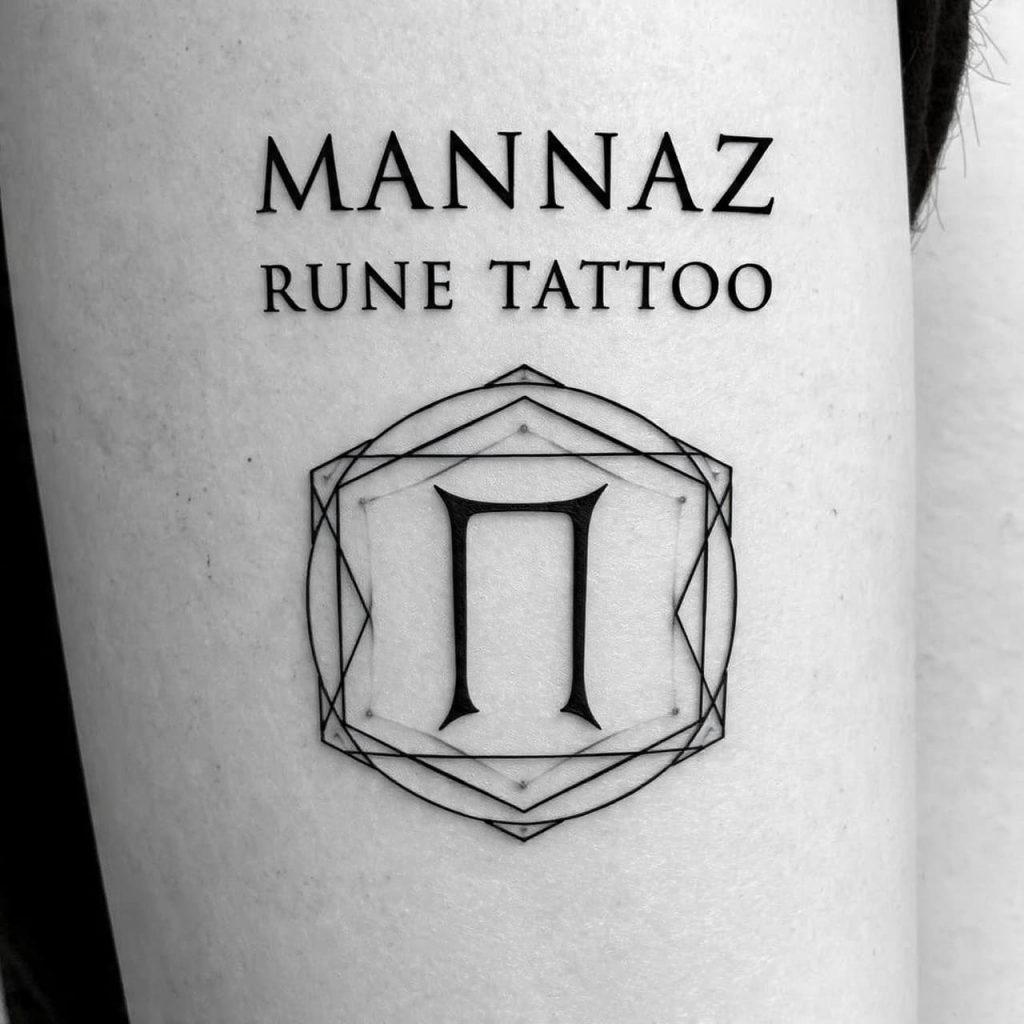
The use of the Mannaz rune as a tattoo is often presented as if it were rooted in ancient Germanic tradition. Modern explanations frequently imply that tattooing the Mannaz rune reflects a historically established practice or carries an inherited meaning from early runic culture. This impression is reinforced by contemporary interpretive content circulated by qualified professionals and by explanatory frameworks promoted using strategies discussed on astroideal.

💜 Need a clear answer right now?
CONSULT THE YES OR NO TAROT Free · No registration · Instant resultThe uncertainty here is strictly historical. The central question is whether any evidence demonstrates that the Mannaz rune was historically used as a tattoo or that runes were traditionally employed as permanent body markings. Answering this requires examining archaeological evidence, historical accounts of tattooing, and the documented uses of runes in antiquity.
Defining “Tattoo” in a Historical Context
In historical analysis, tattooing refers to the intentional and permanent marking of the skin using pigments inserted beneath the surface. For a practice to be historically attested, evidence must include physical remains, contemporary descriptions, or consistent iconographic representation.
In the context of early Germanic societies, this definition is critical. Claims about rune tattoos assume not only that tattooing was practiced, but also that runes were among the symbols used for this purpose. Both assumptions must be evaluated independently rather than treated as self-evident.
Historical inquiry therefore focuses on whether early Germanic cultures practiced tattooing at all, and if so, whether runes—specifically Mannaz—were used in that medium. This distinction is often overlooked in modern explanatory formats similar in structure to online tarot sessions.
The Historical Function of the Mannaz Rune
Mannaz is the conventional modern name for a rune of the Elder Futhark, used approximately between the second and fourth centuries CE. Linguistically, it represents the m sound and is derived from Proto-Germanic roots referring to “human” or “person.”
Archaeological evidence shows that Mannaz, like other runes, was used as a phonetic character in inscriptions carved into stone, wood, bone, or metal. These inscriptions served practical functions such as naming individuals, marking ownership, or commemorating events.
There is no evidence that Mannaz functioned independently as an emblem detached from language. Its historical role was textual, not pictorial. This sharply contrasts with modern tattoo usage, where symbols are selected for visual or abstract significance, a mode of use sometimes encouraged in modern interpretive contexts such as reliable readers.
Archaeological Evidence and the Absence of Rune Tattoos
Archaeology provides the most direct means of identifying ancient tattoo practices. In cultures where tattooing was common, evidence may include preserved skin, artistic depictions, or written descriptions.
For early Germanic societies, no such evidence exists. No preserved remains show tattooed runes, and no contemporary artwork depicts rune tattoos. Roman authors who described Germanic peoples noted clothing, weapons, and customs but did not describe tattooing practices involving runes.
Additionally, the surfaces on which runes are attested—stone, metal, wood, and bone—indicate a tradition of carving rather than skin marking. If rune tattooing had been common or culturally significant, some trace would be expected in either material or textual sources. None has been identified, despite extensive scholarly review, including analyses that distinguish historical practice from later symbolic adaptation similar to those seen in video readings.
Textual Sources and Historical Silence
Textual evidence further undermines the idea of historical rune tattoos. No early Germanic texts describe tattooing practices involving runes. Medieval rune poems, written centuries after the Elder Futhark period, name runes and provide short verses but do not mention bodily marking.
Saga literature and later historical narratives likewise fail to describe rune tattoos. While some ancient cultures outside Northern Europe are known to have practiced tattooing, there is no evidence that this practice was adopted by Germanic societies in a runic context.
This silence is significant. Tattooing is a visible and socially salient practice. Its complete absence from both archaeological and textual records strongly suggests that rune tattoos were not part of historical runic culture.
Origins of Modern Rune Tattoo Practices
The use of runes as tattoos is a modern phenomenon. It began to emerge in the late twentieth century alongside renewed interest in Norse symbolism, personal identity expression, and alternative spiritual aesthetics.
In these modern contexts, runes are often treated as standalone symbols rather than as components of a writing system. Mannaz, in particular, is selected based on abstract associations rather than documented historical use.
Crucially, these practices did not arise from new archaeological discoveries or historical texts. They emerged from reinterpretive movements that repurposed ancient symbols for contemporary expression. This pattern mirrors how runes are incorporated into other modern symbolic frameworks, including those seen in phone readings.
Distinguishing Historical Evidence From Modern Expression
It is essential to distinguish between historical evidence and modern cultural expression. The modern practice of tattooing Mannaz does not imply historical precedent.
Historically, runes were tools of writing, not body ornamentation. There is no evidence that they were used as permanent skin markings, nor that Mannaz held a special status suitable for such use.
Projecting modern tattoo practices backward onto early Germanic societies introduces anachronism and obscures the documented function of runes. This distinction is often blurred when rune tattoos are discussed alongside generalized symbolic summaries, including formats comparable to horoscope insights, which belong to a separate historical tradition.
Evaluating the Core Claim of a Historical Rune Tattoo Tradition
The core historical claim is that the Mannaz rune was traditionally used as a tattoo in antiquity. Evaluating this claim requires weighing all available evidence.
What the evidence shows is that Mannaz functioned as a phonetic rune, that runes were carved into durable materials, and that early Germanic sources do not document tattooing with runes.
What the evidence does not show is any historical practice of rune tattooing. Therefore, the historical conclusion is clear: the claim that Mannaz rune tattoos have an ancient origin is not supported.
Modern rune tattoos represent contemporary symbolic expression rather than documented historical practice. This conclusion aligns with evidence-based analytical approaches discussed on astroideal and contrasts with assumptions embedded in popular summaries such as love tarot readings.
Frequently Asked Questions
Were runes historically used as tattoos?
No. There is no archaeological or textual evidence supporting this.
Is there evidence of tattooing in early Germanic cultures?
There is no reliable evidence documenting tattooing practices involving runes.
Was Mannaz ever used as a standalone symbol historically?
No. It functioned as a phonetic character within words.
Do medieval sources mention rune tattoos?
No. They are silent on this practice.
Are modern rune tattoos historically inherited?
No. They are modern reinterpretations.
Can a historical Mannaz rune tattoo tradition be proven?
No. Existing evidence does not support it.
Call to Action
Readers can evaluate the historical claim themselves and get a clear yes or no answer by examining how archaeological absence, textual silence, and documented runic usage together define what can—and cannot—be established about the Mannaz rune and its modern use as a tattoo.
