

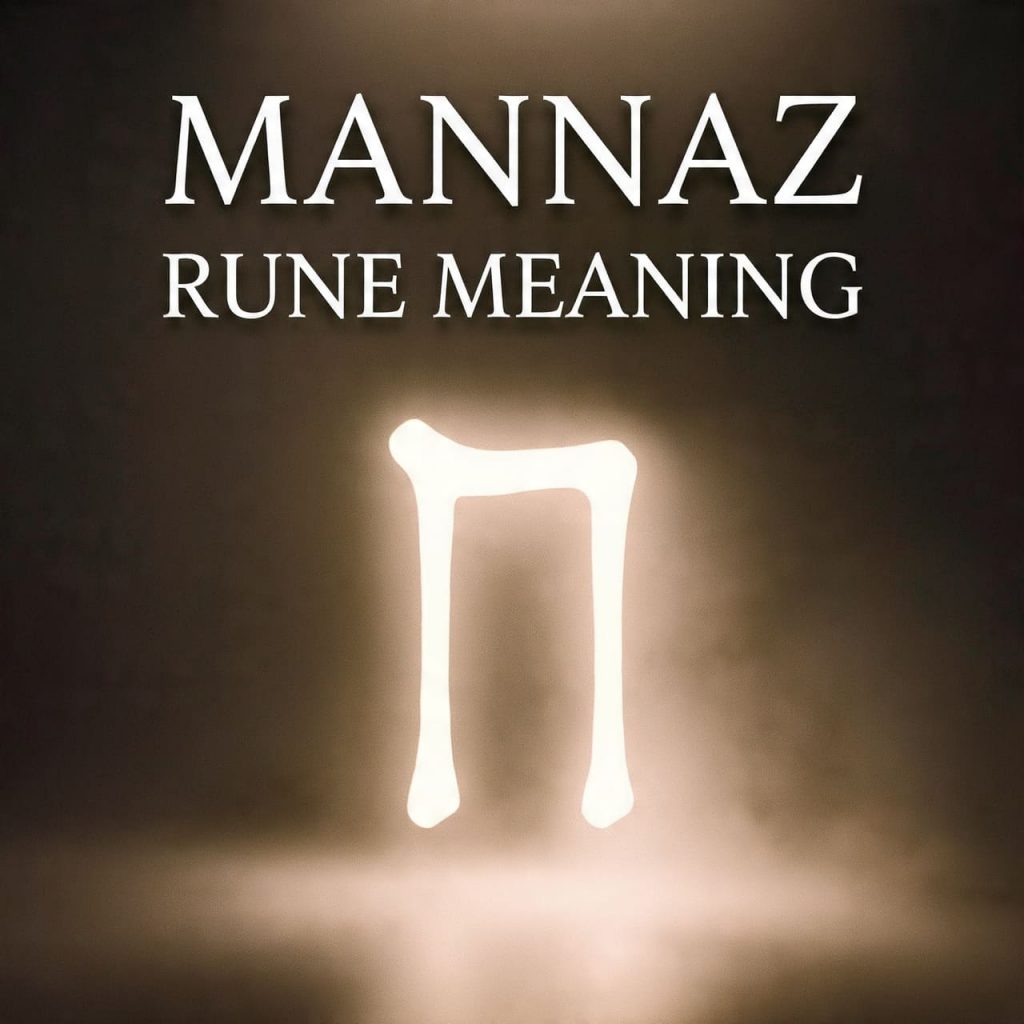
The topic “Mannaz rune meaning” is often misunderstood because modern explanations frequently present a single, fixed meaning as if it were historically documented. In reality, the meaning attributed to Mannaz is the result of later reconstruction rather than direct ancient definition. The uncertainty here is factual and historical, not interpretive or experiential. It concerns whether surviving evidence allows scholars to state, with confidence, what the Mannaz rune “meant” in its original context.

💜 Need a clear answer right now?
CONSULT THE YES OR NO TAROT Free · No registration · Instant resultMany contemporary summaries—sometimes including those published on astroideal—blend medieval poetic descriptions, modern linguistic theory, and recent symbolic systems into a unified narrative. This blending can obscure the limits of the evidence. For a disciplined evaluation, interpretation by qualified professionals in runology and historical linguistics remains the appropriate standard.
The decision this article addresses is explicit and binary: Does the historical record establish a single, definitive meaning for the Mannaz rune? The answer must be yes or no, based strictly on evidence.
Defining “Mannaz” and “Meaning” Historically
“Mannaz” is the conventional scholarly name assigned to one rune within the Elder Futhark, the earliest runic alphabet attested archaeologically, used roughly between the 2nd and 8th centuries CE. The name is reconstructed from later sources and is cognate with Proto-Germanic mann-, meaning “human” or “person.”
The word “meaning,” however, requires careful historical definition. In early writing systems, a character’s primary function is phonetic, not semantic. Any associated “meaning” must therefore be inferred from later explanatory texts or from linguistic comparison, not assumed to be inherent. Confusion arises when phonetic value, name, and symbolic interpretation are treated as identical. This confusion is amplified when explanations appear alongside unrelated interpretive material such as horoscope insights, which operates under a very different evidentiary framework.
Mannaz Within the Elder Futhark System
The Elder Futhark consists of 24 runes arranged in a fixed sequence. Mannaz occupies a specific position within this system and corresponds to a phonetic value commonly reconstructed as /m/. Archaeological inscriptions demonstrate that this phonetic function was primary: Mannaz appears in personal names and short inscriptions where sound value is the operative feature.
There is no indication that the rune’s placement encoded abstract concepts. The order of runes does not correspond to cosmological, moral, or anthropological schemes. Treating Mannaz as if it were designed to convey a defined conceptual meaning misunderstands how early alphabets functioned. Modern representations that suggest otherwise sometimes appear in generalized educational contexts, including those adjacent to online tarot sessions, but such contexts do not reflect ancient usage.
Archaeological Evidence: What Inscriptions Show
Archaeological evidence for Mannaz consists of inscriptions on stone, metal, wood, and bone artifacts. These inscriptions are typically brief and utilitarian. When Mannaz appears, it does so as part of a word, not as an isolated symbol accompanied by explanation.
What this evidence shows is consistency in phonetic application. What it does not show is any explicit semantic instruction. No inscription glosses the rune, explains its significance, or assigns it a conceptual role. Archaeology therefore supports the conclusion that Mannaz functioned as a letter, not as a bearer of an articulated “meaning.” Attempts to extract symbolic content from inscriptional context often rely on inference rather than documentation, even when presented in polished formats similar to video readings.
Rune Poems and the Source of Attributed Meaning
The primary sources used to discuss rune meanings are the medieval rune poems: the Old English Rune Poem, the Old Norse Rune Poem, and the Icelandic Rune Poem. These texts date from centuries after the Elder Futhark period and were composed in Christianized societies.
In these poems, the rune corresponding to Mannaz is associated with humanity, social order, or human relationships. However, these associations reflect the intellectual and literary environment of the medieval period, not necessarily Iron Age practice. The poems do not claim to preserve ancient doctrine; they present poetic reflections. Treating these verses as direct evidence of original meaning extends them beyond their historical scope. This extension resembles the certainty sometimes implied in phone readings, but it lacks primary corroboration.
Linguistic Reconstruction and Its Limits
Comparative linguistics provides a plausible explanation for why the rune was named Mannaz. Cognates across Germanic languages support the reconstruction of a root meaning “human.” This reconstruction is methodologically sound, but it addresses naming, not symbolic doctrine.
Linguistic reconstruction does not demonstrate how rune users conceptualized the sign beyond its phonetic role. It also cannot establish whether the name itself was widely used during the Elder Futhark period. Thus, while linguistics supports the plausibility of the name, it does not prove a fixed or universally recognized “meaning.” Modern interpretations often blur this distinction, especially when circulated by reliable readers or popular reference sites.
Absence of Contemporary Explanatory Texts
A critical limitation in assessing rune meaning is the absence of contemporaneous theoretical writing. Unlike Greek or Latin alphabets, runes are not accompanied by ancient grammatical treatises or philosophical commentary. There is no surviving text from the Elder Futhark period that explains what Mannaz signifies beyond its use in words.
This absence is decisive. Where meaning systems exist, they tend to be documented. The lack of such documentation suggests that runes were not embedded in a formal symbolic framework comparable to later interpretive systems. Assertions of intrinsic meaning therefore rely on later interpretation rather than on direct evidence.
Emergence of Modern Interpretive Frameworks
The modern tendency to assign fixed meanings to individual runes developed primarily in the 19th and 20th centuries. Scholars initially standardized rune names for academic clarity. Later authors extended these names into symbolic systems intended to be comprehensive and accessible.
Over time, repetition of these systems created the impression of antiquity. However, their coherence reflects modern design rather than ancient transmission. The Mannaz rune’s association with “humanity” in modern charts is consistent with its reconstructed name, but consistency does not equal historical proof. Such associations are sometimes presented alongside thematic material like love tarot readings, which further blurs disciplinary boundaries.
Evaluating the Core Claim with Evidence
The core claim examined here is that Mannaz has a definitive, historically established meaning. Evaluating this claim requires separating what is evidenced from what is inferred. Archaeology confirms phonetic use. Linguistics plausibly reconstructs a name. Medieval poems provide later poetic associations. No source from the rune’s original period defines a meaning.
The evidence therefore supports a clear conclusion: There is no single, historically documented meaning of the Mannaz rune beyond its phonetic value; all semantic interpretations are later reconstructions. This conclusion holds regardless of how frequently modern summaries repeat a particular interpretation or how authoritative they appear.
Modern Platforms and Evidence Standards
Platforms such as astroideal often synthesize historical material for contemporary audiences. While such synthesis can be informative, it does not substitute for primary evidence. Academic standards require clear differentiation between attested usage and later interpretation. Applying these standards clarifies that Mannaz’s “meaning” is a scholarly construct, not a documented ancient doctrine.
Recognizing this distinction does not diminish the historical importance of runes. It situates them accurately as components of an early writing system rather than as carriers of fixed symbolic meanings.
Frequently Asked Questions
Is Mannaz named in Elder Futhark inscriptions?
No. The name is reconstructed from later medieval sources.
Does Mannaz have a confirmed symbolic meaning?
No. Only its phonetic value is directly evidenced.
Are rune poems reliable sources for original meaning?
They are valuable but reflect later contexts, not Iron Age practice.
Did runes function like symbolic systems?
Evidence indicates they functioned primarily as a writing system.
Is linguistic reconstruction the same as historical proof?
No. It provides plausible hypotheses, not direct attestation.
Are modern rune meanings historically documented?
They are modern interpretations without ancient confirmation.
Call to Action
To get a clear yes or no answer on claims about ancient symbols, evaluate whether a proposed meaning is supported by contemporaneous evidence or derives from later reconstruction, and distinguish documented history from modern interpretive frameworks.
