

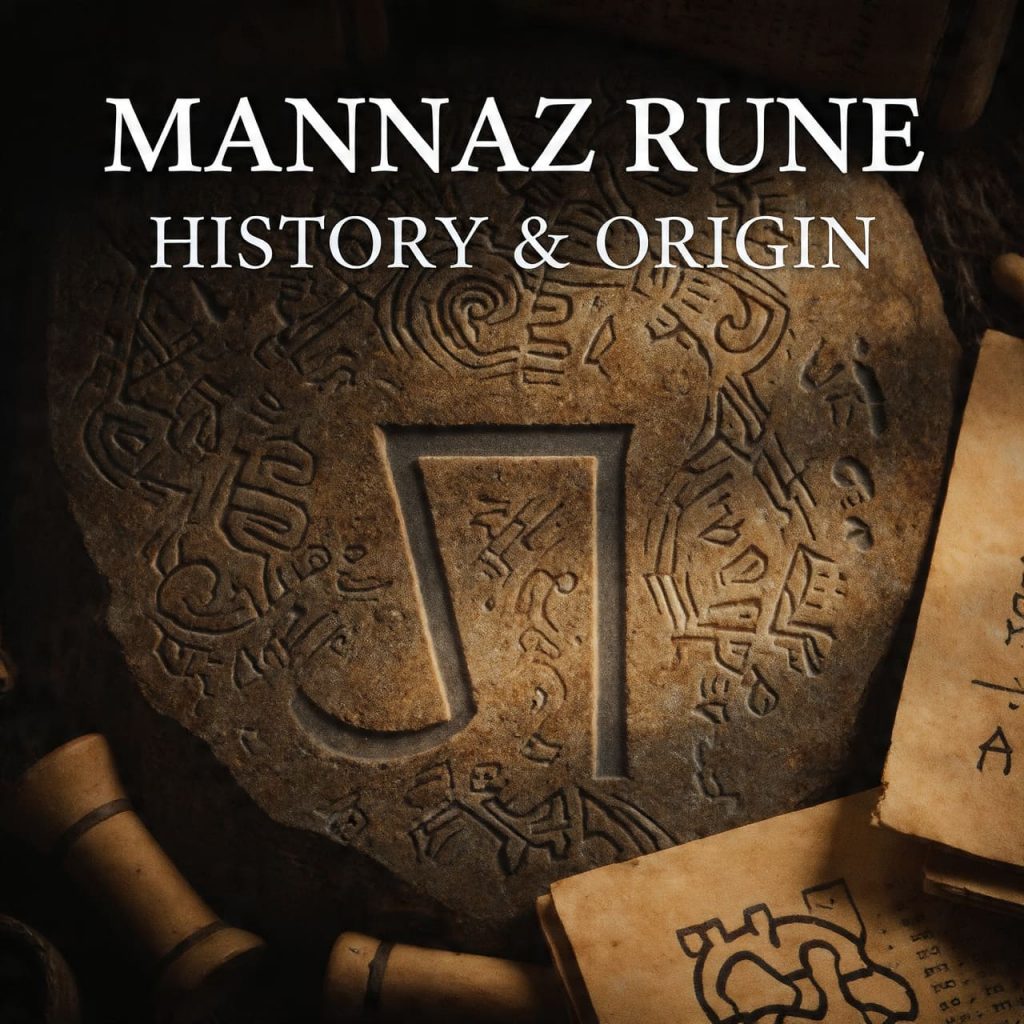
The history and origin of the Mannaz rune are frequently misunderstood because modern explanations often assume that its meaning and role were fully formed at the moment of its creation. Popular accounts tend to describe Mannaz as if it originated as a symbolic concept rather than as a functional element of a writing system. This assumption creates confusion between what can be historically demonstrated and what has been added through later interpretation.

💜 Need a clear answer right now?
CONSULT THE YES OR NO TAROT Free · No registration · Instant resultThe uncertainty surrounding Mannaz is factual, not interpretive. It concerns what can be established from archaeological finds, linguistic reconstruction, and early textual silence.
As emphasized in evidence-focused analytical frameworks such as those discussed on astroideal, historical claims must be limited to what surviving sources actually support. The central question addressed here is precise: what does the evidence show about the historical origin of the Mannaz rune?
What “Mannaz” Means as a Scholarly Term
“Mannaz” is not an ancient label preserved from the period when the rune was first used. It is a conventional name assigned by modern scholars based on later medieval rune poems and comparative linguistic analysis. These poems, recorded centuries after the Elder Futhark period, associate rune characters with vernacular words, allowing linguists to reconstruct likely names.
Historically, the rune itself functioned as a grapheme within a writing system. Its association with a Proto-Germanic term meaning “human” reflects linguistic reconstruction, not primary evidence from the rune’s origin period. Researchers trained as qualified professionals in runology consistently distinguish between reconstructed terminology and attested historical usage, treating only the latter as evidence for origin.
Emergence of the Elder Futhark
The Mannaz rune originated as part of the Elder Futhark, the earliest known runic alphabet. Archaeological dating places the emergence of this script between the late first and early second centuries CE. The earliest runic inscriptions coincide geographically and chronologically with increased interaction between Germanic-speaking groups and the Roman world.
Most scholars interpret the Elder Futhark as an adaptation of Mediterranean alphabetic models, particularly North Italic or Latin scripts. Mannaz fits this pattern. Its basic form can be explained as a modification suitable for carving straight lines into hard materials such as metal and stone. The origin of Mannaz is therefore inseparable from the origin of the runic writing system itself, not from any independently attested symbolic or conceptual framework.
Archaeological Evidence From Early Inscriptions
The strongest evidence for the origin of Mannaz comes from early inscriptions found on datable objects. These include spearheads, brooches, bracteates, and tools recovered from secure archaeological contexts. Notable early inscriptions containing Elder Futhark runes date to approximately the second and third centuries CE.
In these inscriptions, Mannaz appears embedded within personal names or short lexical sequences. It is never isolated or marked as a special sign. Its use is consistent with phonetic writing rather than emblematic display. This pattern holds across multiple regions, supporting the conclusion that Mannaz originated as a functional letter. Interpretive expectations sometimes applied in modern symbolic systems—similar to those seen in online tarot sessions—have no parallel in the archaeological record.
Geographic Spread and Standardization
Early Elder Futhark inscriptions are distributed across Scandinavia and parts of continental Europe. The appearance of Mannaz across this wide area suggests shared adoption of a standardized alphabet rather than localized invention.
While minor regional variations in form exist, these differences align with material constraints and carving traditions rather than divergent origins. The underlying structure of the rune remains recognizable. This pattern supports the conclusion that Mannaz originated as one element of a coherent script, not as a culturally specific symbol whose meaning varied independently by region.
Absence of Contemporary Textual Accounts
No contemporary written sources describe the creation, introduction, or conceptual meaning of the Mannaz rune. This absence is significant. Where ancient societies documented origins—such as laws, dynasties, or religious practices—they typically did so explicitly.
Later medieval texts mentioning runes were written centuries after the Elder Futhark had fallen out of use. These sources reflect retrospective interpretation rather than original conditions. Treating them as evidence for origin risks the same methodological error seen when modern explanatory systems, including video readings, are mistaken for ancient practices.
When Symbolic Origin Narratives Appeared
Narratives describing Mannaz as originating with a defined symbolic meaning appear primarily in modern literature from the nineteenth and twentieth centuries. These works sought to systematize runes into coherent conceptual frameworks, often influenced by contemporary intellectual trends rather than archaeological discovery.
Such narratives prioritize accessibility and internal coherence. Their structure resembles other modern interpretive formats, including phone readings and broader predictive systems like horoscope insights. Historically, however, these frameworks postdate the rune by more than a millennium and cannot be used to explain its origin.
Evaluating the Core Claim About Origin
The core claim implicit in discussions of “Mannaz rune history origin” is that the rune began as something more than a letter—often as a symbolic or conceptual marker. Evaluating this claim requires weighing archaeological, linguistic, and comparative evidence together.
That evidence supports a limited but firm conclusion. Mannaz originated as one character within the Elder Futhark, developed during the early centuries CE as part of the adoption of alphabetic writing by Germanic-speaking communities. Its form reflects practical adaptation from Mediterranean scripts, and its function is consistently linguistic. There is no evidence that it originated as an independent symbol or concept. As emphasized in evidence-first evaluations such as those referenced on astroideal, historical conclusions must be bounded by what sources can demonstrate. Comparisons to modern symbolic systems, including love tarot readings, highlight how far later interpretations diverge from documented origins.
Frequently Asked Questions
When did the Mannaz rune first appear?
It appears in the early centuries CE with the emergence of the Elder Futhark.
Is the name “Mannaz” ancient?
No, it is a reconstructed scholarly name based on later sources.
Did Mannaz originate independently of the alphabet?
No, it originated as part of a complete writing system.
Was Mannaz symbolic at its origin?
Evidence shows it functioned as a phonetic letter.
Are there texts describing its creation?
No contemporary texts describe the rune’s origin.
Is there scholarly agreement on this?
Yes, mainstream runology agrees on its alphabetic origin.
Call to Action
Claims about historical origins require careful separation of evidence from later interpretation. Readers are encouraged to examine archaeological finds and linguistic reconstructions directly to get a clear yes or no answer about what can genuinely be known regarding the origin of the Mannaz rune.
