

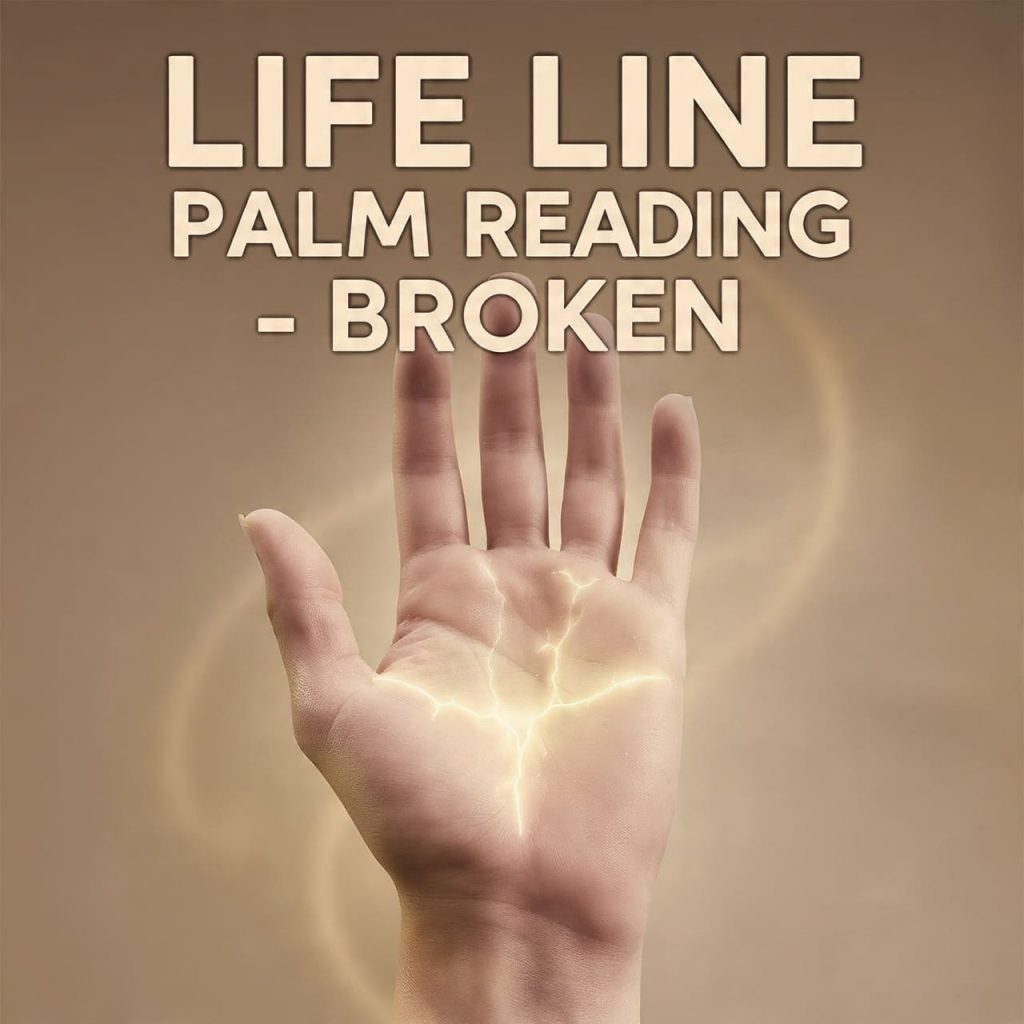
The claim that a “broken” life line in palm reading carries a specific and reliable meaning is widely repeated in modern palmistry, yet it is rarely tested against historical documentation or empirical evidence. Contemporary explanations often treat interruptions in the life line as inherently significant without clarifying when this assumption emerged or whether it was ever consistently defined.

💜 Need a clear answer right now?
CONSULT THE YES OR NO TAROT Free · No registration · Instant resultThis repetition has allowed assertion to replace verification. On platforms such as astroideal, broken life line interpretations are frequently presented as established concepts, despite unresolved questions regarding their historical and factual basis.
This article examines one narrowly defined question: whether there is credible historical or empirical evidence that a broken life line had a recognized, consistent meaning in palmistry. The analysis is strictly evaluative, avoids instruction or application, and aims to reach a clear yes-or-no conclusion based on available evidence.
Defining “Broken” in the Context of the Life Line
Describing a life line as “broken” presupposes agreement on what constitutes a meaningful interruption rather than a natural variation in palmar creases. Early palmistry texts do not provide standardized terminology or criteria for identifying breaks.
Without agreed definitions, the concept of a broken life line cannot be stabilized historically. What one observer might describe as a break could be understood by another as normal segmentation. Modern attempts to formalize this distinction reflect later analytical systems promoted by qualified professionals rather than terminology preserved in early palmistry literature.
Treatment of Line Interruptions in Early Palmistry Sources
Early palmistry manuscripts emphasize the presence and general placement of lines, not their continuity. Where irregularities appear, they are recorded descriptively and without interpretive emphasis.
No surviving historical source assigns a distinct meaning to interruptions in a line corresponding to the modern life line. Breaks are not categorized or highlighted as analytical markers. This absence suggests that later interpretations of broken life lines are additions rather than refinements of early doctrine. Such retroactive structuring mirrors thematic approaches later seen in horoscope insights rather than original palmistry practice.
Manuscript and Visual Evidence Review
Illustrated palmistry manuscripts are sometimes cited as visual support for broken line interpretations. However, these images are schematic and symbolic rather than anatomical records. Line continuity varies widely across illustrations, often for compositional or artistic reasons.
No illustration is accompanied by text explaining that a break in the life line carries specific significance. The inconsistency of depiction undermines claims of standardized interpretation. Modern diagrams emphasizing clean breaks rely on uniform templates developed much later, comparable in presentation style to online tarot sessions.
Emergence of Broken Life Line Interpretations in Modern Sources
The idea that a broken life line has a defined meaning appears primarily in nineteenth- and twentieth-century palmistry books written for popular audiences. During this period, authors sought to systematize palm reading by introducing visually distinct features such as gaps or interruptions.
Interpretations of broken life lines vary substantially between authors, with no agreement on what constitutes a break or why it should matter. This inconsistency indicates that the concept was constructed for explanatory clarity rather than inherited from tradition. The approach parallels modern interpretive formats such as video readings, which prioritize visual distinction over historical continuity.
Scientific Perspective on Broken Life Lines
From a scientific standpoint, interruptions in palmar creases reflect normal anatomical variation. Flexion creases develop during fetal growth and may appear segmented due to skin texture, movement, or aging.
Research in dermatoglyphics does not associate broken or segmented creases with psychological, physiological, or experiential traits. No peer-reviewed studies identify a broken life line as meaningful beyond natural variation. Claims suggesting otherwise lack empirical grounding despite their circulation through reliable readers.
Evaluation of the Core Claim
The core claim is that a broken life line possesses a historically grounded or empirically supported meaning in palm reading. Examination of historical texts reveals no standardized definition or interpretation of broken life lines. Manuscript and visual evidence do not support interruption-based analysis, and scientific research provides no validation.
Interpretations of broken life lines can be traced to modern popular palmistry rather than documented tradition. Even within contemporary platforms such as astroideal, such claims resemble recent interpretive constructs comparable to love tarot readings rather than historically verified practices.
Final evaluation: the claim is not supported by reliable historical or empirical evidence.
Frequently Asked Questions
What is meant by a broken life line?
It refers to a modern description of a life line that appears interrupted or segmented.
Do historical texts define broken life lines?
No historical palmistry texts provide standardized definitions of line breaks.
Is there archaeological evidence supporting broken life line interpretations?
No archaeological or artistic evidence supports interruption-based meanings.
When did broken life line interpretations appear?
They appeared mainly in modern palmistry literature from the nineteenth century onward.
Has science validated claims about broken life lines?
No scientific studies support symbolic interpretations of line breaks.
Are modern explanations historically consistent?
No, they vary widely and lack documented continuity.
Conclusion
After reviewing historical literature, manuscript evidence, and scientific research, the conclusion is definitive: No, there is no credible historical or empirical evidence that a broken life line has an established or authoritative meaning in palm reading. The concept is a modern interpretive construction rather than a documented tradition.
Readers seeking to get a clear yes or no answer should evaluate such claims by examining their historical origin, consistency across sources, and empirical support rather than their repetition or popularity.
