
life line palm reading
In this article
This guide describes symbolic palmistry traditions. Palm lines do not diagnose health or predict lifespan or income. It does not provide an AI analyser or photo upload.
Life line palm reading is one of the most recognized and frequently discussed aspects of palmistry. The life line often draws attention because of widespread myths suggesting it predicts lifespan. Practitioners, however, consistently clarify that this belief is inaccurate. In palmistry, the life line is interpreted as a reflection of vitality, resilience, and how a person experiences change, not how long they will live.
Many believe the life line offers insight into energy levels, adaptability, and personal rhythm throughout life. When read responsibly and in context, it can support self-awareness rather than fear or certainty. Understanding what the life line actually represents is essential for anyone interested in palm reading.
This article provides a comprehensive, informative guide to life line palm reading. It explains where the life line is located, what it traditionally symbolizes, how it is interpreted alongside other palm features, common misconceptions, and how to approach life line readings in a balanced, ethical way.
What Is the Life Line in Palmistry?
Location and identification of the life line
The life line begins between the thumb and index finger and curves around the base of the thumb toward the wrist. It is usually one of the most visible lines on the palm, which contributes to its popularity and frequent misinterpretation.
Accurate identification is important. The life line should not be confused with nearby creases or secondary lines that may appear due to hand movement.
Why it is called the life line
Historically, the line was associated with life force and physical vitality, which led to its name. Over time, this association evolved into the incorrect belief that it predicts lifespan.
Modern palmistry emphasizes that the name reflects energy and experience, not duration of life.
Reflective, not predictive meaning
Practitioners stress that the life line is reflective. It symbolizes how a person engages with life, responds to stress, and manages physical and emotional energy over time.
What the Life Line Represents
Vitality and energy patterns
In palmistry, the life line is often associated with vitality rather than health outcomes. A clear, continuous line is commonly interpreted as steady energy, while variations may suggest shifts in lifestyle or priorities.
These interpretations remain symbolic and contextual.
Response to change and challenge
The life line is also read for how a person responds to change. Branches, curves, or variations are often interpreted as periods of adaptation, learning, or transition rather than disruption.
This perspective helps frame the line as a record of experience rather than fate.
Relationship with environment and lifestyle
Some practitioners view the life line as reflecting how a person interacts with their environment. Lifestyle choices, habits, and stress levels are often discussed in relation to the life line’s appearance.
How to Read the Life Line Step by Step
Observing length without assumptions
Length is often misunderstood. A long life line does not mean a long life, and a short one does not mean a short life. Practitioners suggest length reflects how energy is expressed rather than quantity of years.
Observation should focus on clarity and flow instead of measurement.
Depth and clarity of the line
A deeper, well-defined life line is often associated with strong focus and consistency, while a lighter line may suggest flexibility or sensitivity. Neither interpretation is inherently positive or negative.
Depth is read alongside other palm features for balance.
Curves and spacing
The curve of the life line may reflect openness to experience. A wide curve is often associated with enthusiasm and engagement, while a closer curve may suggest introspection or caution.
These tendencies are symbolic rather than deterministic.
Variations and Markings on the Life Line
Breaks in the life line
Breaks are among the most misunderstood features. Practitioners generally interpret breaks as periods of transition or change rather than loss or danger.
Context is essential. Supporting lines often soften or clarify meaning.
Branches and forks
Branches extending outward from the life line are sometimes associated with expansion, exploration, or new directions. Inward branches may reflect periods of consolidation or focus.
These interpretations emphasize growth rather than disruption.
Parallel or “sister” lines
Some palms show a parallel line running alongside the life line. This is sometimes interpreted as additional support, resilience, or protection, though interpretations vary.
Practitioners caution against exaggerating meaning without full context.
The Life Line and Other Palm Features
Relationship with the head line
The connection between the life line and head line is often examined. When they start together, it may suggest cautious beginnings or thoughtful decision-making. When separated, it may indicate independence.
Neither pattern is considered better; each reflects different approaches.
Relationship with the heart line
Although the heart line is separate, its interaction with the life line can provide emotional context. Balanced spacing may reflect harmony between emotional and physical energy.
Some people explore emotional themes through palmistry alongside love tarot readings for broader symbolic reflection.
Influence of the Venus mount
The Venus mount, located inside the curve of the life line, is associated with affection, warmth, and vitality. A well-developed Venus mount often supports interpretations of strong life energy.
Palmistry looks for harmony between the life line and surrounding features.
Common Misconceptions About the Life Line
“The life line predicts lifespan”
This is the most persistent myth. Practitioners consistently reject this idea, emphasizing that palmistry does not predict death or longevity.
Understanding this prevents unnecessary fear or anxiety.
“A broken life line means danger”
Breaks are symbolic of change, not danger. Many experienced readers see breaks as indicators of transformation or new phases.
Context always determines meaning.
“One feature tells the whole story”
Palmistry does not rely on a single line. The life line must be read alongside the entire hand for accurate reflection.
Free Life Line Palm Readings
What free readings usually include
Free life line readings often focus on identifying the line and explaining general symbolism. These readings are typically introductory and educational.
Even qualified professionals may offer free explanations to help people understand palmistry fundamentals.
Benefits of free life line readings
Free readings allow people to learn without pressure. They help clarify misconceptions and introduce symbolic interpretation.
They are best used as learning tools rather than definitive assessments.
Limitations of free formats
Without dialogue and full hand observation, free readings remain general. Practitioners suggest treating them as starting points.
Digital and Remote Life Line Readings
Online palm reading platforms
Many people explore life line palm reading through online tarot sessions that also include palmistry features. These platforms often provide diagrams and explanations.
Digital access increases accessibility but requires thoughtful interpretation.
Video-based palm reading guidance
Visual learners often benefit from video readings that demonstrate how to locate and interpret the life line accurately.
Seeing examples helps reduce misidentification.
Phone-based palm reading formats
Some prefer phone readings, where palm features are described verbally. This approach emphasizes understanding symbolism rather than relying solely on visuals.
Life Line Readings and Emotional Responsibility
Avoiding fear-based interpretation
Fear-based interpretation undermines palmistry’s purpose. Practitioners emphasize calm, balanced explanation, especially with sensitive lines like the life line.
Responsible reading supports awareness, not anxiety.
Focus on vitality, not outcomes
Life line readings are most useful when focused on vitality, balance, and adaptation rather than outcomes beyond personal control.
This keeps interpretation constructive.
Ethical boundaries in palm reading
Ethical palmistry avoids absolute claims. Many people prefer guidance from reliable readers who communicate clearly and responsibly.
Integrating Life Line Reading With Other Practices
Palmistry and tarot
Palmistry reflects personal tendencies, while tarot explores situational dynamics. Combining the two can offer complementary insight without overreliance on either system.
Each practice serves a different reflective role.
Palmistry and astrology
Astrology examines cycles and timing, while palmistry reflects lived experience. Some people integrate life line readings with horoscope insights to explore broader life themes alongside personal energy.
Comparison overview table
| Practice | Focus | Method | Insight Type |
|---|---|---|---|
| Life line palmistry | Vitality and adaptation | Hand observation | Personal patterns |
| Tarot | Situational context | Symbolic cards | Reflective insight |
| Astrology | Cycles and timing | Birth data | Pattern awareness |
Preparing for a Life Line Palm Reading
Framing thoughtful intentions
Although palm reading is observational, intention guides interpretation. Reflecting on what you want to understand about energy or balance helps focus attention.
Using strategies explained in palm reading for clearer questions can support meaningful exploration during a life line reading.
Choosing which hand to read
Many practitioners read the dominant hand for current energy patterns and the non-dominant hand for inherited tendencies. Both perspectives add depth.
Creating a calm mindset
Life line readings benefit from patience and calm reflection. Rushed interpretation often leads to misunderstanding.
Learning From the Life Line Over Time
Observing gradual changes
Palm lines can change subtly. Observing the life line over time may reflect shifts in lifestyle, priorities, or stress management.
This reinforces palmistry’s focus on development rather than destiny.
Combining study with experience
Studying palmistry concepts alongside personal experience deepens understanding. Journaling observations can help identify patterns.
Using strategies explained in palm reading for clearer questions can further support learning by aligning observation with intention.
Expanding beyond free resources
As interest grows, many people explore books or guided sessions for deeper study of palmistry.
Frequently Asked Questions
Does the life line show how long I will live?
No. It reflects vitality and life experience, not lifespan.
Can the life line change over time?
Yes, it can change subtly as experiences and priorities shift.
Is a short life line bad?
No. Length does not indicate negative outcomes.
Do breaks in the life line mean danger?
They are usually interpreted as transitions or changes.
Which hand should be read?
Most practitioners read both hands for balance.
Are life line readings accurate?
Accuracy is subjective and often measured by relevance rather than prediction.
How often should the life line be read?
Occasionally, with time for reflection between readings.
Conclusion
Life line palm reading is one of the most symbolic and misunderstood aspects of palmistry. When interpreted responsibly, it offers insight into vitality, resilience, and how a person navigates change rather than predicting lifespan or fate. Its value lies in reflection, not certainty.
By understanding what the life line truly represents, recognizing common misconceptions, and reading it in context with the whole hand, individuals can engage with palmistry in a balanced way. Life line readings, when approached thoughtfully, support self-awareness and personal growth rather than fear or fixed conclusions.
¿Prefieres una lectura personal?
Compara profesionales, disponibilidad y tarifas de teléfono, chat o vídeo. Con la primera recarga de al menos 20 € recibes 10 € adicionales, según las condiciones de tu cuenta.
Por teléfono puedes informarte sobre cómo consultar. El chat y la videollamada se abren desde tu cuenta: créala gratis y recibe 10 € adicionales con tu primera recarga de al menos 20 €, o entra si ya la tienes.
Read next
Espiritualidad
Free palm reading online: a diagram and guide to your hand
Read your own palm with a labelled diagram, photo tips and specific explanations of heart, life, marriage and other lines. A manual guide with clear limits.
Espiritualidad
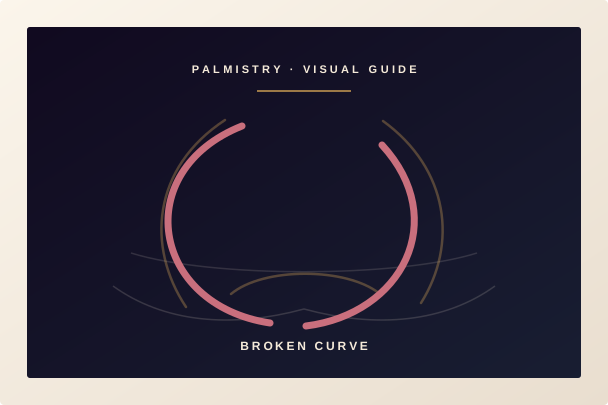
life line palm reading broken
life line palm reading broken. Symbolic meanings, examples and questions to explore.
Espiritualidad
life line palm reading forked
life line palm reading forked. Symbolic meanings, examples and questions to explore.