

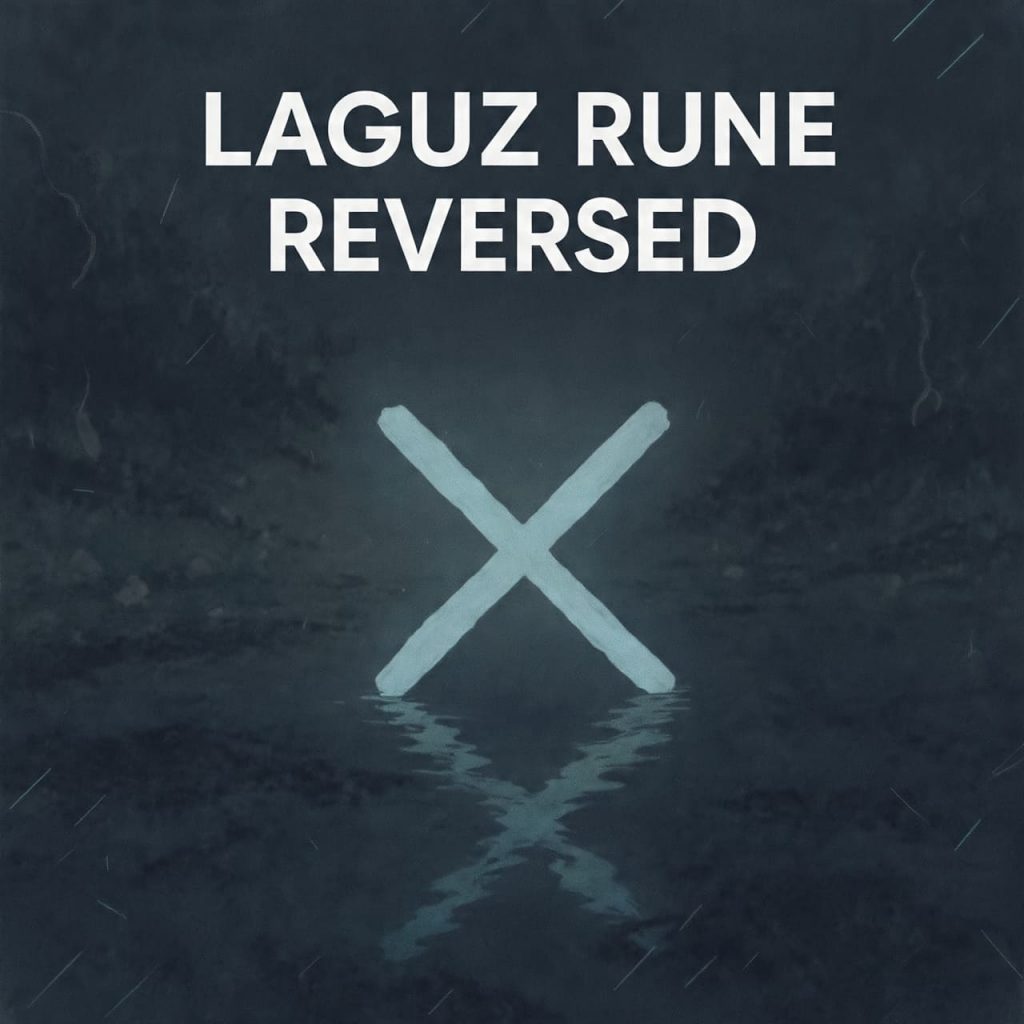
The concept of a “Laguz rune reversed” is widely presented in modern explanations as if runes were historically designed to be interpreted differently when inverted. This assumption is rarely examined critically. Instead, reversal is often treated as an inherent feature of rune interpretation, borrowed implicitly from later symbolic systems.

💜 Need a clear answer right now?
CONSULT THE YES OR NO TAROT Free · No registration · Instant resultThe uncertainty here is factual and historical. It concerns whether any surviving evidence demonstrates that early users of the Laguz rune recognized, recorded, or interpreted a reversed form as meaningful.
Scholarly inquiry by qualified professionals emphasizes that such claims must be evaluated through inscriptional practice, archaeological context, and early textual silence. Evidence-first approaches, including those discussed on astroideal, require asking a precise question: did the concept of a “reversed” Laguz rune exist historically?
What “Reversed” Means in a Historical Context
In modern symbolic systems, “reversed” typically refers to an intentional inversion that alters meaning. Historically, however, this concept presupposes three conditions: a standardized upright orientation, a shared interpretive framework, and explicit acknowledgment that inversion changes meaning.
For early runic writing, none of these conditions are demonstrably present. Runes were carved onto objects without consistent orientation conventions. Stones, weapons, and tools could be rotated depending on use or display. Without a fixed reference orientation, the idea of reversal lacks historical grounding. Treating reversal as meaningful therefore risks projecting later interpretive habits onto earlier material, similar to assumptions sometimes made in systems relying on interpretive authority such as reliable readers.
Historical Function of the Laguz Rune
Laguz is the reconstructed scholarly name for a rune of the Elder Futhark, used approximately between the second and eighth centuries CE. The rune functioned as a grapheme representing a liquid consonant sound within words. Its reconstructed association with water derives from later medieval rune poems and comparative linguistics, not from contemporaneous explanation.
In inscriptions, Laguz appears consistently within names or short lexical sequences. It is not isolated, marked, or distinguished as a conceptual sign. There is no indication that its orientation carried semantic weight. Historically, its function is best understood as phonetic rather than interpretive. Claims that orientation altered meaning are therefore unsupported by primary evidence.
Archaeological Evidence and Orientation
Archaeological material provides direct insight into how runes were carved and viewed. Inscriptions containing Laguz appear on stone, metal, wood, and bone. These objects often lack a clear “top” or “bottom,” and their orientation can vary depending on how the object was positioned.
Importantly, inscriptions sometimes appear upside down or sideways relative to modern expectations, yet scholars do not interpret these as intentional reversals. Instead, they are understood as practical outcomes of carving conditions. If reversal had been meaningful, archaeologists would expect consistent patterns or contextual markers indicating intentional inversion. No such patterns exist. Expectations of interpretive orientation resemble modern frameworks such as online tarot sessions rather than historically documented practice.
Absence of Textual Support for Reversal
In cultures where reversed symbols carried meaning, written explanations typically survive. Procedural texts, instructional manuals, or standardized interpretive formulas often accompany such systems.
No early texts describe rune reversal. Medieval manuscripts that mention runes do not discuss orientation-based meaning. Even later rune poems, which ascribe qualities to runes, do not distinguish between upright and inverted forms. This silence is consistent across sources and regions. It suggests that reversal was not a recognized category in historical rune use.
Variability in Rune Forms and Why It Matters
Runic inscriptions show variation in form across regions and periods. Lines may be longer or shorter, angles sharper or more rounded. These variations reflect carving technique, material constraints, and local tradition.
Crucially, this variability is not accompanied by interpretive differentiation. Different forms are not explained as having different meanings. If reversal mattered, it would likely appear alongside other formal distinctions. Instead, recognition depended on general shape, not precise orientation. Attempts to impose reversed meanings flatten this historical variability in a manner similar to generalized interpretive systems such as video readings.
Emergence of Reversed Rune Interpretations
The idea of reversed runes appears in modern literature, particularly in the twentieth century. Authors adapting runes into symbolic or divinatory systems borrowed structural elements from other interpretive traditions, where reversal plays a defined role.
These modern systems often present reversal as ancient, but their development can be traced through recent publications. Their structure closely resembles interpretive formats designed for regular consultation, such as phone readings. Historically, however, these frameworks postdate the Elder Futhark by more than a millennium and do not reflect documented runic practice.
Evaluating the Core Claim With Evidence
The core claim implied by “Laguz rune reversed” is that historical rune users recognized and interpreted an inverted Laguz as distinct in meaning. Evaluating this claim requires synthesizing archaeological, inscriptional, and textual evidence.
Archaeology shows no orientation-based interpretation. Inscriptions demonstrate functional writing without conceptual inversion. Textual sources are silent on reversal. Modern reversed meanings can be traced to recent interpretive systems rather than ancient transmission. As emphasized in evidence-based discussions such as those on astroideal, historical evaluation must remain bounded by what sources demonstrate. Comparisons to modern symbolic practices, including love tarot readings and popular horoscope insights, highlight how reversal operates in modern systems but underscore its absence in historical rune use.
The evidence therefore supports a clear conclusion: there is no historical basis for interpreting a reversed Laguz rune as meaningful.
Frequently Asked Questions
Did ancient sources mention reversed runes?
No surviving sources describe rune reversal.
Was orientation important in rune carving?
Orientation varied and was not used interpretively.
Do inscriptions show intentional inversion?
No patterns indicate meaningful inversion.
When did reversed meanings appear?
They appeared in modern symbolic literature.
Are reversed runes accepted in scholarship?
No, mainstream runology rejects the concept.
Is Laguz unique in this respect?
No, no runes show historical reversal meaning.
Call to Action
Historical claims must be tested against material and textual evidence. Readers are encouraged to examine inscriptional records and scholarly analyses directly to get a clear yes or no answer on whether the concept of a reversed Laguz rune has any historical foundation.
