

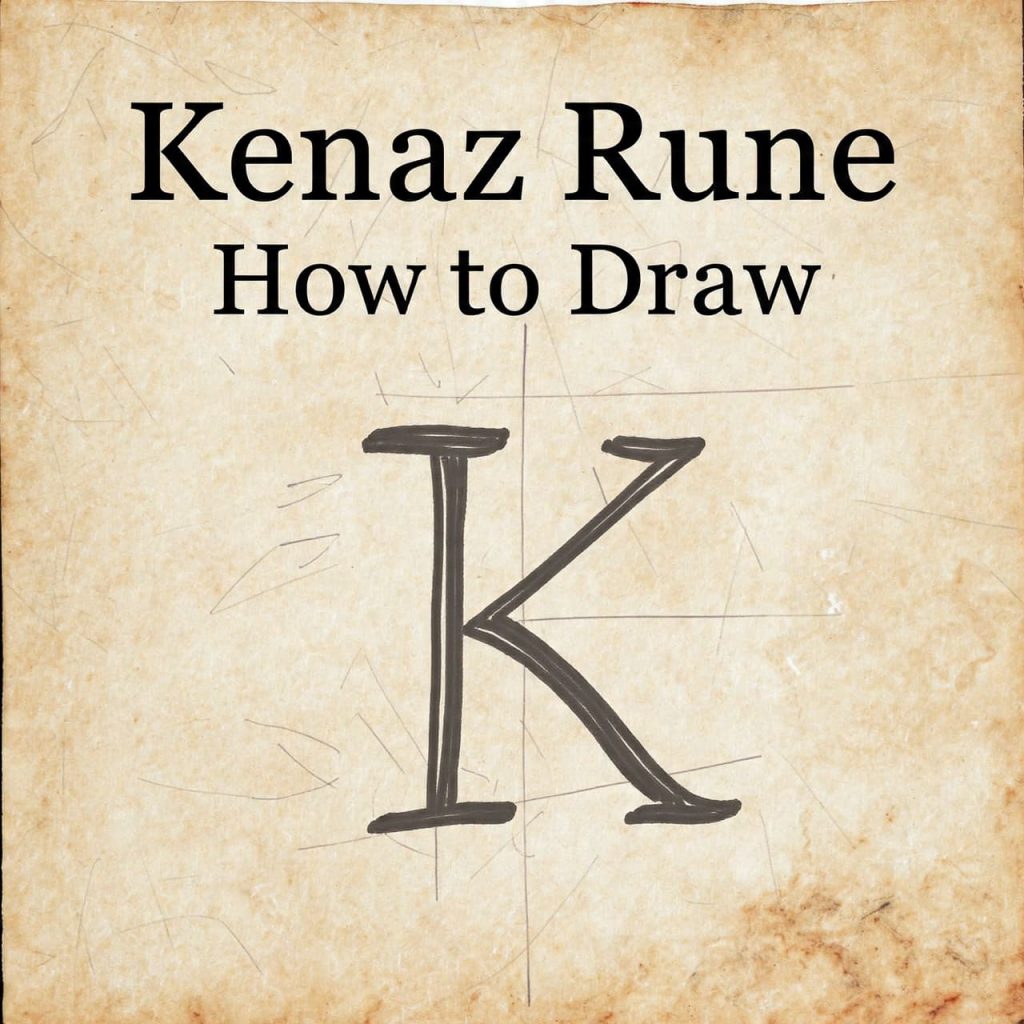
The question of how to draw the Kenaz rune is often presented as if there were a single correct or traditional method passed down unchanged from ancient times. Many modern guides show a standardized shape and describe it as historically accurate without explaining how that conclusion was reached. This creates uncertainty for readers who want to know whether the way Kenaz is commonly drawn today reflects historical practice or modern convention. The issue is not artistic preference; it is evidentiary.

💜 Need a clear answer right now?
CONSULT THE YES OR NO TAROT Free · No registration · Instant resultUnderstanding how Kenaz was drawn requires examining inscriptions, materials, and writing practices rather than relying on instructional tradition.
When evaluated using evidence-first analytical standards such as those emphasized by astroideal, the question becomes clearer, particularly when historical boundaries are maintained by qualified professionals rather than simplified for instructional convenience.
What “How to Draw” Means Historically
Before assessing how to draw Kenaz, it is important to define what “drawing” meant in historical context. In early runic cultures, runes were not drawn in the modern sense. They were carved, incised, or etched into hard surfaces such as stone, wood, bone, and metal.
This distinction matters. Carving imposes structural constraints that influence shape, angle, and line direction. Smooth curves were difficult to produce, so straight lines and angular forms dominated runic writing.
Therefore, any discussion of how Kenaz was drawn must focus on carving practices and inscriptional evidence, not modern pen-and-paper reproduction.
Historical Origin of the Kenaz Rune
Kenaz originates from the Elder Futhark, the earliest known runic alphabet, used approximately between the 2nd and 8th centuries CE. The Elder Futhark consists of 24 runes, each functioning as a phonetic character within a writing system.
Kenaz appears as the sixth rune in this sequence. Its form is derived from earlier Mediterranean alphabets, particularly Latin and North Italic scripts. This lineage confirms that Kenaz was designed to represent a sound, not to serve as a decorative or symbolic image.
Understanding this origin is essential when evaluating how the rune was rendered visually.
The Basic Structural Form of Kenaz
In surviving inscriptions, Kenaz generally appears as an angular form resembling an open angle or less-than sign, often described as a vertical line with two diagonal strokes extending from one side.
However, this description should not be mistaken for a fixed template. The exact proportions, angles, and orientation vary depending on material, available space, and the carver’s technique.
The consistent feature is angular construction. Curved versions of Kenaz are modern stylizations rather than historically supported forms.
Variations Across Inscriptions
Runic inscriptions demonstrate variation rather than uniformity. Kenaz may appear slightly wider, narrower, taller, or shorter depending on context. In some cases, the vertical line is emphasized; in others, the diagonal strokes are more pronounced.
These variations indicate that there was no single authoritative “correct” way to draw Kenaz. The goal was legibility within the inscription, not adherence to a standardized diagram.
This variability is a crucial point often overlooked in modern guides.
Materials and Their Influence on Shape
The medium strongly influenced how Kenaz was rendered. On stone, deeper and straighter cuts were preferred. On wood, grain direction affected stroke placement. On metal, finer lines were possible.
These practical factors explain why Kenaz does not appear identically across artifacts. Drawing methods adapted to material constraints, reinforcing that form followed function.
Any claim of a universally correct drawn shape ignores this material reality.
Linguistic Function Over Visual Precision
Kenaz’s primary function was linguistic. It represented a sound, not an image to be contemplated or stylized. As long as the rune was recognizable within the writing system, minor visual differences were acceptable.
This principle explains why inscriptions tolerate variation. Visual precision mattered less than phonetic clarity.
This evidence-based understanding is consistently emphasized by reliable readers who prioritize inscriptional context over modern diagrammatic uniformity.
When Standardized Drawing Guides Appeared
Standardized diagrams of runes, including Kenaz, emerged in the modern era. As runes ceased to function as everyday writing tools, they were reproduced in books, charts, and educational materials.
To aid teaching, simplified and regularized forms were created. These forms are useful for learning but should not be confused with historical standards.
This process mirrors how symbolic systems are regularized in love tarot readings, where consistency is prioritized for clarity rather than historical variation.
Kenaz in Modern Drawing Instructions
Modern instructions on how to draw Kenaz often present a step-by-step process. While helpful for beginners, these instructions reflect pedagogical choice, not archaeological reconstruction.
They assume pen-and-paper drawing rather than carving, and they impose uniform proportions that were not enforced historically.
Understanding this difference helps readers distinguish between educational convenience and historical evidence.
Evaluating Claims of Correctness
The key historical question is: Is there a single, historically correct way to draw the Kenaz rune?
To answer yes, evidence would need to show consistent, standardized form across regions and centuries. Such evidence does not exist. Inscriptions show recognizable similarity but not strict uniformity.
Therefore, the historically accurate answer is no. There was no single correct drawing method, only recognizable variation within a functional range.
This evaluative approach aligns with the clarity encouraged in online tarot sessions, where limits of historical certainty are clearly stated.
Drawing Versus Interpreting
A common source of confusion is conflating drawing with interpretation. Modern symbolic systems often suggest that the way a rune is drawn affects its meaning.
Historically, there is no evidence that slight variations in drawing altered meaning. As long as Kenaz was legible, its function remained unchanged.
Meaning resided in language, not stroke order or angle.
Learning Through Visual and Spoken Formats
Many people learn to draw Kenaz through visual tutorials or spoken explanations. Visual formats similar to video readings can demonstrate common modern representations, while spoken explanations resembling phone readings may provide historical background.
These formats support learning, but they do not establish historical authority.
Drawing Kenaz and Astrology-Based Systems
Some modern drawing guides combine rune forms with astrological symbolism. Historically, rune systems developed independently of astrology.
General horoscope insights may offer reflective frameworks, but they do not inform how runes were historically drawn. Combining these systems is a modern synthesis rather than an ancient practice.
Maintaining separation preserves accuracy.
Why Accuracy in Drawing Matters
Accuracy matters because drawing is often the first point of contact with runes. Misrepresenting standardized forms as ancient fact creates false confidence and obscures historical reality.
Clear distinction allows modern drawing practice to exist without claiming false lineage.
Respecting variation strengthens understanding rather than weakening it.
Frequently Asked Questions
Is there one correct way to draw Kenaz?
No. Historical evidence shows variation.
Were runes drawn or carved?
They were primarily carved or incised.
Do proportions matter historically?
Only for legibility, not symbolism.
Are modern diagrams wrong?
They are modern conventions, not ancient standards.
Can Kenaz be stylized?
Stylization is modern artistic choice.
Is scholarly consensus clear?
Yes. No fixed canonical form existed.
Call to Action
If you are deciding whether there is a historically correct way to draw the Kenaz rune, the evidence allows a clear conclusion. Distinguishing inscriptional reality from modern convention replaces assumption with clarity. If your aim is to get a clear yes or no answer grounded in archaeological and linguistic evidence rather than instructional tradition, examining carved inscriptions and material context provides the most reliable foundation for that decision.
