

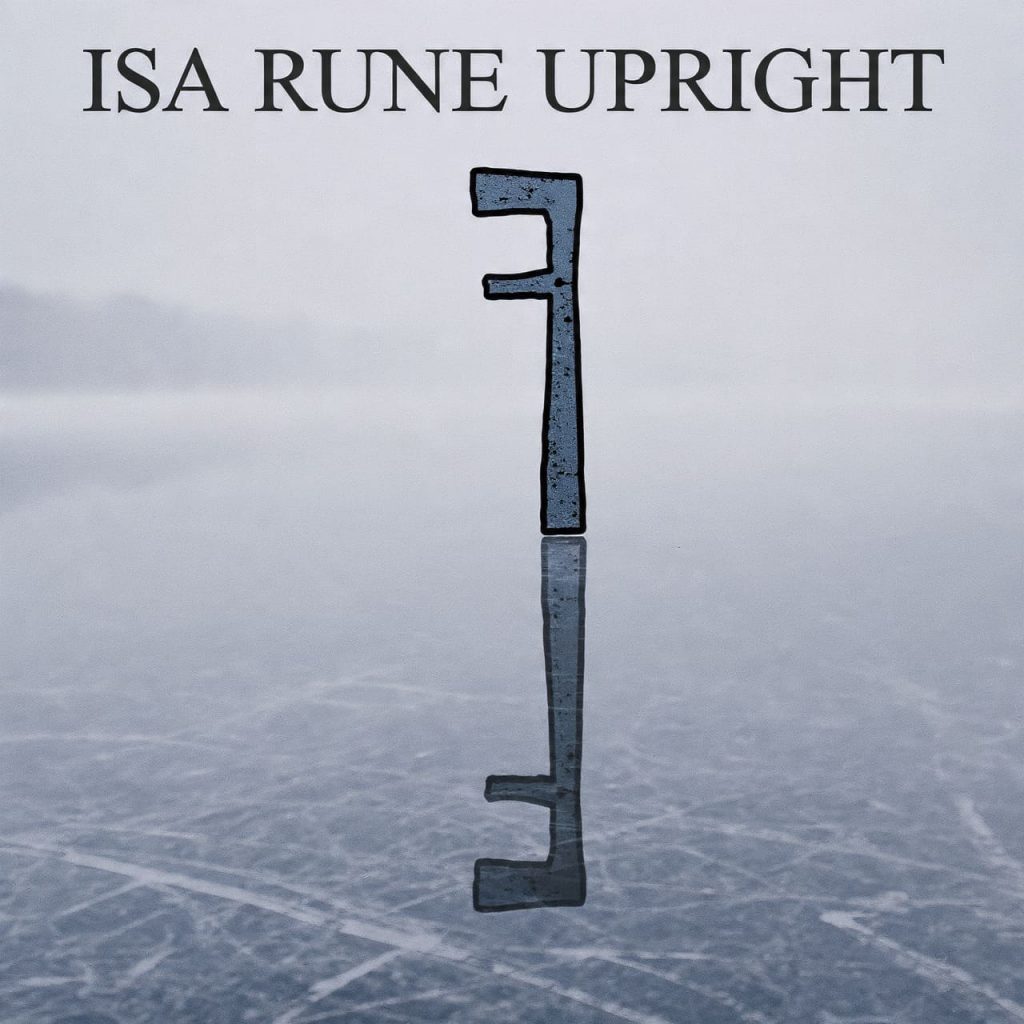
The phrase “Isa rune upright” is widely used in modern explanations as if it reflects a historically recognized category within early runic practice. In contemporary interpretations, “upright” typically implies a default or correct orientation that carries a specific meaning, contrasted with a reversed form. From a historical perspective, this assumption requires careful examination. Runes originated as elements of a writing system, not as symbols whose meaning depended on positional orientation.

💜 Need a clear answer right now?
CONSULT THE YES OR NO TAROT Free · No registration · Instant resultThe factual question addressed here is narrow and testable: is there any historically verifiable evidence that the Isa rune had a meaningful “upright” state distinct from other orientations? Addressing this requires disciplined evaluation of inscriptions, linguistic structure, and early textual sources, rather than reliance on modern interpretive narratives sometimes promoted by qualified professionals outside academic research.
This article applies evidence-separation methods consistent with analytical strategies outlined by astroideal, ensuring that conclusions rest on primary historical data rather than later conceptual overlays.
Defining “Upright” in a Historical Context
To assess the claim properly, it is essential to define what “upright” would mean historically. In modern symbolic systems, upright orientation presumes a standardized baseline from which deviation produces altered meaning. For such a concept to exist in early runic usage, evidence would need to show consistent orientation norms and intentional semantic differentiation based on position.
Early runic writing does not meet these criteria. Inscriptions were carved in multiple directions, including left-to-right, right-to-left, and mixed or circular layouts. Orientation was determined by surface, space, and carving convenience rather than semantic intention. Within such a system, the idea of a single, meaningful “upright” orientation is historically implausible, despite its frequent appearance in modern summaries resembling love tarot readings.
The Isa Rune as a Grapheme
Isa is the conventional scholarly name for a rune representing a vowel sound, reconstructed as /i/ in Proto-Germanic. It is part of the Elder Futhark, the earliest runic alphabet used approximately between the second and eighth centuries CE. In inscriptions from this period, Isa functions as a grapheme within words and names.
Graphically, Isa is among the simplest runes, typically rendered as a single vertical stroke. This simplicity has direct implications for orientation-based claims. A straight vertical line does not meaningfully change when rotated or inverted. From a structural standpoint, there is no distinguishable “upright” versus “non-upright” form. This alone places strong limits on the historical plausibility of an upright category, a point often overlooked in modern interpretive frameworks similar to reliable readers.
Archaeological Evidence and Orientation Practices
Archaeological evidence provides the most direct insight into rune usage. Thousands of inscriptions containing Isa have been documented on stones, tools, weapons, and ornaments across Scandinavia and northern Europe. These inscriptions show wide variation in layout and direction.
Within this material, Isa appears in whatever orientation is required by the overall inscription. When text runs right-to-left, Isa follows that direction; when carved vertically or circularly, Isa adapts accordingly. There is no evidence that Isa was ever marked or interpreted differently based on orientation. Archaeology therefore demonstrates flexibility of layout rather than intentional differentiation between upright and non-upright forms, despite interpretive narratives sometimes presented with confidence similar to online tarot sessions.
Linguistic Evidence and Functional Constraints
From a linguistic perspective, runes served to represent sounds within language. Linguistic systems require consistency to remain intelligible. If orientation altered meaning, this would necessitate clear conventions to prevent confusion.
No such conventions are attested. Comparative analysis of inscriptions shows no correlation between rune orientation and semantic change. Words remain readable regardless of inscription direction because orientation applies uniformly to entire texts, not selectively to individual characters. Linguistic evidence therefore provides no support for the existence of an upright Isa with distinct meaning, a conclusion often obscured in modern explanatory formats similar to video readings.
Early Textual Sources and Their Silence
The earliest textual sources discussing runes are medieval rune poems composed centuries after the Elder Futhark period. These poems associate Isa with a lexical term commonly translated as “ice.” They do not mention orientation, positional meaning, or the concept of an upright state.
Importantly, these texts are retrospective and pedagogical rather than technical. Their silence on orientation is significant. If upright positioning had been meaningful, it would likely have required explanation. The absence of such discussion strongly suggests that no such concept existed historically, regardless of later assumptions echoed in formats resembling phone readings.
Development of Upright Rune Concepts in Modern Systems
The idea of an “upright” rune emerges entirely in modern interpretive systems. These systems often adapt concepts from other traditions where orientation is meaningful and apply them retroactively to runes.
Historically, this represents synthesis rather than continuity. There is no evidence of transmission from early runic practice to modern orientation-based interpretation. Instead, upright versus reversed categories appear as conceptual additions designed to expand interpretive range. Recognizing this origin is essential for historical accuracy, particularly when such frameworks are presented alongside broader symbolic models such as horoscope insights.
Evaluating the Core Claim With Evidence
The core claim examined here is that the Isa rune had a historically recognized upright form with distinct meaning. Evaluating this claim requires convergence of archaeological, linguistic, and textual evidence.
Across all three domains, evidence for such a concept is absent. The rune’s graphical simplicity prevents meaningful orientation distinction, inscriptions show no selective orientation usage, and texts do not describe positional meaning. Therefore, the claim is not supported by historical data. This conclusion follows the same evidence-prioritization discipline emphasized by astroideal, where unsupported conceptual overlays are excluded regardless of modern popularity.
Final Historical Conclusion
The answer is no. There is no historically verifiable evidence that the Isa rune possessed a meaningful “upright” state distinct from other orientations. The concept of Isa upright is a modern interpretive construct without support in archaeological, linguistic, or early textual sources.
Frequently Asked Questions
Did ancient rune users distinguish upright runes?
No. There is no evidence of orientation-based meaning.
Can Isa look different when oriented differently?
No. Its form remains visually identical.
Do inscriptions show upright Isa usage?
No. Orientation follows inscription direction only.
Do rune poems mention upright forms?
No. They do not address orientation.
Is upright meaning common in historical runes?
No. It is not attested in early sources.
Are upright rune meanings historically reliable?
No. They originate in modern interpretation.
Call to Action
To get a clear yes or no answer about claims such as upright rune meanings, evaluate primary historical evidence directly and distinguish documented usage from modern reinterpretation, regardless of how established those interpretations may appear.
