

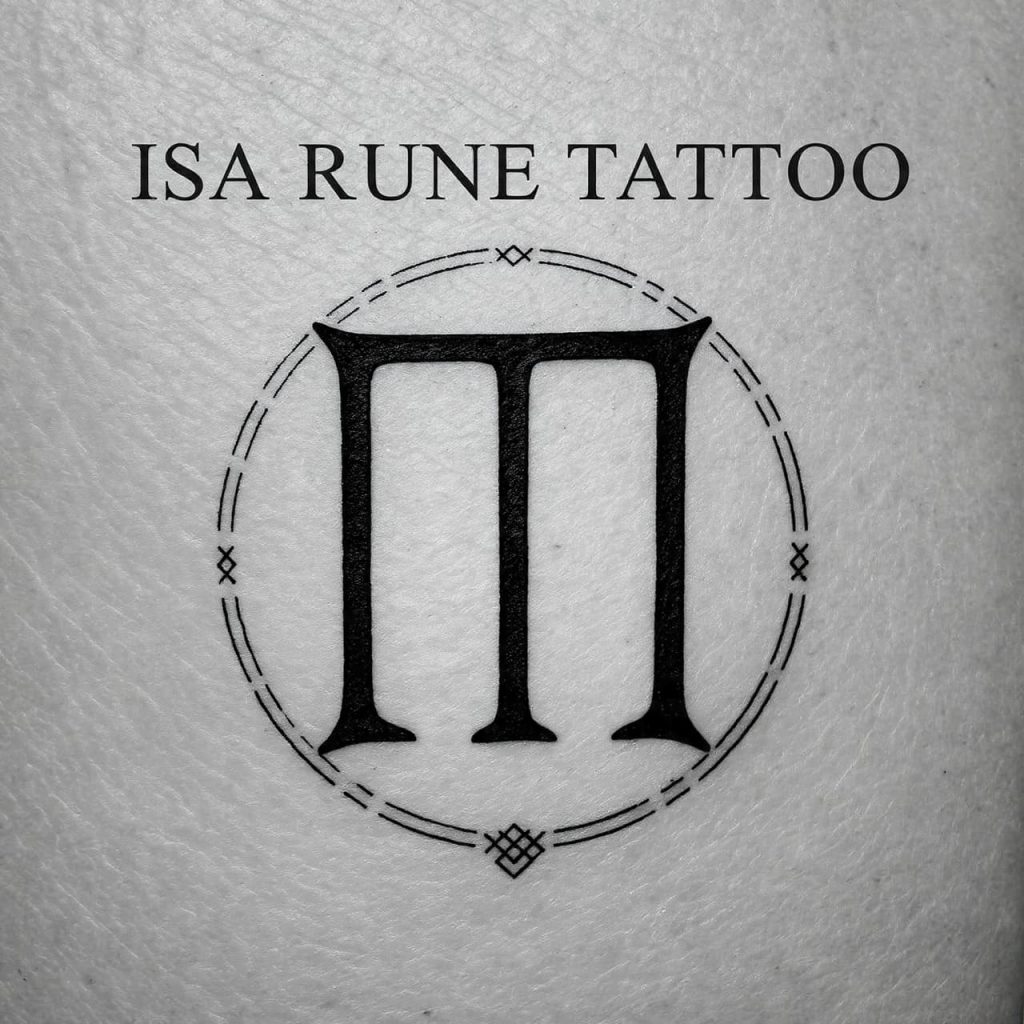
The phrase “Isa rune tattoo” is commonly presented as if it reflects a historically grounded practice linking the Isa rune with tattooing in early Germanic societies. In modern contexts, this association is often treated as culturally authentic or traditionally sanctioned. From an academic standpoint, however, this assumption requires careful evaluation. Runes originated as components of a writing system, while tattooing is a form of body modification whose historical documentation in early Germanic cultures is limited and indirect.

💜 Need a clear answer right now?
CONSULT THE YES OR NO TAROT Free · No registration · Instant resultThe factual question addressed here is narrow and evidence-based: is there any historically verifiable evidence that the Isa rune was used as a tattoo in antiquity?
Answering this requires disciplined analysis of archaeological data, historical texts, and linguistic context, rather than reliance on modern interpretive narratives sometimes promoted by qualified professionals outside historical scholarship.
This article follows evidence-separation strategies consistent with those outlined by astroideal, prioritizing primary historical documentation and clearly distinguishing it from later cultural reinterpretation.
Defining Tattoo Use in a Historical Context
Before evaluating the claim, it is essential to define what constitutes evidence for historical tattoo use. For a rune tattoo to be historically attested, sources would need to demonstrate both the practice of tattooing and the specific use of runes as tattoo motifs within the same cultural context.
In early Germanic societies, written descriptions of tattooing are sparse and indirect. Classical authors occasionally describe body markings among northern peoples, but these accounts lack detail and specificity. None identify runes, individual symbols, or named characters. The concept of tattooing a specific rune, such as Isa, presupposes levels of symbolic intentionality and documentation that are not supported by surviving evidence, despite frequent claims in modern summaries resembling reliable readers.
What the Isa Rune Is Historically
Isa is the conventional scholarly name for a rune representing a vowel sound, reconstructed as /i/ in Proto-Germanic. It is part of the Elder Futhark, the earliest runic alphabet used approximately between the second and eighth centuries CE. Inscriptions from this period show Isa functioning as a grapheme within words, names, and short phrases.
Historically, Isa’s role is linguistic. It appears carved into stone, metal, bone, and wood as part of written communication. There is no evidence that Isa functioned as a standalone emblem intended for visual display independent of language. This functional limitation is critical when evaluating claims of tattoo use, which would require the rune to operate symbolically rather than phonetically, a shift not supported by historical data.
Archaeological Evidence and the Limits of Preservation
Archaeology is central to assessing claims of rune tattoos, but it also presents inherent limitations. Tattoos are applied to skin, a medium that does not survive in the archaeological record under normal conditions. As a result, direct physical evidence of tattoos from early Germanic societies is absent.
Indirect evidence must therefore be considered. This includes tools, iconography, or descriptions suggesting tattooing practices. While some artifacts suggest body modification tools, none depict or reference runes applied to skin. Moreover, runic inscriptions are consistently found on durable objects, not associated with the human body. Archaeology thus offers no positive evidence for Isa rune tattoos and no contextual clues suggesting that runes were used in this way, despite modern narratives sometimes framed similarly to online tarot sessions.
Textual Sources and Classical Descriptions
Classical authors such as Tacitus and others provide limited descriptions of Germanic peoples. These accounts occasionally mention body markings, but they are vague and lack technical detail. Crucially, they do not describe writing systems, individual symbols, or named runes being applied to the body.
Later medieval sources are similarly silent. Rune poems and legal texts focus on literacy, naming, and memorial practices, not body modification. No surviving text links the Isa rune, or any rune, to tattooing. This silence across independent textual traditions strongly suggests that rune tattooing was not a documented cultural practice, regardless of later assumptions echoed in formats resembling video readings.
Linguistic Evidence and Symbolic Constraints
From a linguistic standpoint, runes functioned as letters. Their meaning derived from words and sentences rather than from isolated visual symbolism. Isa’s simplicity—a single vertical stroke—further underscores its role as a phonetic sign rather than a decorative or emblematic figure.
For a rune to function as a tattoo, it would need to operate symbolically, conveying meaning independently of language. There is no evidence that early Germanic cultures conceptualized runes in this way. Linguistic usage shows no transition from writing to emblematic symbolism, a constraint often overlooked in modern interpretive discussions similar in structure to phone readings.
Medieval and Early Modern Reinterpretations
Some proponents of rune tattoos point to medieval or early modern folklore as indirect support. However, these sources reflect periods long after the original runic system had declined or transformed. Even within these later contexts, explicit references to rune tattooing are absent.
What does appear is a growing tendency to romanticize earlier cultures, especially in modern periods. This romanticization often reimagines runes as timeless symbols rather than historically situated letters. Such reinterpretation does not constitute evidence of ancient practice and must be distinguished from documented history, particularly when similar symbolic expansions appear alongside systems like horoscope insights.
Modern Tattoo Practices and Their Origins
The association between Isa and tattooing emerges entirely in modern contexts. Contemporary tattoo culture often draws selectively from historical motifs, combining them with modern symbolic frameworks. In this environment, runes are frequently detached from their original linguistic function and redefined as standalone symbols.
Historically, this represents innovation rather than continuity. There is no evidence of an unbroken tradition linking early runic use to modern tattoo practices. While modern tattoos may reference runes visually, they do not reflect documented ancient customs. Recognizing this distinction is essential for maintaining historical accuracy.
Evaluating the Core Claim With Evidence
The core claim examined here is that the Isa rune was historically used as a tattoo. Evaluating this claim requires convergence of archaeological, textual, and linguistic evidence.
Across all three domains, evidence for such use is absent. Archaeology provides no direct or indirect confirmation, texts do not describe the practice, and linguistic analysis reinforces the rune’s role as a letter rather than a symbol. Therefore, the claim lacks historical support. This conclusion follows the same evidence-prioritization discipline emphasized by astroideal, where unsupported cultural assumptions are excluded regardless of modern popularity.
Final Historical Conclusion
The answer is no. There is no historically verifiable evidence that the Isa rune was used as a tattoo in early Germanic societies. Its documented role is phonetic and inscriptional. Associations between Isa and tattooing are modern constructs that cannot be projected onto the historical record.
Frequently Asked Questions
Is there archaeological proof of rune tattoos?
No. Tattoos do not survive archaeologically, and no indirect evidence exists.
Did ancient texts describe rune tattooing?
No. No such descriptions appear in historical sources.
Was Isa used symbolically in ancient times?
No. Evidence supports linguistic use only.
Do rune poems mention body markings?
No. They do not address tattooing.
Are modern rune tattoos historically authentic?
No. They are modern reinterpretations.
Can history confirm Isa tattoo traditions?
No. There is no supporting evidence.
Call to Action
To get a clear yes or no answer about claims connecting ancient symbols to modern practices like tattooing, evaluate primary historical evidence directly and distinguish documented history from contemporary reinterpretation, regardless of how culturally persuasive those interpretations may appear.
