

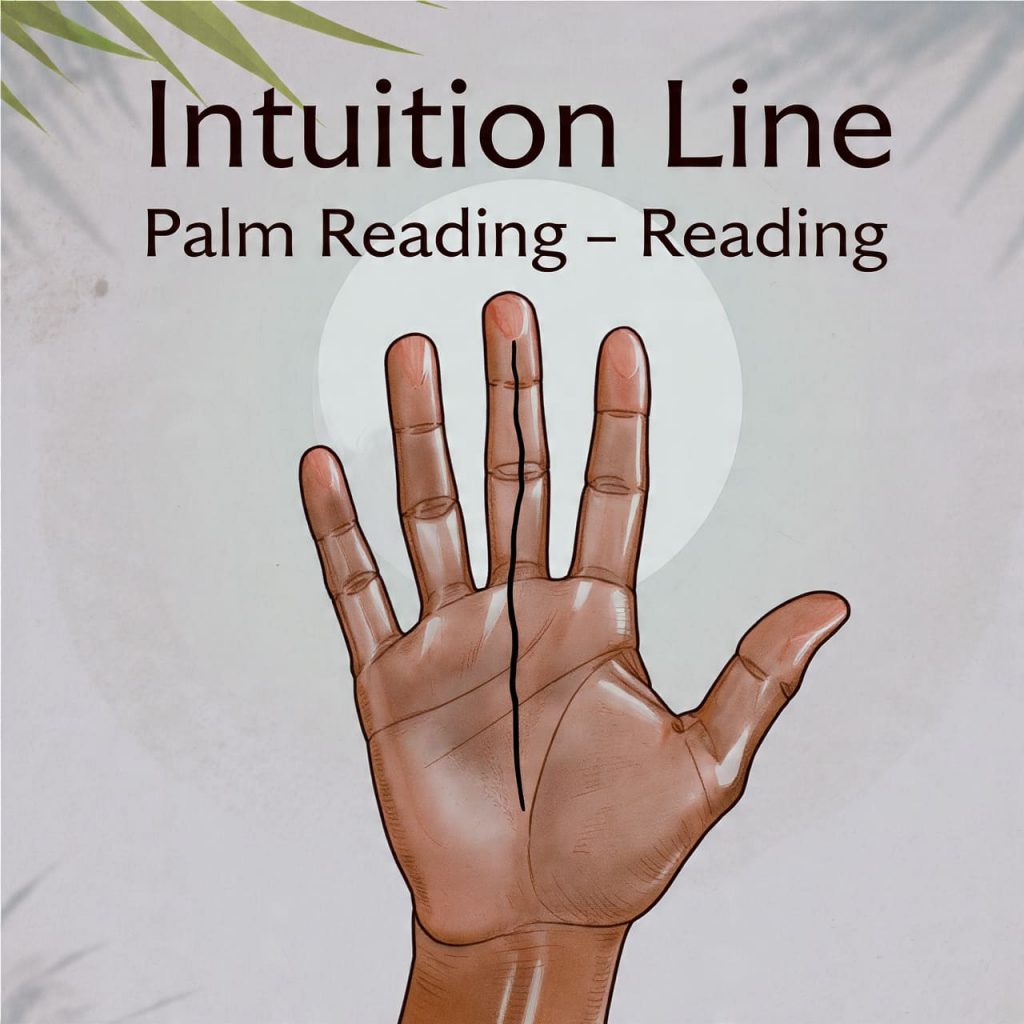
The phrase “intuition line palm reading reading” is commonly used to suggest that the intuition line on the palm can be actively interpreted to reveal factual information about a person’s intuitive capacity. This framing introduces a second layer of misunderstanding: not only is the intuition line treated as a concrete indicator, but the act of “reading” it is implied to produce reliable knowledge.

💜 Need a clear answer right now?
CONSULT THE YES OR NO TAROT Free · No registration · Instant resultHistorically, neither assumption is supported by evidence. Popular explanations often collapse symbolic tradition, interpretive authority, and factual inference into a single claim, giving it an appearance of legitimacy. This problem persists even in settings that emphasize consultation with qualified professionals, where the difference between cultural interpretation and evidence-based assessment is not always made explicit.
The question evaluated here is strictly factual and limited in scope: does reading the intuition line in palmistry have historical or evidentiary validity as a method for identifying intuition or perceptual ability? Using evidence-evaluation principles discussed at astroideal, this article examines the origin of the claim, the nature of the sources, and what the evidence actually supports, leading to a single yes-or-no conclusion.
Historical Status of “Reading” the Intuition Line
Unlike major palm lines that appear in many early manuals, the intuition line occupies an uncertain position in palmistry history. Where it appears at all, it is inconsistently described and rarely emphasized. More importantly, early palmistry texts do not describe a standardized method for “reading” this line. Interpretations varied according to author, region, and symbolic framework.
Some writers treated the line as optional or supplementary, while others ignored it entirely. There was no shared procedure for determining what counted as a valid intuition line or how its presence should be evaluated. This absence of methodological agreement is significant, because it means that the act of “reading” the intuition line was never standardized within the tradition itself. Modern claims repeated by individuals presented as reliable readers therefore project consistency onto a practice that historically lacked it.
Symbolic Context and Interpretive Logic
Palmistry developed as a symbolic system grounded in analogy rather than observation. Features of the hand were interpreted through cosmological associations linking parts of the palm to planets and abstract qualities. The area where the intuition line is said to appear was symbolically associated with imagination or inward awareness, not because of observed behavioral correlation, but because of its position within a symbolic map.
Within this framework, “reading” the intuition line meant applying symbolic rules, not evaluating evidence. No attempt was made to test whether individuals with certain markings demonstrated greater intuitive accuracy. The interpretive act was justified internally, by reference to tradition and correspondence. As these ideas entered modern circulation, they were simplified and disseminated through formats such as online tarot sessions, where symbolic interpretation is often presented without historical context.
Textual and Archaeological Evidence
A review of surviving palmistry texts shows repeated assertions about symbolic meaning but no documentation of verification. No source describes comparing intuition line readings with independent measures of perception, judgment, or insight. The act of “reading” the line is presented as authoritative rather than evidentiary.
Archaeological evidence does not support the claim either. Variations in palm creases along the outer edge of the hand are visible in artistic depictions across cultures, but there is no indication that these variations were associated with cognitive traits. Modern sciences that study cognition and perception rely on neurological and behavioral methods, not external hand features. Claims sometimes implied during video readings therefore lack alignment with both historical documentation and scientific practice.
Modern Expansion of the Concept
The idea of actively “reading” the intuition line gained prominence in modern palmistry, particularly during the late nineteenth and twentieth centuries. During this period, authors expanded the number of named lines and emphasized interpretive techniques that could be easily taught. The intuition line was framed as something that could be examined, interpreted, and explained in a reading context.
These developments did not involve new evidence. Interpretations differed widely between authors, and some contradicted earlier works that did not recognize the line at all. Despite this, the practice was presented with increasing confidence, especially as it spread through popular manuals and remote formats such as phone readings. The authority of the reading was asserted, not demonstrated.
Direct Evaluation of the Core Claim
The claim under evaluation is that reading the intuition line in palmistry has factual or historical validity as a method for identifying intuition. Historical analysis shows that the line itself is inconsistently defined and absent from many early sources. The act of reading it was never standardized or tested.
Scientific evidence offers no support. Intuition, however defined, is studied through psychological and neurological research that does not involve palm features. No peer-reviewed studies demonstrate a correlation between intuition line readings and measurable cognitive outcomes. References to related symbolic practices, including generalized horoscope insights, do not provide evidentiary support, as they rely on similar non-empirical reasoning.
Why the Practice Continues
The continued use of intuition line readings is best explained by cultural repetition and narrative appeal. The idea that intuition can be visually identified and interpreted is compelling and easy to communicate. Over time, repetition can create an impression of validation even when no evidence exists.
Modern compilations often place palmistry readings alongside other symbolic interpretations, such as love tarot readings, reinforcing the sense of a unified interpretive system. As emphasized again in methodological analyses at astroideal, coherence within a symbolic framework does not establish factual accuracy.
Conclusion: Based on historical documentation and scientific review, the answer is no. Reading the intuition line in palmistry does not have factual or evidentiary validity as a method for identifying intuition or perceptual ability.
Frequently Asked Questions
Is there a historical method for reading the intuition line?
No. Methods vary widely and were never standardized.
Do early palmistry texts emphasize intuition line readings?
No. Many omit the line entirely.
Has intuition line reading been tested scientifically?
No. There is no record of empirical testing.
Do cognitive sciences use palm features?
No. Palm lines are not used in cognitive assessment.
Are modern readings based on new evidence?
No. They rely on symbolic reinterpretation.
Does interpretive tradition equal factual method?
No. Tradition alone does not establish validity.
Call to Action
When evaluating interpretive claims, examine how the method is defined, whether it was ever tested, and what evidence supports it. Applying that standard allows you to get a clear yes or no answer grounded in documented history rather than repeated assertion.
