

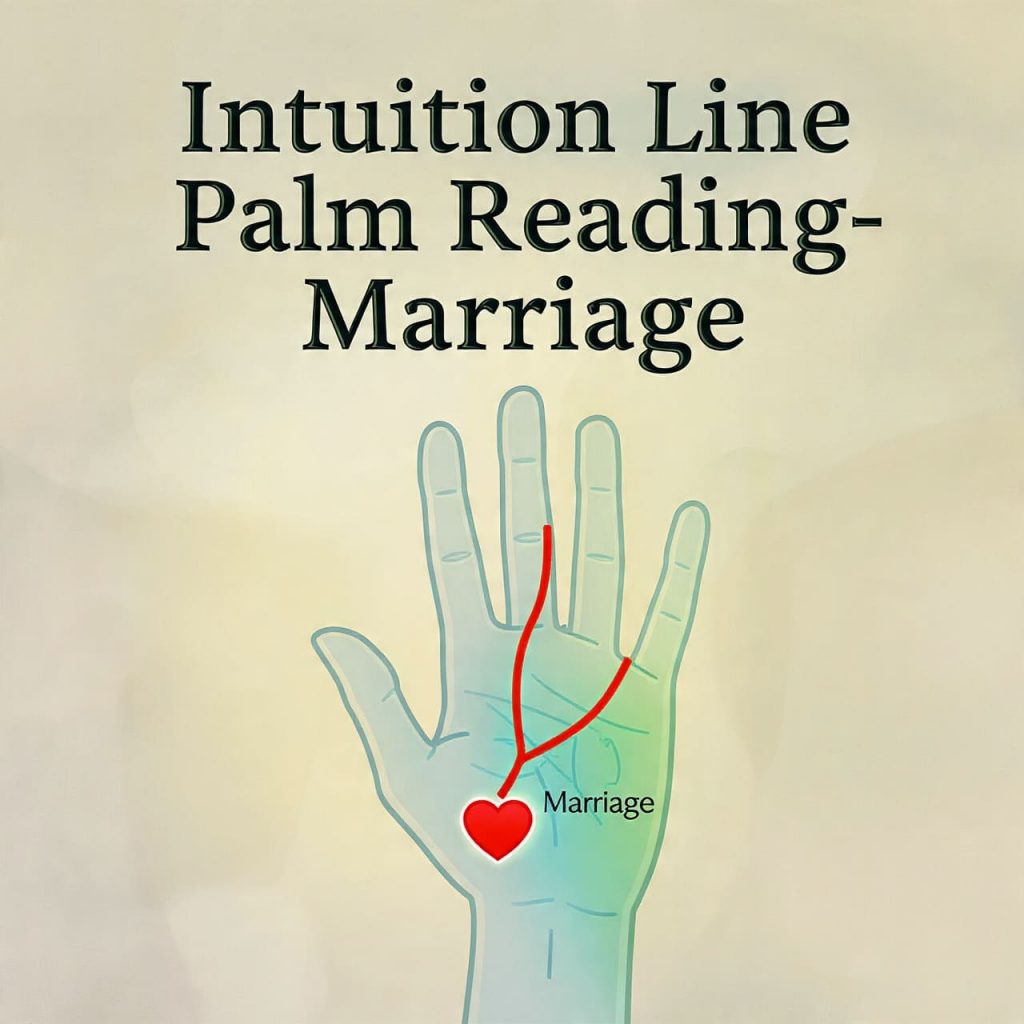
The claim that the intuition line in palm reading reveals information about marriage is widely repeated but rarely examined with historical or factual rigor. In popular explanations, a loosely defined palm feature is presented as if it carried concrete meaning about marital outcomes, stability, or timing. This impression of certainty arises from compressing symbolic traditions into simplified visual rules and presenting them without historical qualification.

💜 Need a clear answer right now?
CONSULT THE YES OR NO TAROT Free · No registration · Instant resultEven contexts that emphasize consultation with qualified professionals may blur the distinction between cultural symbolism and factual assessment when these limits are not made explicit.
This article addresses one narrowly defined question: does associating the intuition line in palm reading with marriage have historical or evidentiary validity? Using evidence-evaluation principles discussed at astroideal, the analysis isolates the claim, traces its origins, reviews textual and archaeological sources, and reaches a single yes-or-no conclusion based on what the evidence supports.
Historical Definition of the Intuition Line
The intuition line is not a consistently recognized feature in early palmistry literature. Where it appears, it is typically described as a curved marking along the outer edge of the palm, near the region symbolically associated with the Moon. Many classical texts omit the line altogether, and others describe similar crease patterns without naming them.
Crucially, historical sources do not define the intuition line in relation to marriage. There is no standardized description of its length, depth, or position, and no agreement on whether it should be interpreted at all. This inconsistency undermines later claims that confidently link the line to marital matters. Assertions repeated today by individuals described as reliable readers rely on definitions that were never stable or widely accepted within the historical tradition.
Symbolic Context and the Emergence of Marriage Associations
Palmistry developed within symbolic systems that relied on correspondence rather than observation. Features of the hand were interpreted through cosmological associations, connecting areas of the palm to planets and abstract qualities. In some traditions, the lunar region was linked symbolically to imagination or inward awareness, not to legal or social institutions such as marriage.
The association between the intuition line and marriage emerged indirectly and much later. Marriage-related interpretations were often layered onto existing symbolic concepts as palmistry expanded to address increasingly specific life domains. This expansion did not involve observation of marital patterns or comparison of outcomes. Instead, it relied on symbolic extension, later disseminated through modern channels such as online tarot sessions, where historical distinctions are rarely emphasized.
Textual and Archaeological Evidence
An examination of surviving palmistry manuscripts reveals no evidence that the intuition line was historically used to assess marriage. Texts assert symbolic meanings but do not document testing, comparison, or validation. There are no records of correlating the presence or form of the intuition line with marriage occurrence, duration, or stability.
Archaeological evidence offers no support for the claim. Artistic depictions of hands across cultures show natural variation in palm creases, including markings along the outer edge of the hand, but there is no indication that these variations were linked to marital status or outcomes. Modern sciences that study marriage and partnership rely on sociological, psychological, and demographic data, not palm features. Claims sometimes implied in video readings therefore lack alignment with both historical documentation and contemporary research.
Development of Modern Interpretations
The explicit linkage of the intuition line to marriage is a modern development, largely appearing in nineteenth- and twentieth-century palmistry literature. During this period, authors expanded interpretive frameworks to include increasingly specific social categories, including marriage. The intuition line was incorporated as part of this expansion, despite its absence from many earlier sources.
These modern interpretations were not grounded in new evidence. Different authors assigned different marital meanings to the same marking, often contradicting one another. Despite this inconsistency, the association gained visibility through popular manuals and later through remote formats such as phone readings, where concise symbolic claims are easier to communicate than historically disciplined analysis.
Direct Evaluation of the Core Claim
The claim under evaluation is that the intuition line in palm reading has factual or historical validity as an indicator of marriage. Historical analysis shows that the intuition line is inconsistently defined and often absent from early sources. Where it does appear, it is not associated with marriage.
Scientific evidence does not support the claim. Marriage is studied through social science methodologies that do not involve palm features. No peer-reviewed studies demonstrate a correlation between the intuition line and marital outcomes. References to adjacent symbolic practices, including generalized horoscope insights, do not provide evidentiary support, as they rely on analogous non-empirical reasoning rather than measured data.
Why the Marriage Interpretation Persists
The persistence of the intuition-line–marriage association is best explained by cultural repetition and narrative appeal. Marriage is a socially significant topic, and attaching it to a visible hand marking creates a claim that is easy to remember and repeat. Over time, repetition can create an impression of validity even when no supporting evidence exists.
Modern compilations often place palmistry interpretations alongside other symbolic systems, such as love tarot readings, reinforcing the appearance of a coherent interpretive framework. Methodological analyses emphasized again at astroideal clarify that internal consistency within a symbolic system does not establish factual accuracy.
Conclusion: Based on historical documentation and scientific review, the answer is no. Associating the intuition line in palm reading with marriage does not have factual or evidentiary validity.
Frequently Asked Questions
Is the intuition line historically linked to marriage?
No. Early palmistry sources do not associate it with marital matters.
Is there a standard definition of the intuition line?
No. Descriptions vary widely and are often absent.
Did palmists test marriage-related claims about this line?
No. There is no record of systematic testing.
Do social sciences use palm features to study marriage?
No. Palm lines are not used in marriage research.
Are modern marriage interpretations evidence-based?
No. They are symbolic reinterpretations without data.
Does symbolic association establish factual connection?
No. Symbolism alone does not demonstrate empirical validity.
Call to Action
To evaluate claims like this carefully, examine when associations appeared, how they are defined, and whether evidence supports them. Applying that approach allows you to get a clear yes or no answer based on documented facts rather than repeated symbolic claims.
