

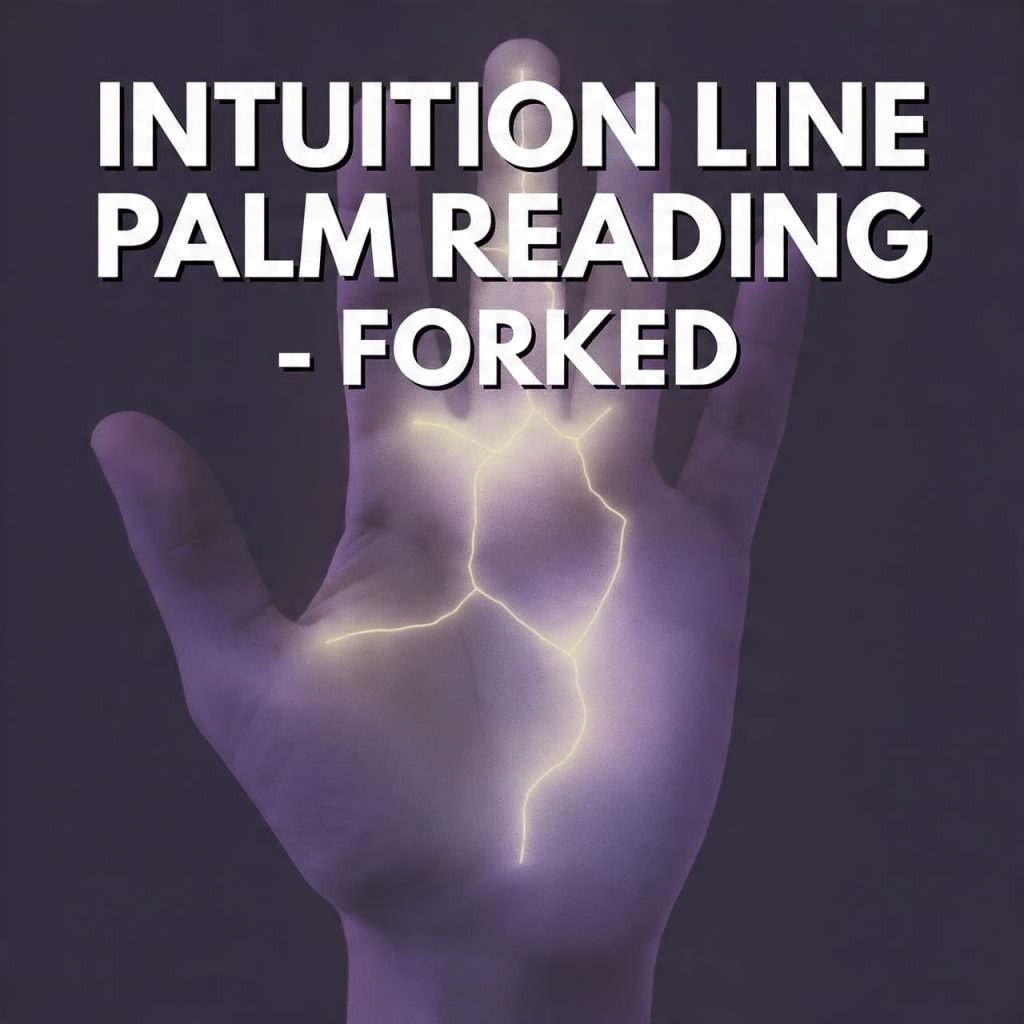
The claim that a forked intuition line in palm reading conveys factual information about intuition or perceptual capacity is widely circulated but rarely examined with historical discipline. In popular explanations, branching or splitting in a palm line is often treated as inherently meaningful, as though visual complexity alone implies measurable significance.

💜 Need a clear answer right now?
CONSULT THE YES OR NO TAROT Free · No registration · Instant resultThis framing obscures the origins of the claim and replaces historical context with assumed authority. Such assumptions persist even in environments that emphasize consultation with qualified professionals, where symbolic interpretation and factual evaluation are not always clearly distinguished.
This article addresses one narrowly defined question: does a forked intuition line in palm reading have historical or evidentiary validity as an indicator of intuition? Using evidence-evaluation principles discussed at astroideal, the analysis isolates the claim, reviews its origins, examines textual and archaeological sources, and reaches a single yes-or-no conclusion grounded in documented evidence.
Historical Definition of a “Forked” Intuition Line
The intuition line itself is not a consistently recognized feature in early palmistry literature. Where it appears, it is generally described as a curved marking along the outer edge of the palm, near the area traditionally associated with the Moon. A “forked” intuition line in modern explanations is defined as one that splits into two or more branches at one end or along its length.
Historically, this definition lacks consistency. Many classical texts omit the intuition line entirely, and those that describe similar markings do not categorize them according to branching or forks. Some authors considered minor offshoots irrelevant, while others counted them without explanation. There was no shared standard for identifying what constituted a meaningful fork. This lack of agreement is significant when evaluating claims repeated today by individuals presented as reliable readers, because the foundational feature was never uniformly defined within the tradition.
Symbolic Origins and Interpretive Logic
Palmistry developed within symbolic and analogical systems rather than empirical frameworks. Features of the hand were interpreted through correspondence with planets and abstract qualities, not through observation of cognition or behavior. The region associated with the intuition line was symbolically linked to imagination or inward awareness based on cosmological models, not measured perceptual differences.
Within this symbolic framework, branching in a line was not evaluated through comparison with intuitive performance. A fork represented a visual variation within a symbolic map of the hand, not a data point subject to verification. As palmistry traditions spread and were simplified, these symbolic distinctions were condensed into easily repeated claims and circulated widely through modern formats such as online tarot sessions, where historical nuance is rarely preserved.
Textual and Archaeological Evidence
An evidence-based assessment requires examining what historical sources actually document. Surviving palmistry manuscripts assert symbolic meanings for certain markings but do not describe testing, comparison, or verification. No source records observing individuals with forked intuition lines to determine whether they differed in perception, judgment, or insight.
Archaeological evidence offers no support for the claim. Artistic depictions of hands across cultures show natural variation in palm creases along the outer edge of the hand, including branching patterns. There is no indication that these variations were historically linked to intuitive capacity or mental traits. Modern sciences that study cognition and perception rely on neurological and psychological methods, not palm features. Claims sometimes implied in video readings therefore lack alignment with both historical documentation and contemporary research.
Emergence of Modern Interpretations Emphasizing Forks
The emphasis on a forked intuition line is largely a modern development. In the nineteenth and twentieth centuries, palmistry authors expanded interpretive frameworks by subdividing lines according to visible characteristics such as length, continuity, or branching. Forks became a convenient visual category that allowed for additional interpretation without introducing new evidence.
These interpretations were not grounded in observational research. Different authors assigned different meanings to forked intuition lines, and some directly contradicted one another. Despite this inconsistency, the idea gained visibility through popular manuals and later through remote formats such as phone readings, where concise symbolic distinctions are easier to communicate than historically disciplined analysis.
Direct Evaluation of the Core Claim
The claim under evaluation is that a forked intuition line in palm reading has factual or historical validity as an indicator of intuition. Historical analysis shows that the intuition line is inconsistently defined and often absent from early sources. Where it does appear, branching or forks are not treated as meaningful variables tied to perceptual ability.
Scientific evidence does not support the claim. Intuition, however defined, is studied through cognitive and neurological research that does not involve palm features. No peer-reviewed studies demonstrate a correlation between forks in an intuition line and measurable intuitive performance. References to adjacent symbolic practices, including generalized horoscope insights, do not provide evidentiary support, as they rely on analogous non-empirical reasoning rather than measured data.
Why the Forked-Line Interpretation Persists
The persistence of interpretations focused on a forked intuition line is best explained by cultural repetition and visual salience. Branching patterns naturally attract attention and invite categorization, and simple visual rules are easy to remember and repeat. Over time, repetition can create an impression of validity even when no supporting evidence exists.
Modern compilations often place palmistry interpretations alongside other symbolic systems, such as love tarot readings, reinforcing the appearance of a unified interpretive framework. Methodological analyses emphasized again at astroideal clarify that internal coherence within a symbolic system does not establish factual accuracy.
Conclusion: Based on historical documentation and scientific review, the answer is no. A forked intuition line in palm reading does not have factual or evidentiary validity as an indicator of intuition.
Frequently Asked Questions
Is the intuition line consistently defined in early palmistry texts?
No. Many early sources omit it, and others describe it inconsistently.
Are forks historically meaningful for the intuition line?
No. Fork-based interpretations are largely modern additions.
Did palmists test claims about forked intuition lines?
No. There is no record of systematic testing or observation.
Do cognitive sciences recognize palm line forks?
No. Palm features are not used in cognitive assessment.
Are modern interpretations supported by empirical research?
No. They rely on symbolic reinterpretation rather than data.
Does visual branching imply factual significance?
No. Visual variation does not establish measurable validity.
Call to Action
To evaluate claims like this rigorously, examine how features are defined, when interpretations appeared historically, and whether evidence supports them. Applying that approach allows you to get a clear yes or no answer grounded in documented history rather than repeated symbolic assertions.
