

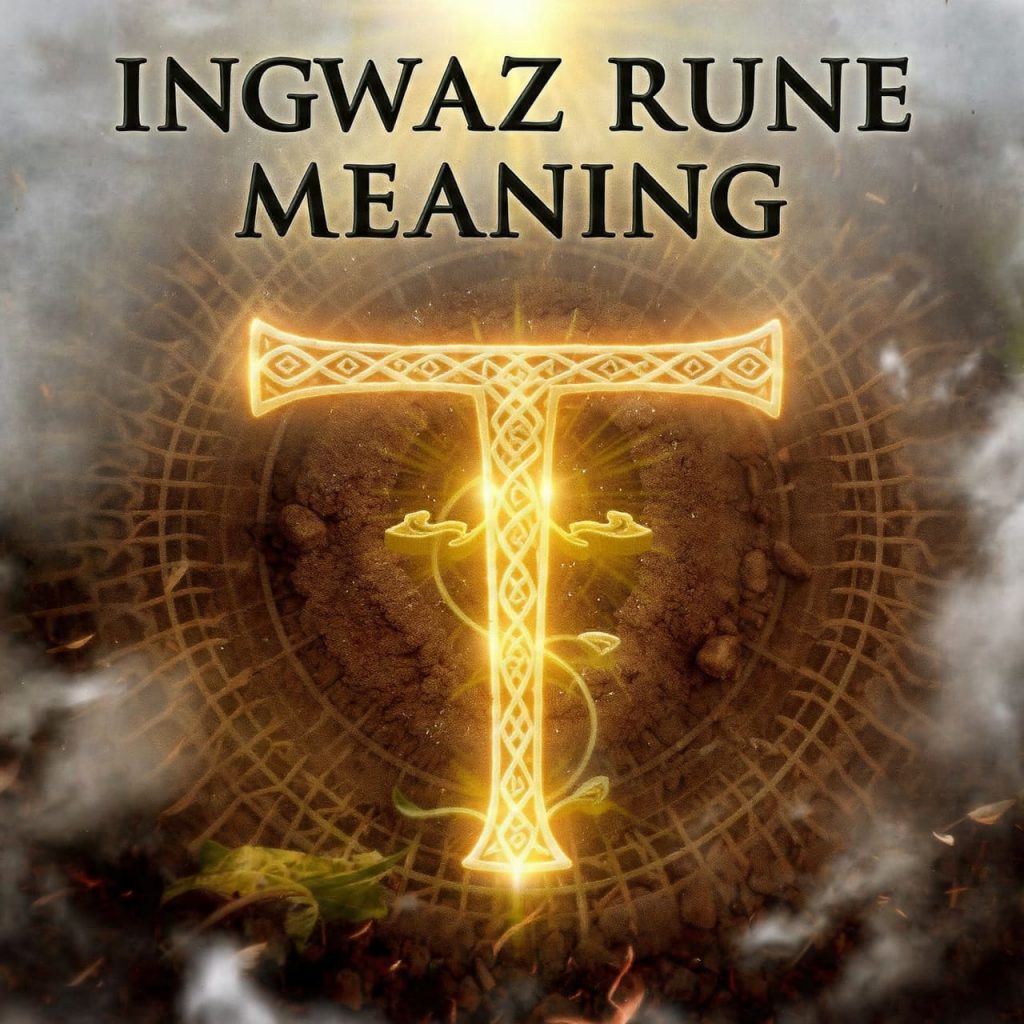
The phrase “Ingwaz rune meaning” is often presented as if the rune carried a clearly defined symbolic or conceptual significance from the moment it entered use. Many modern explanations describe Ingwaz as embodying a specific idea or force, implying that this meaning was historically fixed and universally recognized. This impression is widespread, yet it is rarely tested against the historical record.

💜 Need a clear answer right now?
CONSULT THE YES OR NO TAROT Free · No registration · Instant resultThe uncertainty here is factual and historical, not interpretive or experiential. It concerns what can actually be demonstrated about the meaning of the Ingwaz rune based on archaeological evidence, linguistic reconstruction, and early textual sources.
Scholarly analysis by qualified professionals emphasizes that claims about meaning must be grounded in attested usage rather than later interpretive systems.
Evidence-first approaches, including analytical strategies discussed on astroideal, frame the central question precisely: did the Ingwaz rune historically possess an intrinsic symbolic meaning beyond its function as a written character?
Defining Ingwaz as a Historical Term
“Ingwaz” is not a name directly recorded from the period when the rune was first used. It is a reconstructed scholarly designation derived from later medieval rune poems and comparative linguistics. These poems associate rune characters with words, allowing scholars to infer likely names, but they postdate the Elder Futhark period by several centuries.
Historically, the rune itself existed as a grapheme within a writing system. Any discussion of its meaning must therefore distinguish between the rune’s original function and the later interpretive traditions that assigned names and associations. Conflating reconstructed names with original meaning risks attributing medieval or modern ideas to an earlier period without evidence.
Ingwaz Within the Elder Futhark
Ingwaz is a rune of the Elder Futhark, the earliest known runic alphabet, used roughly between the second and eighth centuries CE. Unlike many other runes, Ingwaz does not have a clear phonetic value that maps neatly onto later alphabets. It is generally understood to represent a nasal sound cluster or to function as a logographic element, but its exact phonetic role remains debated.
What is clear is that Ingwaz appears as part of the standardized Elder Futhark set. Its inclusion reflects the needs and conventions of a writing system rather than an explicitly symbolic agenda. The presence of Ingwaz alongside other phonetic runes supports the view that it originated within a linguistic framework, not as an abstract emblem.
Archaeological Evidence From Inscriptions
Archaeological evidence provides the strongest basis for evaluating claims about meaning. Inscriptions containing Ingwaz are comparatively rare, but they do exist on datable objects such as bracteates and other inscribed artifacts from northern Europe.
In every securely identified instance, Ingwaz appears embedded within an inscription rather than isolated or highlighted. There are no examples where it is visually emphasized or accompanied by explanatory imagery. This usage pattern aligns with functional writing rather than symbolic display. If Ingwaz had been understood primarily as a symbol with intrinsic meaning, archaeologists would expect repeated standalone usage or contextual markers indicating such a role. The absence of these patterns is significant. Claims of implicit meaning resemble assumptions sometimes associated with reliable readers rather than conclusions drawn from material evidence.
Linguistic Reconstruction and Its Limits
Comparative linguistics plays a central role in discussions of Ingwaz. The reconstructed name is linked to a Proto-Germanic root associated with a deity or ancestral figure, inferred from later Old Norse and Old English sources. This linguistic association explains how medieval authors understood the rune name.
However, linguistic reconstruction does not establish how the rune was understood at the time of its origin. It reconstructs later naming conventions, not original semantic intent. Treating reconstructed associations as evidence of intrinsic meaning extends linguistic data beyond its methodological limits. This distinction is critical for maintaining historical discipline.
Textual Sources and Retrospective Interpretation
Texts that mention Ingwaz come from medieval rune poems composed long after the Elder Futhark fell out of use. These poems provide valuable insight into later cultural memory but do not document original meaning.
Where these texts assign descriptive qualities to runes, they do so within a poetic and didactic framework specific to the medieval period. There is no indication that these descriptions preserve unbroken tradition from the rune’s origin. Using such texts to infer original meaning risks anachronism. Modern explanatory styles that present rune meanings as ancient truths resemble later interpretive systems such as online tarot sessions rather than historically attested practice.
Geographic Distribution and Consistency
The limited but geographically dispersed appearances of Ingwaz suggest that it was part of a shared alphabetic system rather than a localized symbolic sign. Its form is relatively consistent where it appears, indicating standardization within the script.
This consistency supports the conclusion that Ingwaz was recognized as a component of writing rather than as a culturally variable symbol. If its meaning had been central or symbolic, greater regional variation or contextual elaboration might be expected. Instead, the evidence points to functional inclusion.
Absence of Contemporary Explanatory Evidence
No contemporary texts explain the creation, purpose, or meaning of Ingwaz. This absence is not unique to Ingwaz but applies to the Elder Futhark as a whole. Where ancient societies documented symbolic systems, they often left explanatory records.
The lack of such records for runes suggests that they were not conceived primarily as symbols with inherent meanings. Modern narratives that fill this gap often rely on coherence rather than evidence, similar in structure to video readings or phone readings, which prioritize interpretive clarity over historical attestation.
Emergence of Modern Meaning Frameworks
The idea that Ingwaz carries a specific symbolic meaning emerges primarily in modern literature, particularly from the nineteenth and twentieth centuries. During this period, scholars and enthusiasts sought to systematize runes into symbolic sets aligned with mythology, psychology, or natural cycles.
These frameworks can be traced to modern publications rather than archaeological discoveries. Their structure parallels other contemporary symbolic systems, including horoscope insights, which organize symbols into coherent thematic categories. While influential today, these systems are not reconstructions of ancient usage.
Evaluating the Core Claim With Evidence
The core claim implied by “Ingwaz rune meaning” is that Ingwaz historically conveyed an intrinsic symbolic or conceptual meaning. Evaluating this claim requires integrating archaeological evidence, linguistic reconstruction, and textual analysis.
The evidence supports a limited conclusion. Ingwaz originated as a component of the Elder Futhark writing system. Its reconstructed name and later associations do not demonstrate original symbolic meaning. No inscriptions, artifacts, or contemporary texts show that it functioned as an independent signifier. As emphasized in evidence-based discussions such as those on astroideal, historical conclusions must be bounded by what sources can demonstrate. Comparisons to modern interpretive systems, including love tarot readings, highlight how later meanings diverge from documented origins.
The most accurate conclusion is therefore careful and evidence-based: there is no historical proof that the Ingwaz rune possessed an intrinsic meaning beyond its role within a writing system.
Frequently Asked Questions
Is the name “Ingwaz” historically attested?
No, it is a reconstructed scholarly name.
Did Ingwaz have a symbolic meaning in antiquity?
There is no evidence that it did.
How was Ingwaz used in inscriptions?
It appears as part of written sequences, not as a standalone symbol.
Do medieval texts preserve its original meaning?
They reflect later interpretation, not original usage.
Is Ingwaz unique among runes?
No, the same issues apply to most Elder Futhark runes.
Do scholars agree on this assessment?
Yes, mainstream runology supports this view.
Call to Action
Understanding rune meaning requires separating archaeological evidence from later interpretation. Readers are encouraged to examine early inscriptions and linguistic reconstructions directly to get a clear yes or no answer on what can genuinely be known about the historical meaning of the Ingwaz rune.
