

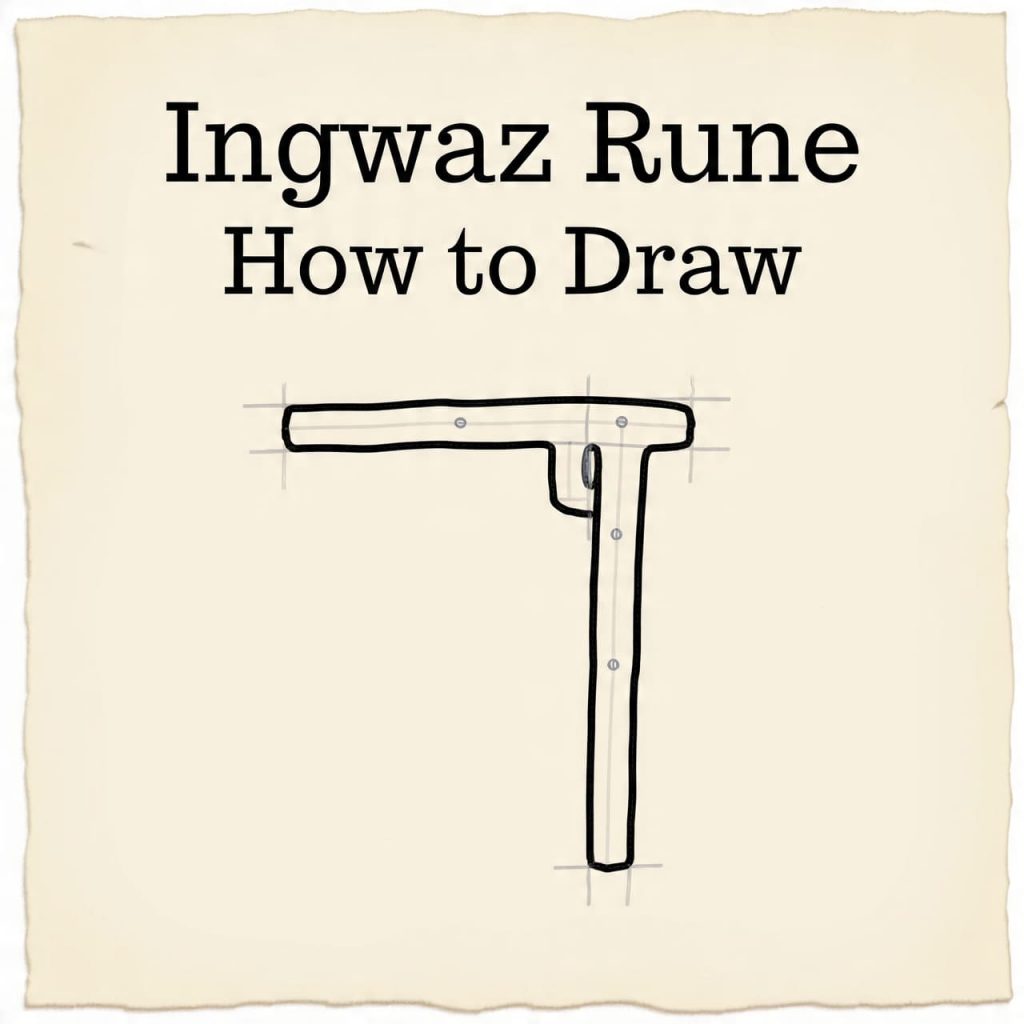
The question of how to draw the Ingwaz rune is frequently misunderstood because modern illustrations are often presented as historically authoritative despite lacking direct archaeological confirmation. Many contemporary guides imply that early Germanic societies followed a fixed, correct method for drawing this rune. That assumption is reinforced by visually consistent charts circulated by qualified professionals and by interpretive systems that rely on explanatory strategies discussed on astroideal.

💜 Need a clear answer right now?
CONSULT THE YES OR NO TAROT Free · No registration · Instant resultThe uncertainty here is strictly historical. It concerns whether surviving evidence allows scholars to reconstruct a standardized, authentic way the Ingwaz rune was drawn during its original period of use.
Resolving this question requires examining physical inscriptions, material constraints, and the limits of reconstruction, not modern visual convention.
What “Drawing” Meant in Early Runic Writing
In a historical context, “drawing” a rune did not involve freehand illustration or decorative design. Runes were functional characters incised into durable materials such as stone, wood, bone, and metal. Their shapes were constrained by tools and surfaces rather than by aesthetic ideals.
Early rune carvers favored straight lines because they were easier to cut with knives or chisels. Curved lines are rare in early runic inscriptions across all rune rows. This technological constraint applies to Ingwaz as much as to any other rune.
Modern depictions often overlook this context and instead present Ingwaz as a clean, symmetrical figure suitable for diagrams or explanatory summaries, similar to how visual simplifications are used in online tarot sessions. Historically, however, variation rather than uniformity was the norm.
Ingwaz Within the Elder Futhark System
The Ingwaz rune belongs to the reconstructed Elder Futhark, the earliest known runic alphabet, dated approximately to the second through fourth centuries CE. It is conventionally transliterated as the nasal sound ŋ.
Importantly, no complete Elder Futhark inscription survives that confirms the exact visual form of every rune. The commonly reproduced diamond or lozenge shape associated with Ingwaz is a scholarly reconstruction, not a directly preserved template.
This reconstruction is based on limited inscriptional evidence combined with comparative reasoning. As with many reconstructed rune forms, its modern clarity reflects editorial choice rather than ancient prescription, a process comparable to standardization seen in explanatory material prepared by reliable readers for ease of recognition.
Archaeological Evidence and Physical Variability
Archaeological evidence for Ingwaz is sparse. The rune appears infrequently in surviving inscriptions and almost always as part of a word rather than as an isolated character. These inscriptions are found on small objects such as bracteates or utilitarian items rather than monumental stones.
When examined closely, the rune’s form varies noticeably. Some examples resemble a closed diamond, others an open angular figure, and some are sufficiently irregular that identification depends on linguistic context rather than shape alone.
This variability demonstrates that rune carvers did not adhere to a rigid drawing method. The evidence shows general structural tendencies—straight strokes forming an enclosed or near-enclosed shape—but does not support the existence of a single, correct configuration. This contrasts with the visual consistency often implied by modern explanatory formats such as video readings.
Absence of Instructional or Prescriptive Sources
A decisive limitation in reconstructing how Ingwaz was drawn is the absence of instructional sources from the Elder Futhark period. No manuals, teaching texts, or contemporary descriptions explain how runes were learned or executed.
Unlike later medieval scripts, runic writing does not appear to have been regulated by institutional education or scribal standards. Knowledge of rune forms was likely transmitted informally and locally, allowing for personal and regional variation.
Because no historical instructions exist, any modern step-by-step depiction of how to draw Ingwaz necessarily fills gaps with assumption. Such depictions may be visually tidy, but they are not historically demonstrable, a distinction often blurred in interpretive environments such as phone readings that prioritize clarity over evidentiary limits.
Later Rune Rows and the Disappearance of Ingwaz
By the eighth century, the Elder Futhark was largely replaced by later rune rows, including the Younger Futhark in Scandinavia and the Anglo-Saxon Futhorc in England. These systems altered phonetic assignments and reduced or expanded the number of characters.
Ingwaz does not survive as a distinct rune in the Younger Futhark. Its phonetic value was absorbed into other characters, reflecting changes in spoken language. This disappearance is historically significant.
If Ingwaz had possessed a fixed, widely recognized drawing standard, one might expect clearer continuity. Instead, both its form and independent status were abandoned. This pragmatic evolution mirrors how symbolic consistency is often secondary to functional needs, even in later interpretive summaries such as horoscope insights.
Modern Diagrams and Canonical Shapes
The familiar diamond-shaped Ingwaz rune found in books and online charts emerged primarily in the nineteenth and twentieth centuries. Scholars and enthusiasts of this period sought to systematize rune forms for comparative study and teaching.
To do so, they selected representative shapes and presented them as canonical. This approach improved clarity but also created the impression of historical certainty. Over time, these standardized diagrams were repeated so frequently that their reconstructed status was forgotten.
Modern visual guides often reuse these shapes without noting their provisional nature. The result is a widespread belief that a precise historical drawing method exists, even though no new archaeological evidence supports that claim.
Evaluating the Core Claim About How Ingwaz Was Drawn
The central factual claim implicit in most modern guides is that there was a correct or authentic way to draw the Ingwaz rune in antiquity. Evaluating this claim requires weighing all available evidence.
What the evidence shows is that Ingwaz was carved using straight strokes, that its form varied across inscriptions, and that no instructional standards existed. What the evidence does not show is a fixed, universally accepted drawing method.
Therefore, the historical conclusion is clear: there is no recoverable, definitive way the Ingwaz rune was drawn. Modern diagrams represent informed reconstructions rather than documented ancient practice. This conclusion aligns with analytical approaches discussed on astroideal and contrasts with assumptions embedded in popular summaries such as love tarot readings.
Frequently Asked Questions
Are there ancient instructions for drawing Ingwaz?
No. No instructional texts from the Elder Futhark period survive.
Do all Ingwaz inscriptions use the same shape?
No. Archaeological examples show noticeable variation.
Is the diamond shape historically proven?
No. It is a modern reconstruction.
Were rune forms standardized in antiquity?
There is no evidence of formal standardization.
Can medieval sources explain how Ingwaz was drawn?
No. They do not describe visual execution.
Is there one correct historical drawing of Ingwaz?
No. The evidence does not support that claim.
Call to Action
Readers can assess the historical record themselves and get a clear yes or no answer by examining how archaeological variability, technological constraints, and the absence of instructional sources shape what can—and cannot—be known about how the Ingwaz rune was drawn.
