

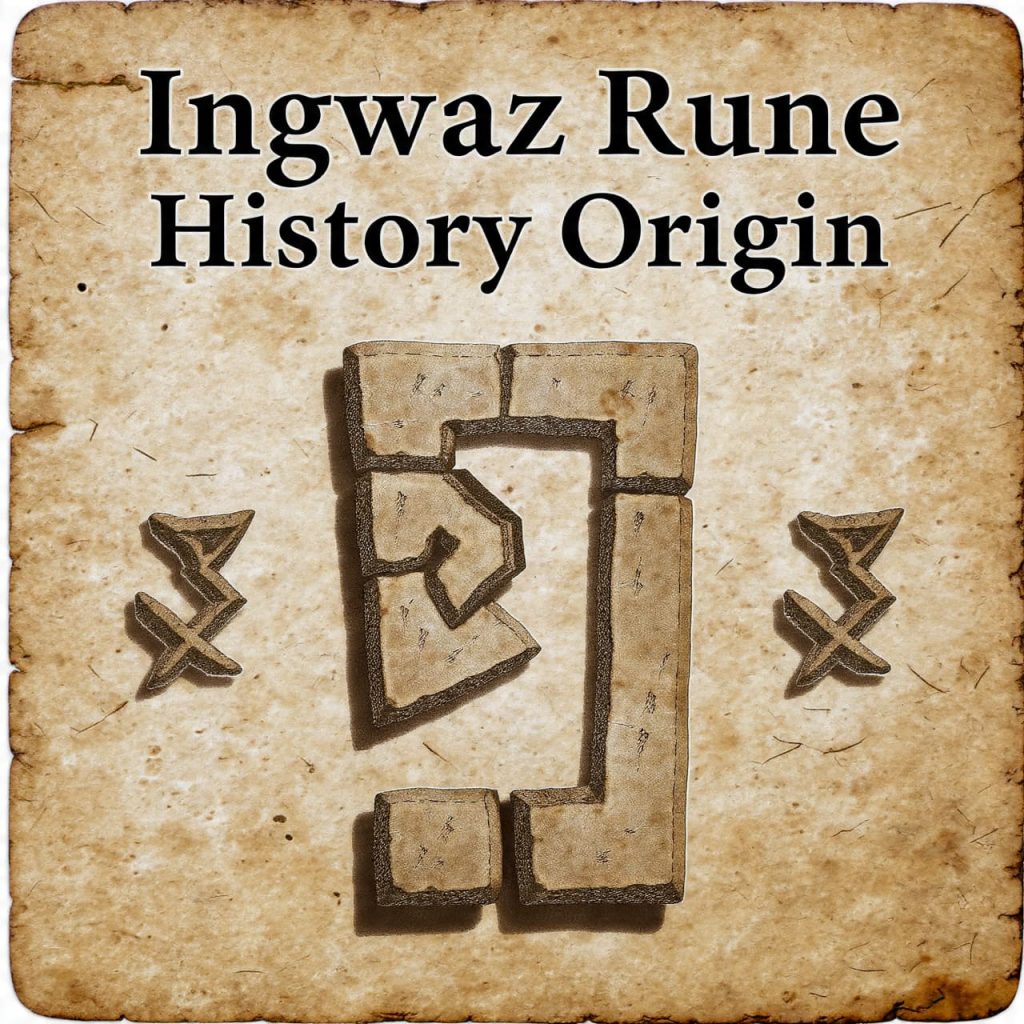
The history and origin of the Ingwaz rune are commonly misunderstood because modern discussions often merge archaeological evidence with later interpretive traditions. This blending obscures what can be established from surviving sources versus what was added centuries afterward. As a result, many readers assume a certainty that the historical record does not support. Clarifying this distinction requires a strictly evidence-based approach grounded in early Germanic material culture and linguistics, not interpretive systems promoted by modern platforms such as qualified professionals or explanatory strategies discussed on astroideal.

💜 Need a clear answer right now?
CONSULT THE YES OR NO TAROT Free · No registration · Instant resultThe uncertainty surrounding Ingwaz is historical rather than emotional. The rune appears infrequently in early inscriptions, and its meaning must be reconstructed from comparative evidence rather than explicit contemporary explanations.
The central question is therefore narrow and factual: can the historical origin and function of the Ingwaz rune be established with confidence from primary sources?
Defining the Ingwaz Rune in Historical Terms
Ingwaz is the conventional modern name for a rune that appears in later reconstructions of the Elder Futhark rune row. Historically, the rune is represented by a diamond or lozenge-like form and is conventionally transliterated as ŋ (the “ng” sound). This phonetic value is critical because runes were primarily phonemic characters, not symbolic devices.
The name “Ingwaz” itself does not appear in any surviving Elder Futhark inscriptions. Instead, it is reconstructed from later rune poems recorded in Old Norse, Old English, and Old Icelandic manuscripts dated several centuries after the rune’s initial use. These poems provide names and short verses for each rune but reflect a later literary tradition rather than the original naming conventions of the early Iron Age.
What the evidence shows is that the rune existed as a grapheme associated with a nasal phoneme. What it does not show is that its name, interpretation, or cultural significance was fixed or universally agreed upon during its earliest period of use.
Origin Within the Elder Futhark System
The Elder Futhark rune system emerged between the second and third centuries CE among Germanic-speaking populations of Northern Europe. The system consists of twenty-four characters, adapted from Mediterranean alphabets, most likely through contact with Roman or North Italic writing traditions.
Ingwaz appears toward the end of the reconstructed Elder Futhark sequence, but its placement is inferred rather than directly attested. No complete Elder Futhark inscription survives that definitively confirms the ordering of all runes. The rune’s inclusion is based on comparative reconstructions using later rune rows and phonological necessity.
Archaeological artifacts bearing runic inscriptions—such as bracteates, weapon fittings, and stones—demonstrate that runes were used primarily for names, ownership marks, and brief statements. These contexts provide no explicit commentary on rune names or abstract meanings. Thus, while Ingwaz likely originated as part of this early writing system, its original cultural framing remains undocumented.
Archaeological and Epigraphic Evidence
The physical evidence for Ingwaz is limited. The rune appears rarely in extant inscriptions, and when it does, it is embedded in words rather than isolated or emphasized. This makes it difficult to extract interpretive significance beyond its phonetic function.
Key finds include inscriptions from Scandinavia and Northern Germany dated to the Migration Period. In these examples, the rune functions as expected within a linguistic sequence. There are no dedicatory inscriptions or explanatory texts that associate the rune with myths, deities, or abstract concepts.
Scholars have examined rune stones, portable objects, and amulets to determine whether any consistent contextual pattern emerges. The conclusion is negative: the evidence does not demonstrate that Ingwaz carried a distinct symbolic role separate from its phonetic value. Claims to the contrary rely on extrapolation rather than direct archaeological proof.
Linguistic Reconstruction and the Name “Ingwaz”
The association of the rune with the name “Ingwaz” derives from comparative linguistics and later medieval texts. The Old English rune poem refers to a figure named “Ing,” while the Old Norse tradition references “Yngvi.” These names are linguistically related and likely reflect a mythological or legendary figure known in later Germanic tradition.
However, the rune poems date from the eighth to the thirteenth centuries CE, long after the Elder Futhark had fallen out of common use. Linguists caution that these poems reflect the worldview of their own time, not necessarily that of the early rune users.
The reconstruction of the rune name as “Ingwaz” is therefore a scholarly convenience. It allows modern researchers to discuss the rune consistently, but it should not be mistaken for direct historical testimony. This distinction is often lost in popular summaries, including those associated with modern divinatory formats such as reliable readers.
Transition to Later Rune Rows
By the eighth century, the Elder Futhark was gradually replaced by the Younger Futhark in Scandinavia and the Anglo-Saxon Futhorc in England. These systems reduced or expanded the rune set, altering phonetic assignments and sometimes dropping characters entirely.
Ingwaz does not appear as a distinct rune in the Younger Futhark. Its phonetic value was absorbed into other characters, reflecting changes in spoken language. This disappearance is significant: it indicates that the rune was not considered indispensable or uniquely meaningful within later writing systems.
If Ingwaz had held a central symbolic or ritual role, one might expect continuity or adaptation rather than omission. The historical record instead shows pragmatic modification driven by linguistic evolution, not preservation of symbolic content.
Emergence of Modern Interpretations
The modern understanding of Ingwaz as a concept-laden symbol originates in the nineteenth and twentieth centuries. During this period, scholars and enthusiasts sought to reconstruct pre-Christian Germanic belief systems, often filling gaps in the evidence with comparative mythology.
These reconstructions coincided with broader cultural movements interested in folklore, nationalism, and esotericism. As a result, runes were increasingly presented as carriers of abstract meanings rather than as components of a writing system. This trend accelerated in the late twentieth century with the rise of commercial interpretive practices, including online tarot sessions and video readings.
Crucially, these interpretations do not derive from new archaeological discoveries. They represent reinterpretations of existing material through modern conceptual frameworks. The historical evidence base remains unchanged.
Evaluating Claims About Ingwaz’s Original Meaning
The core historical claim often encountered is that Ingwaz originally represented a specific concept or entity beyond its phonetic role. Evaluating this claim requires examining what primary sources actually attest.
The evidence includes inscriptions, comparative alphabetic analysis, and later medieval texts. Inscriptions confirm phonetic usage only. Alphabetic analysis explains form and sound correspondence. Medieval texts provide names but are temporally distant.
What the evidence does not provide is a contemporaneous explanation linking the rune to a defined symbolic meaning at the time of its creation. Therefore, from a strictly historical standpoint, the claim that Ingwaz had a known, original symbolic meaning cannot be substantiated. Modern associations, including those circulated through phone readings and similar formats, represent later developments rather than recoverable ancient facts. This conclusion aligns with methodological approaches discussed on astroideal and contrasts with interpretations found in popular summaries such as love tarot readings.
Frequently Asked Questions
What time period does the Ingwaz rune originate from?
The rune originates from the Elder Futhark period, approximately the second to fourth centuries CE.
Is the name “Ingwaz” attested in early inscriptions?
No. The name is reconstructed from later medieval rune poems, not early inscriptions.
Does archaeological evidence show symbolic use of Ingwaz?
No. Archaeological evidence shows phonetic use only.
Did Ingwaz appear in the Younger Futhark?
No. The rune does not appear as a distinct character in the Younger Futhark.
Are rune poems reliable sources for original meanings?
They are useful for later traditions but not definitive for early Elder Futhark usage.
Can a definitive original meaning of Ingwaz be proven?
No. Existing evidence does not support a provable original symbolic meaning.
Call to Action
The historical record allows readers to evaluate the claim about Ingwaz independently and to get a clear yes or no answer by weighing inscriptions, linguistic reconstruction, and chronology rather than relying on inherited interpretations or modern summaries.
