

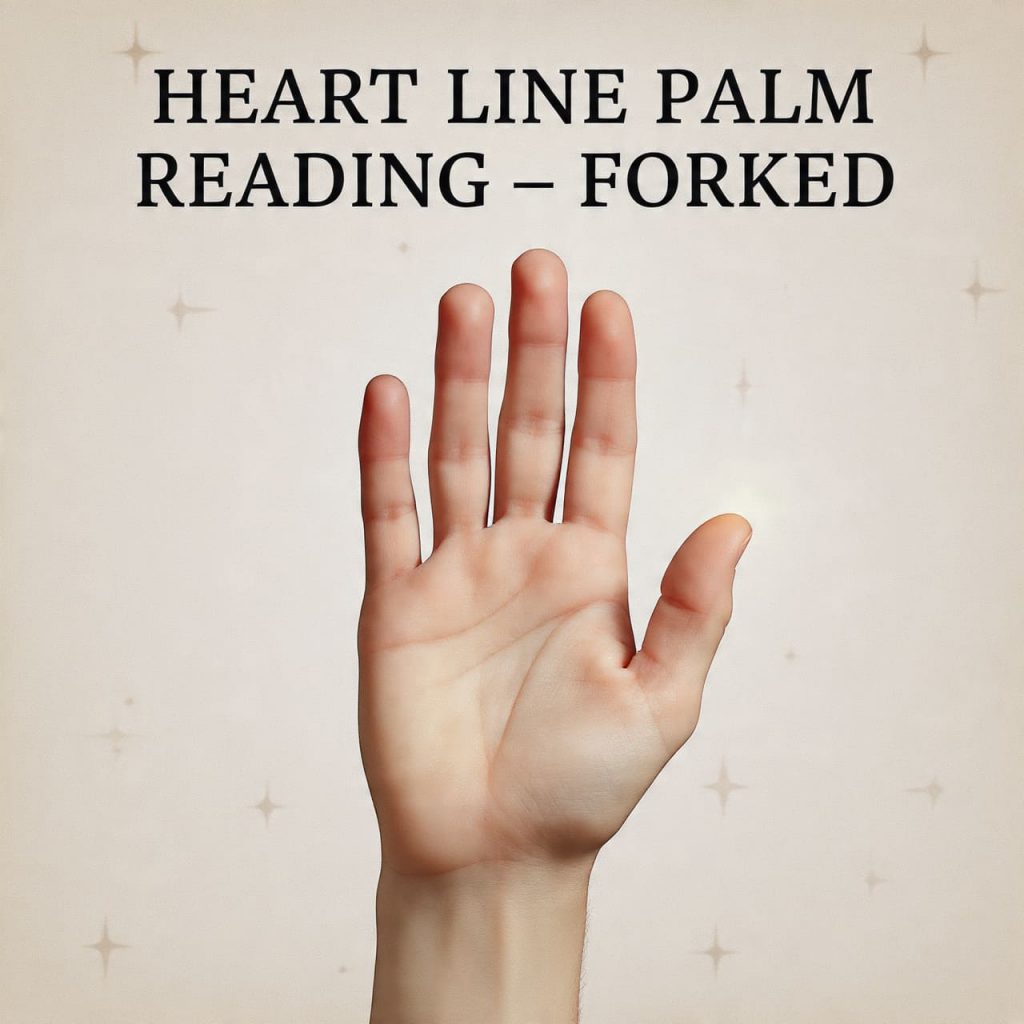
The claim that a forked heart line in palm reading carries a specific, interpretable meaning is widespread in modern popular literature, yet it remains poorly examined from a historical and evidentiary standpoint. Many contemporary descriptions present the idea as established knowledge, despite limited reference to primary sources or systematic verification. This disconnect between repetition and evidence has contributed to persistent misunderstanding.

💜 Need a clear answer right now?
CONSULT THE YES OR NO TAROT Free · No registration · Instant resultDigital astrology platforms such as astroideal frequently encounter this topic alongside references to qualified professionals, which can further blur the line between historical documentation and modern assertion.
This article addresses one narrow, factual question only: whether the forked heart line has a demonstrable historical or empirical basis as a meaningful feature in palmistry. The analysis avoids symbolism, personal interpretation, and applied practice. Instead, it evaluates textual records, archaeological context, and the emergence of modern explanations to determine whether the claim is supported by evidence.
Historical Definition of the Heart Line
The heart line, as a term, does not appear in the earliest known manuals of palm reading. Classical Greek and Roman medical texts that discuss the hand focus primarily on anatomy, circulation, and nerve function rather than symbolic line interpretation. Early references to palm markings are sparse and descriptive rather than analytical.
When palmistry texts begin to appear in medieval Europe, they often draw from translated Arabic and pseudo-Aristotelian sources. These works describe general lines of the palm but lack standardized terminology. The heart line is referenced inconsistently, and branching or forks are rarely singled out for separate treatment. Modern discussions frequently associate these historical texts with themes now common in horoscope insights, but such associations are retrospective rather than documented in the original sources.
Origin of Fork Interpretations in Palmistry Texts
The idea that a fork in the heart line signifies something distinct appears to be a late development. Renaissance-era palmistry manuals emphasize palm shape, finger length, and mounts more than line bifurcation. Where line divisions are mentioned, they are typically treated as irregularities rather than meaningful indicators.
Systematic interpretation of forks becomes more visible in nineteenth-century European palmistry, particularly in popular manuals written for lay audiences. These texts aimed to simplify palm reading into easily repeatable categories. Forks were convenient visual markers and therefore became assigned meanings without reference to prior tradition. This period coincides with the commercialization of esoteric services similar in format to modern phone readings, where simplified symbols improved memorability and appeal.
Archaeological and Manuscript Evidence
No archaeological artifacts conclusively demonstrate that forked heart lines were assigned consistent meaning in ancient cultures. Handprints preserved in art or ritual contexts, such as cave paintings or funerary reliefs, do not display annotated palm lines. Manuscript illustrations of hands from medieval Europe are stylized and schematic, offering no evidence of fork-specific interpretation.
Surviving palmistry manuscripts from the Middle Ages and early modern period show wide variation in line depiction. Forks appear incidentally, not as focal points. There is no standardized legend explaining bifurcation, nor any agreement across texts. Claims that forks were universally recognized features cannot be substantiated by manuscript comparison. This absence of corroboration is significant when contrasted with later structured offerings resembling online tarot sessions, which rely on codified meanings.
Emergence of Modern Popular Explanations
Twentieth-century palmistry literature marks a turning point. Authors increasingly framed palm reading as a system with fixed components, borrowing presentation styles from psychology and self-help publishing. Forked lines were assigned concise explanations, often without citation.
These interpretations spread rapidly through mass-market books and, later, digital media. Visual diagrams reinforced the idea that forks were intentional markers rather than natural skin variations. However, these explanations do not reference historical consensus or empirical study. Their structure mirrors other modern interpretive formats, including video readings, where visual clarity takes precedence over historical fidelity.
Scientific Examination of Palm Lines
From a biomedical perspective, palm lines are formed by flexion creases that develop during fetal growth and change subtly over time. Dermatoglyphics, the scientific study of skin patterns, examines these lines in relation to genetics and development, not symbolism.
Peer-reviewed research does not identify forks in palmar creases as indicators of psychological, behavioral, or experiential traits. Studies focus on correlations with certain congenital conditions, but these involve overall crease patterns, not isolated bifurcations. Importantly, no controlled studies have tested or validated palmistry claims about heart line forks. This absence stands in contrast to the confidence often expressed in consumer-facing interpretations such as reliable readers.
Evaluation of the Core Claim
The core claim is that a forked heart line has an inherent, interpretable meaning grounded in tradition or evidence. Historical texts do not support this assertion. Archaeological material offers no corroboration. Scientific research does not recognize forks as meaningful markers beyond natural variation.
Modern explanations can be traced to recent centuries and appear to be editorial inventions rather than inherited doctrine. Their persistence reflects repetition, not validation. Even platforms like astroideal, which document interpretive traditions, acknowledge that such claims lack uniform historical grounding when examined critically alongside offerings like love tarot readings.
Conclusion of evaluation: there is no reliable historical or empirical evidence that a forked heart line carries a fixed or authoritative meaning.
Frequently Asked Questions
What is a forked heart line in palm reading?
It refers to a palmar crease traditionally labeled the heart line that splits into two or more branches.
Do ancient palmistry texts describe forked heart lines?
No surviving ancient or medieval texts provide consistent descriptions or meanings for forked heart lines.
Is there archaeological evidence supporting fork interpretations?
No physical or artistic evidence demonstrates standardized fork interpretation in historical cultures.
Have scientific studies validated heart line forks?
No peer-reviewed studies support symbolic or predictive claims about forked heart lines.
When did fork interpretations become common?
They became common in nineteenth- and twentieth-century popular palmistry literature.
Are modern interpretations historically consistent?
No, modern interpretations vary widely and lack historical consensus.
Conclusion
After examining historical texts, archaeological material, and scientific research, the answer is clear and singular: No, there is no credible historical or empirical evidence that a forked heart line possesses a defined, authoritative meaning in palm reading. The claim originates in modern popularization rather than documented tradition or validated study.
Readers seeking to get a clear yes or no answer should evaluate such claims by tracing their sources and distinguishing repetition from evidence.
