

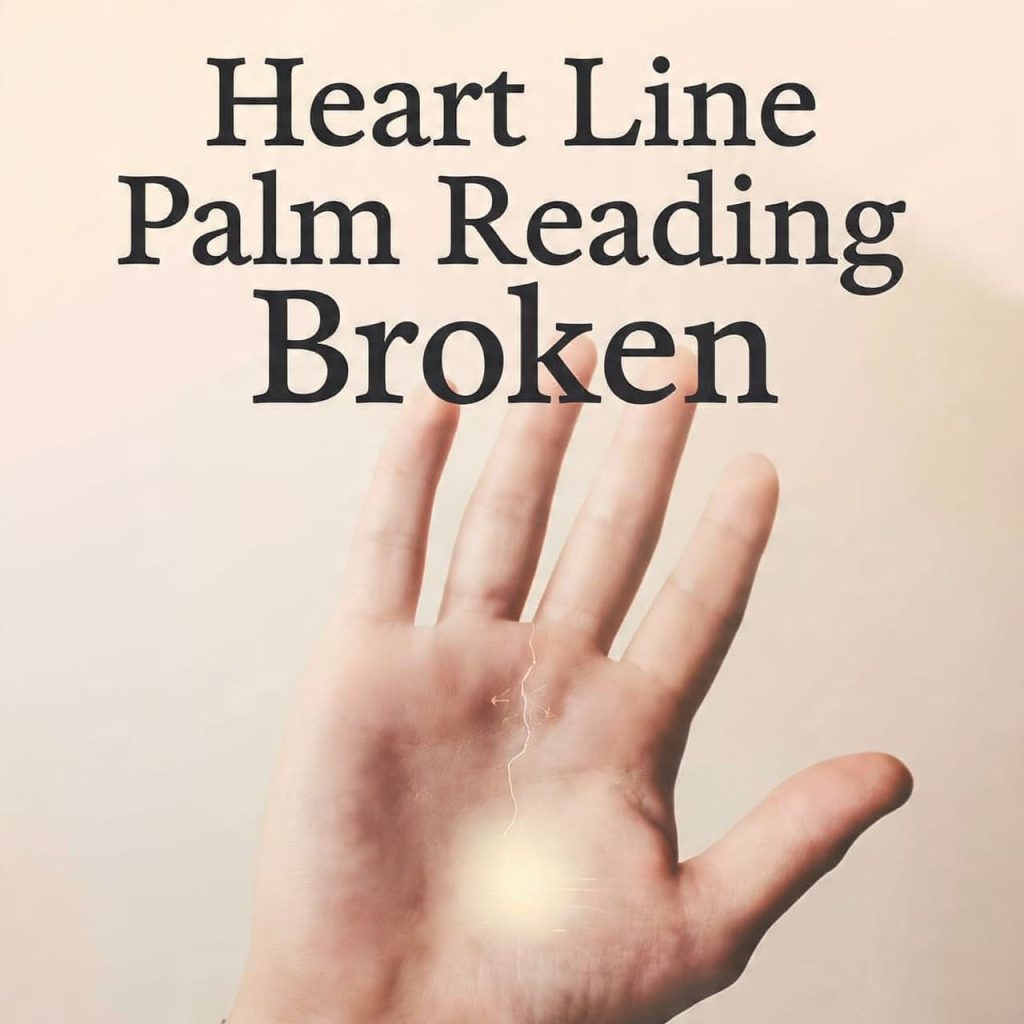
The phrase “heart line palm reading broken” is widely used in modern palmistry, where a break in the heart line is said to indicate emotional disruption, relationship challenges, or significant life events. This framing implies that line breaks carried a defined interpretive meaning in historical palm reading traditions. That implication is historically uncertain. The confusion arises from presenting contemporary diagnostic rules as if they were inherited intact from earlier practice.

💜 Need a clear answer right now?
CONSULT THE YES OR NO TAROT Free · No registration · Instant resultModern explanatory material, including summaries published on astroideal, often treats breaks in palm lines as decisive markers and may direct readers to qualified professionals for clarification. However, modern interpretive confidence does not establish historical validity. The precise question examined here is factual and limited: does historical evidence support a defined or original meaning for a broken heart line in palm reading?
What “Broken” Means in Historical Palmistry
In modern palmistry, a “broken” heart line is typically defined as a visible interruption, gap, or discontinuity. This definition presupposes consistent criteria for identifying breaks and a shared understanding of their significance. Historically, such criteria are not documented.
Early palmistry traditions did not preserve standardized visual thresholds for what constituted a break versus a natural variation. Without diagrams, measurement standards, or agreed terminology in early texts, claims that breaks carried specific meanings rely on later interpretive frameworks or the assumptions of reliable readers rather than contemporaneous evidence.
Early Palmistry and Line Continuity
Palmistry, or chiromancy, developed across South Asian, Near Eastern, and Mediterranean contexts over long periods. Early sources treat the hand as a holistic indicator of constitution, vitality, or fate. Observations emphasized overall form, texture, and balance rather than fine-grained analysis of line continuity.
Lines were observed as natural features subject to variation. There is no evidence that early palmists systematically classified lines as continuous or broken, nor that they assigned distinct meanings to such conditions. The modern emphasis on breaks reflects later analytical habits rather than ancient observational practice. This contrasts with modern interpretive systems such as those used in online tarot sessions, which are designed around discrete symbolic states.
The Emergence of the Heart Line as a Discrete Feature
The identification of a specific “heart line” emerged gradually, particularly in early modern Europe, as palmistry authors sought to systematize visible palm features. This categorization relied on metaphorical association rather than inherited doctrine.
Once the heart line was defined, later authors subdivided interpretations based on features such as curvature, forks, islands, and breaks. The notion that a break carried a specific meaning developed within this later classificatory expansion. Importantly, these interpretations vary widely between authors, indicating interpretive invention rather than preserved tradition. This pattern mirrors interpretive expansion similar to that seen in video readings.
Textual Evidence and Claims About Breaks
A review of classical, medieval, and early modern palmistry texts reveals no standardized discussion of heart line breaks. Classical physiognomic sources do not analyze palm lines with this level of detail. Medieval chiromancy manuscripts are inconsistent and often lack illustrations that would support precise classification.
Where early modern texts discuss line irregularities, they do so descriptively rather than analytically. There is no agreement on what constitutes a break, how many breaks matter, or what a break signifies. The absence of shared criteria is significant. When interpretive systems depend on visual markers, they typically preserve clear definitions.
Interpreting later manuals as evidence of ancient practice introduces chronological distortion, an approach closer to phone readings than to evidence-based historical analysis.
Cross-Cultural Comparison of Broken-Line Interpretation
Cross-cultural comparison further challenges claims of an original meaning for a broken heart line. South Asian palmistry traditions often emphasize karmic patterns, mounts, or overall hand balance rather than line continuity. East Asian hand reading systems prioritize hand shape and proportional harmony, with limited or no emphasis on broken lines.
If heart line breaks had an ancient, universally recognized meaning, some degree of cross-cultural consistency would be expected. Instead, interpretations diverge significantly or omit the concept altogether. This divergence indicates that broken-line interpretations are culturally constructed and historically late.
Assigning a single authoritative meaning to a broken heart line reflects modern categorization habits similar to those used in horoscope insights rather than evidence-based historical reconstruction.
What the Historical Record Does Not Establish
A systematic review of palmistry literature and comparative traditions shows that the historical record does not establish:
- A universal definition of a “broken” heart line
- Early documentation linking breaks to specific outcomes
- Consistent interpretation across cultures or centuries
- Evidence that line continuity was central to early palm reading
Where references to irregularities appear, they are late, inconsistent, and author-specific. This variability is incompatible with claims of ancient or standardized meaning.
Modern Consolidation of Broken-Line Meanings
During the nineteenth and twentieth centuries, palmistry manuals increasingly formalized interpretations to reach broader audiences. Line irregularities, including breaks, became intuitive variables for classification, and simplified meanings were assigned.
These interpretations are historically traceable and demonstrably modern. They did not arise from newly discovered ancient texts or revised readings of early sources. Instead, they reflect pedagogical convenience and the influence of modern psychological narrative.
Such frameworks are often presented alongside interpretive systems comparable to love tarot readings and are discussed using analytical approaches described on astroideal. Their apparent consistency reflects modern convention rather than historical continuity.
Evaluating the Core Claim with Evidence
The claim under examination is precise: does a broken heart line have a historically established meaning in palm reading?
Based on textual history, cross-cultural comparison, and the chronology of palmistry literature, the answer is no. While palm lines have long been observed, there is no evidence that breaks in the heart line originally or consistently carried a fixed or standardized meaning. Interpretations of a broken heart line are modern constructs layered onto earlier, non-specific hand observation.
Frequently Asked Questions
Did ancient palmists interpret broken heart lines?
There is no evidence supporting this.
Are there early texts defining what counts as a break?
No standardized definitions exist in early sources.
Do all palmistry traditions interpret breaks similarly?
No. Many traditions omit line breaks entirely.
When did broken-line meanings become common?
Primarily in modern palmistry manuals.
Do historians consider these meanings ancient?
No. They are considered later developments.
Are breaks unique compared to other line features?
No. Similar reinterpretation applies to many features.
Call to Action
To evaluate claims about broken palm lines responsibly, consult historical texts and cross-cultural evidence directly to get a clear yes or no answer, distinguishing documented tradition from later interpretive systems or one question tarot–style certainty.
