

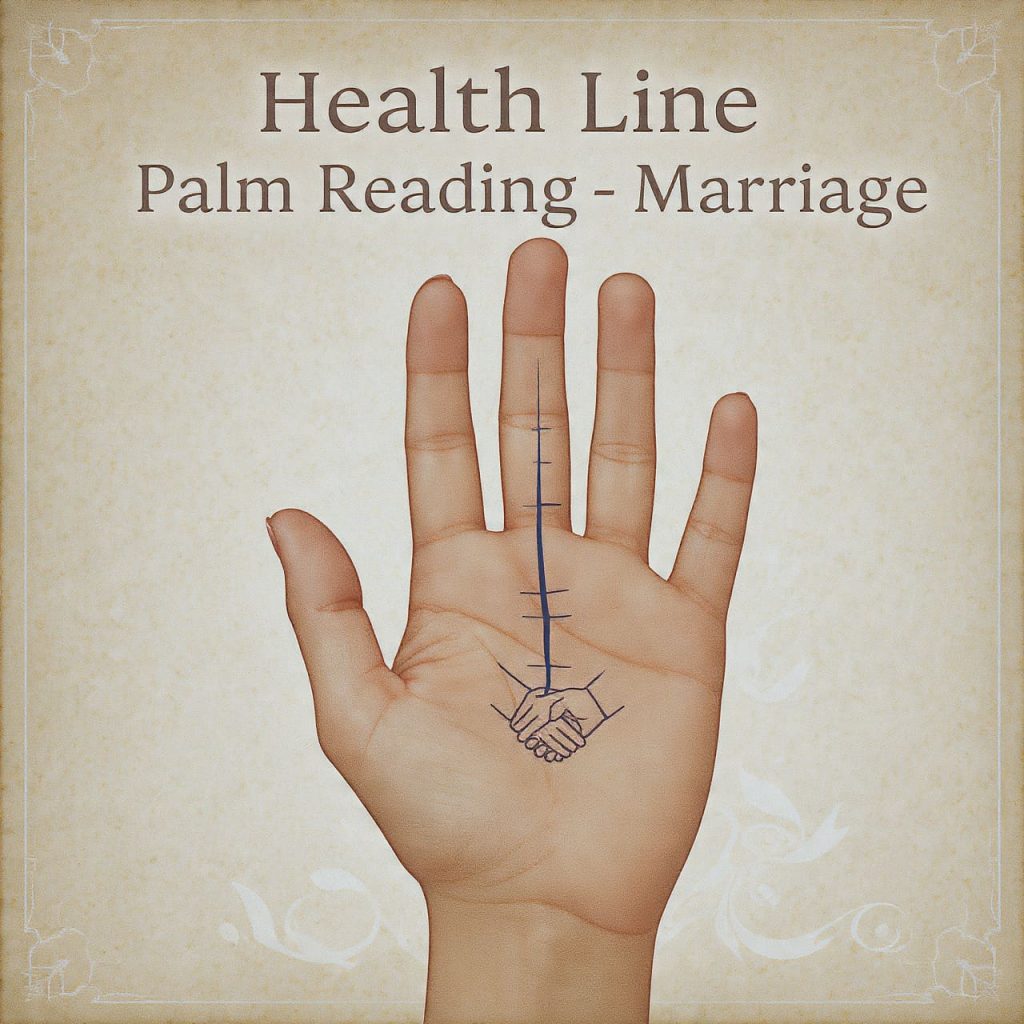
The phrase “health line palm reading marriage” is widely misunderstood because it combines two separate symbolic domains—physical health and marital relationships—into a single factual claim. In modern palmistry content, this linkage is often presented as traditional and reliable, suggesting that a palm marking associated with health can also provide concrete information about marriage. Historical sources and scientific research, however, do not clearly support such an association.

💜 Need a clear answer right now?
CONSULT THE YES OR NO TAROT Free · No registration · Instant resultThe uncertainty examined here is strictly historical and factual, not emotional or practical. Did palmistry traditions ever establish a documented connection between a so-called health line and marriage-related facts, or is this association a modern construct formed through later symbolic expansion?
This article evaluates that question using textual history, archaeological context, and anatomical research, following evidence-first analytical standards consistent with critical approaches discussed on astroideal. The conclusion is explicitly binary.
Defining the “Health Line” in Historical Context
In contemporary palmistry, the health line—often identified with the Mercury line—is described as a palm marking linked to physical well-being. Historically, however, palmistry texts do not define a line whose primary or exclusive purpose is medical, nor do they extend such a line’s meaning into marital or relational domains.
Early palmistry sources relied on symbolic language and treated the hand holistically. Bodily condition, where mentioned, was framed in terms of temperament or balance rather than discrete medical states. Crucially, no historical text assigns marital significance to any line described as health-related. Assertions that such interpretations were transmitted by qualified professionals lack support in primary documentation.
Marriage and Health as Separate Symbolic Domains
In ancient Indian, Chinese, and Greco-Roman traditions, marriage and health were understood as distinct aspects of life. Marriage was embedded in legal, social, or moral frameworks, while health was addressed through philosophical or medical systems such as balance or humoral theory. Hand reading, when present, reflected symbolic correspondence rather than analytical crossover between these domains.
Medieval European palmistry, influenced by astrology and humoral medicine, continued this separation. Different parts of the hand were symbolically associated with different qualities, but there is no evidence that health-related markings were interpreted for marital facts. The historical record therefore shows differentiation, not convergence, between health and marriage symbolism.
Textual and Archaeological Evidence Review
A review of surviving palmistry manuscripts reveals no textual evidence linking a health-related palm feature with marriage-related facts. Descriptions of lines vary widely between sources, and illustrations are schematic rather than anatomically precise. This variability indicates symbolic intent rather than analytical measurement.
Archaeological evidence likewise provides no support. There are no standardized charts, instructional tools, or artifacts demonstrating that health-associated palm markings were interpreted for marital significance. What the evidence shows is culturally shaped symbolism; what it does not show is a method for reading marriage facts from a health-related line.
This absence is decisive when evaluating claims of historical legitimacy.
Modern Convergence of Health and Marriage Interpretations
The association between health lines and marriage appears primarily in modern popular palmistry. From the nineteenth century onward, palmistry was reorganized to address a wide range of personal topics within a single reading. Health, relationships, and marriage were grouped together to create comprehensive-looking interpretations.
This trend parallels the rise of generalized interpretive services offered by reliable readers, where multiple life domains are addressed simultaneously. In this commercial context, linking health lines to marriage simplified complex symbolic traditions into accessible narratives. Historically, this represents reinterpretation rather than continuity.
Scientific Perspective on Health–Marriage Palm Claims
From a scientific standpoint, palmar lines are studied within dermatoglyphics. Research shows that these creases form during fetal development and are influenced by genetic and mechanical factors. They are static anatomical features, not records of later social events.
No peer-reviewed studies demonstrate a relationship between any palm line and marriage outcomes. There is also no plausible causal mechanism by which a crease formed before birth could encode both health and marital information. Modern interpretive settings, including online tarot sessions and video readings, may present such interpretations, but they do not introduce empirical validation.
Evaluating the Core Claim With Evidence
The core claim is that a health line in palm reading has factual meaning regarding marriage. Evaluating this claim requires assessing historical continuity and empirical support.
Historically, continuity is absent. No ancient or medieval text links health-related palm features to marriage facts. Empirically, scientific research on palmar anatomy provides no support for such cross-domain interpretation. What exists instead is a modern symbolic framework reinforced through repetition.
On evidentiary grounds, the claim does not hold. There is no historical documentation or scientific data supporting the idea that a health line conveys factual information about marriage.
Separation From Other Interpretive Systems
The blending of health and marriage interpretations is often reinforced through association with other divinatory practices. In contemporary contexts, palm reading is frequently bundled with astrology or card-based interpretation, creating an impression of shared legitimacy.
Historically, these systems developed independently, each with its own symbolic grammar. Even within palmistry, bodily and marital symbolism were not unified. The inclusion of health–marriage interpretations alongside services such as phone readings or horoscope insights reflects modern packaging rather than documented tradition.
Final Historical Assessment
Based on surviving texts, archaeological context, and scientific research, the association of a health line with marriage in palm reading lacks historical grounding and empirical support. It represents a modern interpretive convergence rather than an evidence-based tradition.
This assessment aligns with critical evaluation approaches discussed on astroideal, which emphasize distinguishing documented historical practice from later symbolic expansion. In contemporary discourse, such associations are sometimes reinforced through love tarot readings, but these do not alter the evidentiary conclusion.
The factual answer to the central question is therefore clear and unambiguous: no, health line palm reading does not provide evidence-based information about marriage.
Frequently Asked Questions
Do historical palmistry texts link health lines to marriage?
No surviving ancient or medieval texts connect health-related palm features with marriage facts.
Were health and marriage interpreted together historically?
Historical sources treated these domains as symbolically separate.
Is there scientific evidence for health–marriage palm readings?
No scientific studies support extracting marriage-related facts from palm lines.
When did this combined interpretation appear?
It emerged in modern popular palmistry literature.
Are these interpretations consistent across cultures?
No, they vary widely and lack historical consistency.
Do modern readings add new evidence?
No, they repeat symbolic interpretations without independent verification.
Call to Action
Readers seeking to get a clear yes or no answer should evaluate claims about health line palm reading and marriage by examining primary historical sources and empirical research, rather than relying on modern interpretive combinations presented without evidentiary support.
