

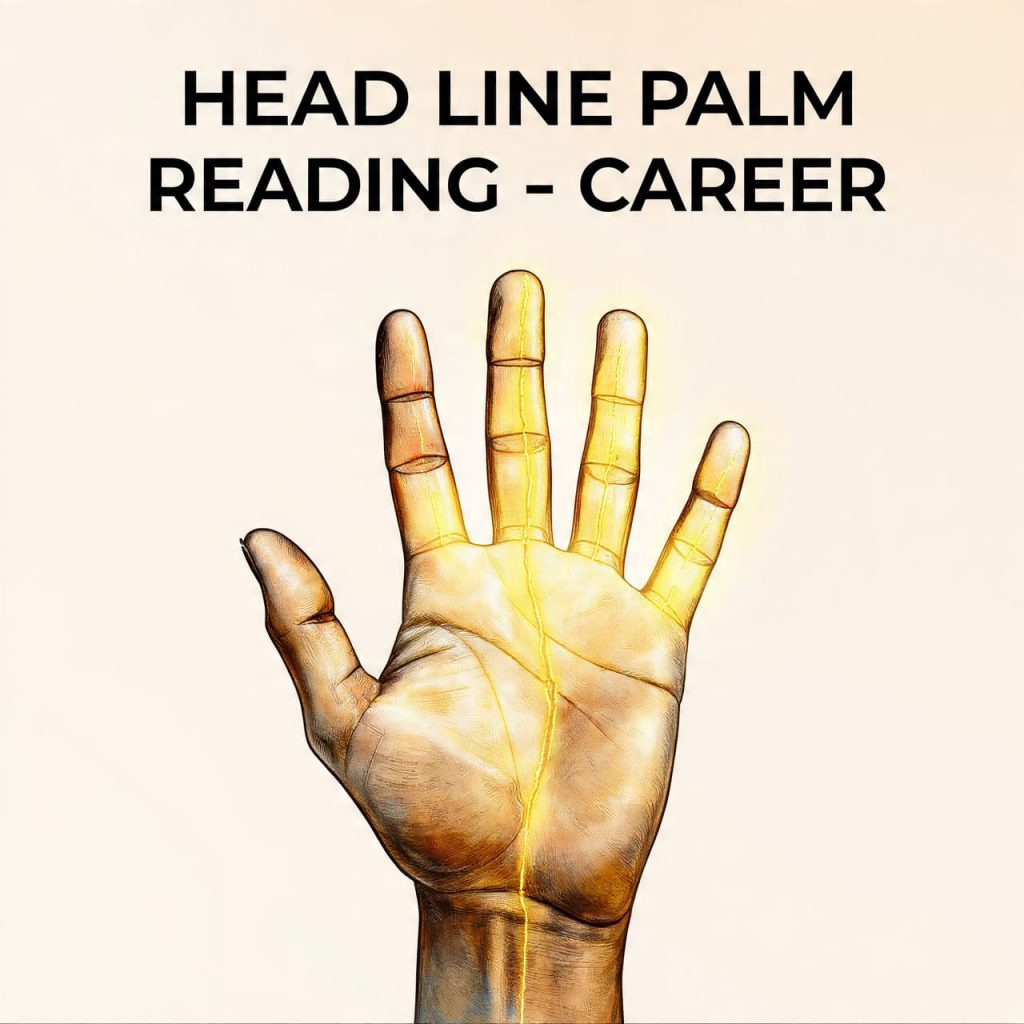
The assertion that the head line in palm reading can be used to determine or analyze career-related matters is common in modern palmistry discourse, yet it is rarely tested against historical records or empirical evidence. Contemporary explanations often present this association as traditional knowledge without demonstrating when or how it emerged. As a result, repetition has substituted for documentation.

💜 Need a clear answer right now?
CONSULT THE YES OR NO TAROT Free · No registration · Instant resultOn platforms such as astroideal, this topic frequently appears alongside references to qualified professionals, which can give the impression that the claim rests on established foundations rather than modern interpretation.
This article evaluates a single factual question: whether there is credible historical or empirical evidence that the head line was traditionally or systematically used to interpret career or occupational matters in palmistry. The analysis is strictly historical and evidentiary, avoiding instruction, guidance, or prediction, and aims to reach a clear yes-or-no conclusion.
Career as a Category in Early Palmistry
In early palmistry texts, career or occupation is not treated as a discrete analytical category. Classical and medieval writings that reference the hand do so descriptively, often in medical or philosophical contexts, rather than as tools for vocational analysis.
When palmistry manuals begin to appear in Europe, they emphasize general observations rather than structured life domains. No early source identifies a specific palmar line as relevant to career determination. Attempts to retroactively align early palmistry with occupational analysis resemble thematic frameworks later seen in horoscope insights, but these frameworks are absent from original materials.
Lack of Head Line–Career Association in Historical Sources
Surviving palmistry manuscripts from the medieval and early modern periods do not associate the head line with career, profession, or work-related outcomes. Even when lines are discussed, they are described in broad terms without vocational attribution.
No primary source outlines a method for examining the head line to infer occupational matters. This absence is important because it indicates that career-focused interpretations were not part of early palmistry systems. The later segmentation of palmistry into career-focused explanations follows a logic similar to commercial offerings such as phone readings rather than historical precedent.
Review of Manuscript and Visual Evidence
Illustrated palmistry manuscripts are often cited to support modern interpretations, but these illustrations are schematic and symbolic rather than observational. They rarely include explanatory text and do not depict real palms with analytical intent.
Comparative examination of these images shows no consistent emphasis on the head line in relation to work or profession. Line labeling varies widely, and no legend connects the head line to career themes. Modern diagrams that claim such associations rely on standardized templates developed centuries later, comparable in presentation style to online tarot sessions.
Emergence of Career Interpretations in Modern Palmistry
The association between the head line and career appears primarily in nineteenth- and twentieth-century popular palmistry literature. During this period, authors increasingly divided palmistry into thematic categories such as love, health, and career to appeal to a broader audience.
These career interpretations vary substantially between authors, with no consistent definition or rationale. The lack of agreement suggests that these associations were constructed rather than inherited. This modular approach mirrors modern interpretive services, including video readings, which emphasize clear thematic separation over historical continuity.
Scientific Assessment of Career Claims
From a scientific perspective, there is no mechanism by which a palmar crease could encode information about career or occupational outcomes. Palmar lines are flexion creases formed during fetal development and influenced by hand movement.
Scientific fields such as dermatoglyphics study these creases for developmental correlations, not symbolic or vocational meaning. No peer-reviewed studies demonstrate any relationship between the head line and career-related traits or outcomes. Claims asserting such relationships lack empirical support despite their promotion through reliable readers.
Evaluation of the Core Claim
The core claim is that the head line has a historically grounded or empirically supported role in palm reading related to career. Examination of historical texts shows no such role. Manuscript and visual evidence do not support career-specific interpretation of the head line, and scientific research provides no validation.
The career association can be traced to modern popular palmistry rather than documented tradition. Even within contemporary platforms such as astroideal, this association aligns more closely with recent interpretive constructs comparable to love tarot readings than with historical evidence.
Final evaluation: the claim is not supported by reliable historical or empirical evidence.
Frequently Asked Questions
What does head line palm reading career refer to?
It refers to the modern idea that the head line can be interpreted to assess career or occupational matters.
Do historical palmistry texts support this idea?
No historical texts consistently link the head line with career or profession.
Is there archaeological evidence for this interpretation?
No archaeological or artistic evidence supports a career-based role for the head line.
When did career interpretations become common?
They became common in modern palmistry literature from the nineteenth century onward.
Has science validated career interpretations of the head line?
No scientific studies support such interpretations.
Are modern explanations historically consistent?
No, they vary widely and lack documented continuity.
Conclusion
After reviewing historical literature, manuscript evidence, and scientific research, the conclusion is unequivocal: No, there is no credible historical or empirical evidence that the head line was traditionally or reliably used in palm reading to interpret career matters. The association is a modern construction rather than a documented inheritance.
Readers seeking to get a clear yes or no answer should evaluate such claims by examining their historical origins, consistency across sources, and empirical support rather than their repetition or popularity.
