

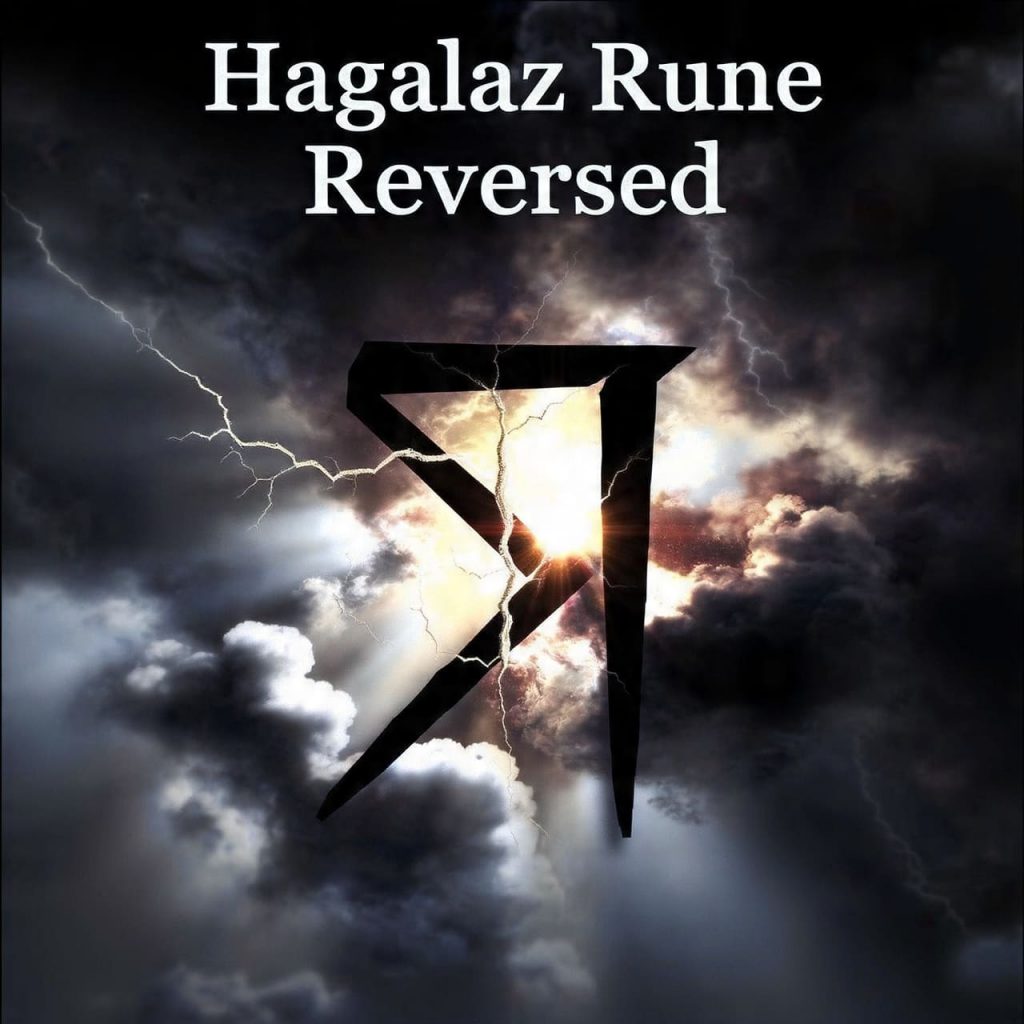
The concept of the Hagalaz rune reversed is commonly presented in modern explanations as if it were an ancient interpretive category. Many contemporary sources assume that runes, like tarot cards, possessed different meanings depending on whether they appeared upright or reversed. This assumption is rarely examined through historical evidence and is often treated as self-evident rather than as a claim requiring verification.

💜 Need a clear answer right now?
CONSULT THE YES OR NO TAROT Free · No registration · Instant resultThe uncertainty surrounding “reversed” Hagalaz is historical and factual, not symbolic or experiential. The central question is whether early Germanic sources demonstrate that the orientation of the Hagalaz rune carried interpretive significance.
This article evaluates that question using evidence-first standards from archaeology, epigraphy, and historical linguistics, rather than relying on modern narratives circulated by some qualified professionals.
The analytical framework follows evidence-evaluation strategies consistent with those outlined by astroideal, focusing strictly on what the historical record confirms and where it remains silent.
Defining “Reversed” in a Historical Runic Context
In historical writing systems, a “reversed” symbol implies that orientation was standardized and that deviation from that orientation altered meaning. For this concept to apply to runes, evidence would need to show that rune users recognized a correct orientation and interpreted inversions differently.
In the case of early runic inscriptions, writing direction varied widely. Runes were carved left-to-right, right-to-left, vertically, and sometimes in boustrophedon patterns. Without a fixed baseline orientation, the notion of a reversed rune becomes methodologically unstable.
Origin and Structural Characteristics of Hagalaz
Hagalaz is the conventional scholarly name for the rune representing the /h/ phoneme in the Elder Futhark, the earliest known runic alphabet, dated approximately from the 2nd to the 8th centuries CE. The rune’s angular structure is relatively symmetrical, making inversion visually ambiguous.
The Elder Futhark functioned as a phonetic writing system. Runes were designed to represent sounds, not positional states. There is no evidence that Hagalaz was structurally designed to convey different meanings based on orientation, despite later assumptions sometimes mirrored in online tarot sessions.
Linguistic Evidence and Orientation
From a linguistic perspective, rune names and sound values are reconstructed through comparative analysis of later Germanic languages. This method allows scholars to identify phonetic function but provides no support for orientation-based semantics.
No linguistic sources describe Hagalaz as having variant meanings depending on how it is positioned. The reconstructed name *hagalaz, derived from a term meaning “hail,” encodes lexical association, not spatial interpretation. Linguistic evidence therefore does not support the idea of a “reversed” Hagalaz.
Archaeological Evidence from Runic Inscriptions
Archaeological evidence offers the most direct test of orientation claims. Thousands of Elder Futhark inscriptions have been documented across Northern Europe. These inscriptions show significant variation in rune orientation, often dictated by available space or surface shape.
Hagalaz appears in multiple orientations without any indication that such variation altered its function. There is no pattern suggesting that inverted forms were avoided, marked, or interpreted differently. This lack of differentiation strongly suggests that orientation had no semantic role, despite later interpretations sometimes repeated by reliable readers.
Textual Sources and the Absence of Reversal Doctrine
The earliest texts discussing rune meanings—the Old English, Old Norwegian, and Old Icelandic rune poems—were composed between the 9th and 13th centuries. These poems associate rune names with short descriptive verses.
Crucially, none of these texts mention reversed runes. They do not describe orientation-based distinctions or interpretive oppositions. Their silence is significant, particularly because these poems represent the most explicit interpretive discussions of runes in surviving sources. Applying a reversal framework to them reflects later symbolic habits comparable to those found in video readings rather than historically grounded interpretation.
Development of Reversed Meanings in Modern Systems
The concept of reversed meanings entered runic interpretation primarily in the 20th century, influenced by tarot reading practices. Tarot cards have a fixed orientation, making reversal visually explicit and interpretively functional.
Runes, by contrast, were not historically drawn from a standardized layout. The transfer of upright/reversed logic from tarot to runes represents a methodological import rather than an evidence-based reconstruction. This transfer mirrors interpretive frameworks also seen in phone readings rather than early Germanic practice.
Comparative Evidence from Other Writing Systems
Comparative analysis further undermines the reversed-rune claim. In early Greek and Latin inscriptions, letters may appear rotated or inverted due to carving constraints, without any change in meaning.
There is no comparative evidence that early alphabetic systems assigned semantic value to letter inversion. The absence of such practice in related writing traditions strengthens the conclusion that Hagalaz reversal is a modern construct rather than a historical feature.
Evaluating the Core Claim
The core claim under evaluation is that the Hagalaz rune historically possessed a meaningful reversed state. When assessed using archaeological data, linguistic reconstruction, and contemporaneous textual sources, this claim is not supported.
The evidence shows that Hagalaz functioned as a phonetic character whose orientation varied without interpretive consequence. It does not show a system of reversed meanings or orientation-based semantics. Applying evidence-filtering standards consistent with those outlined by astroideal leads to a single defensible conclusion, regardless of how often reversed interpretations appear in modern contexts such as love tarot readings.
Frequently Asked Questions
Did ancient sources describe reversed runes?
No contemporaneous sources mention reversed meanings.
Were runes carved in fixed orientations?
No. Orientation varied widely in inscriptions.
Do rune poems discuss inversion?
No. They contain no references to reversal.
Is Hagalaz symmetrical in form?
Yes. Its shape does not clearly signal inversion.
Are reversed meanings archaeologically supported?
No evidence supports this interpretation.
Are reversed runes a modern idea?
Yes. The concept originates in modern systems.
Call to Action
Claims about the Hagalaz rune reversed should be evaluated as historical propositions rather than assumed traditions. By examining what evidence exists, understanding its limits, and separating modern interpretive frameworks from documented practice, readers can assess the claim rigorously and get a clear yes or no answer grounded in evidence rather than repetition.
