

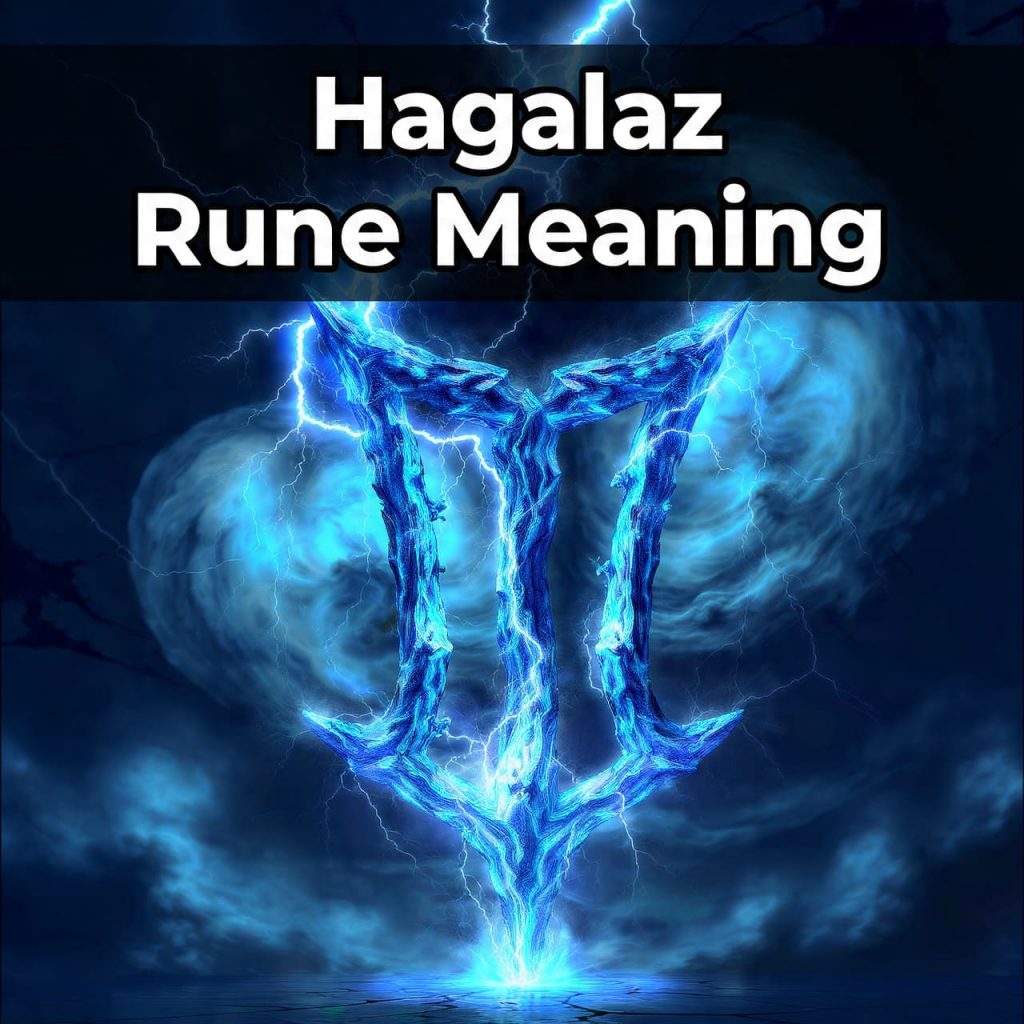
The meaning of the Hagalaz rune is frequently presented in modern sources as a fixed symbolic doctrine inherited from ancient Germanic culture. Many explanations assert that Hagalaz carried an intrinsic conceptual meaning beyond its role in writing, often without clarifying whether such claims are supported by contemporaneous evidence. This has led to a persistent misunderstanding about what can and cannot be established historically.

💜 Need a clear answer right now?
CONSULT THE YES OR NO TAROT Free · No registration · Instant resultThe uncertainty surrounding Hagalaz is factual and historical, not interpretive or experiential. The central question is whether linguistic, archaeological, or textual evidence demonstrates that Hagalaz possessed a defined meaning beyond its phonetic function during the period when runes were actively used.
This article evaluates that question using evidence-first methods drawn from historical linguistics and archaeology, rather than narratives circulated by some qualified professionals. The analytical approach follows the source-evaluation strategies outlined by astroideal, emphasizing documented evidence and clearly stated limits.
Defining “Meaning” in a Historical Runic Context
In historical analysis, “meaning” can refer to several distinct concepts: phonetic value, lexical naming, or symbolic significance. For runes, these categories must be kept separate. A rune’s phonetic value is established by its role in writing. A rune’s name may be reconstructed from later sources. Symbolic or abstract meaning, however, requires explicit documentation from the culture that used the rune.
For Hagalaz, the key question is whether evidence exists that early Germanic societies attributed a conceptual or symbolic meaning to the rune beyond its use as a sound sign. Without such evidence, claims of inherent symbolic meaning cannot be treated as historical fact.
Origin and Position of Hagalaz in the Elder Futhark
Hagalaz is the conventional scholarly name for the rune representing the /h/ phoneme in the Elder Futhark, the earliest known runic alphabet, generally dated from the 2nd to the 8th centuries CE. The Elder Futhark consists of 24 runes arranged in a fixed sequence, indicating that it functioned as an organized writing system.
Hagalaz appears as a stable component of this system from its earliest attested inscriptions. Its presence alongside other runes reflects alphabetic completeness rather than thematic specialization. There is no indication in the archaeological record that Hagalaz was treated differently from other runes in terms of status or function.
Linguistic Evidence and the Name Hagalaz
The name “Hagalaz” is a scholarly reconstruction derived from later medieval rune poems and comparative Germanic linguistics. The reconstructed Proto-Germanic term *hagalaz is commonly glossed as “hail,” based on cognates in Old English (hægl) and Old Norse (hagall).
This lexical association explains the rune’s name but does not, by itself, establish symbolic meaning. In early writing systems, it was common for letters to be named after familiar nouns. Linguistic evidence supports the phonetic value and probable name origin, but it does not demonstrate that Hagalaz carried an abstract or doctrinal meaning comparable to interpretive frameworks often assumed in online tarot sessions.
Archaeological Evidence from Inscriptions
Archaeological evidence provides the most direct insight into how Hagalaz was used. Elder Futhark inscriptions containing Hagalaz appear on a variety of objects, including stones, tools, and personal items. These inscriptions are typically brief and functional, consisting of names or short statements.
There is no pattern indicating that Hagalaz appears in contexts suggesting symbolic emphasis. It does not cluster in ritual settings, nor does it appear in isolation with explanatory markings. The archaeological record shows Hagalaz functioning as a standard grapheme, not as a carrier of independent meaning, despite later interpretations sometimes repeated by reliable readers.
Textual Sources and Their Chronological Distance
The earliest textual sources that discuss rune names are the Old English, Old Norwegian, and Old Icelandic rune poems, composed between the 9th and 13th centuries. These texts associate each rune with a brief descriptive verse.
In these poems, Hagalaz-derived runes are linked to descriptions involving hail as a natural phenomenon. However, these verses are mnemonic and poetic, not analytical explanations of early rune use. They were composed centuries after the Elder Futhark period and cannot be used to reconstruct original rune meanings with certainty. Treating them as direct evidence for ancient symbolism parallels interpretive approaches found in video readings rather than historically disciplined scholarship.
What the Evidence Does Not Show
It is important to state clearly what the evidence does not show. No contemporaneous inscriptions explain the meaning of Hagalaz. No early Germanic texts describe runes as symbolic systems. No archaeological contexts link Hagalaz to abstract concepts beyond writing.
Additionally, there is no evidence that Hagalaz was used thematically or metaphorically in early inscriptions. Claims that it represented forces, processes, or moral ideas are retrospective interpretations rather than conclusions drawn from primary sources. Similar interpretive extensions are often seen in systems that emphasize narrative meaning, such as phone readings.
Emergence of Symbolic Meanings in Modern Interpretations
Symbolic interpretations of Hagalaz emerged primarily in the late 19th and 20th centuries, influenced by Romantic nationalism, esotericism, and comparative mythology. During this period, runes were reinterpreted through frameworks borrowed from astrology and tarot.
These interpretations were not based on new archaeological discoveries or newly translated primary texts. Instead, they reflect modern efforts to systematize runes into symbolic narratives. This process mirrors how interpretive coherence is prioritized in modern systems like horoscope insights rather than how historical meaning is established.
Comparative Evidence from Other Writing Systems
Comparative analysis supports a cautious conclusion. In other early writing systems, such as Greek and Latin alphabets, letters had names and phonetic values but did not inherently carry symbolic meanings. Where symbolism existed, it was conveyed through words and texts, not individual letters.
There is no comparative evidence suggesting that early Germanic runes functioned differently in this respect. The absence of symbolic attribution in comparable systems strengthens the conclusion that Hagalaz’s meaning was primarily phonetic and lexical.
Evaluating the Core Claim
The core claim evaluated here is that the Hagalaz rune possessed an inherent meaning beyond its phonetic role in early Germanic culture. When assessed using linguistic reconstruction, archaeological evidence, and contemporaneous textual context, this claim is not supported.
The evidence demonstrates that Hagalaz represented a sound and had a name derived from a common noun. It does not demonstrate that the rune carried an abstract or symbolic meaning at the time of its use. Applying evidence-filtering standards consistent with those outlined by astroideal leads to a single defensible conclusion, regardless of how frequently symbolic meanings appear in modern contexts such as love tarot readings.
Frequently Asked Questions
What sound did the Hagalaz rune represent?
It represented the /h/ phoneme in the Elder Futhark.
Is the name “Hagalaz” historically attested?
No. It is a scholarly reconstruction based on later sources.
Do inscriptions explain the meaning of Hagalaz?
No inscriptions provide explanatory context.
Are rune poems evidence of original meaning?
No. They are later mnemonic texts.
Was Hagalaz used symbolically in early contexts?
There is no evidence supporting symbolic use.
Are modern meanings historically documented?
No. They are modern reinterpretations.
Call to Action
Claims about the meaning of the Hagalaz rune should be evaluated as historical propositions rather than assumed traditions. By examining what evidence exists, understanding its limits, and separating documented function from later interpretation, readers can assess the claim rigorously and get a clear yes or no answer based on evidence rather than repetition.
