

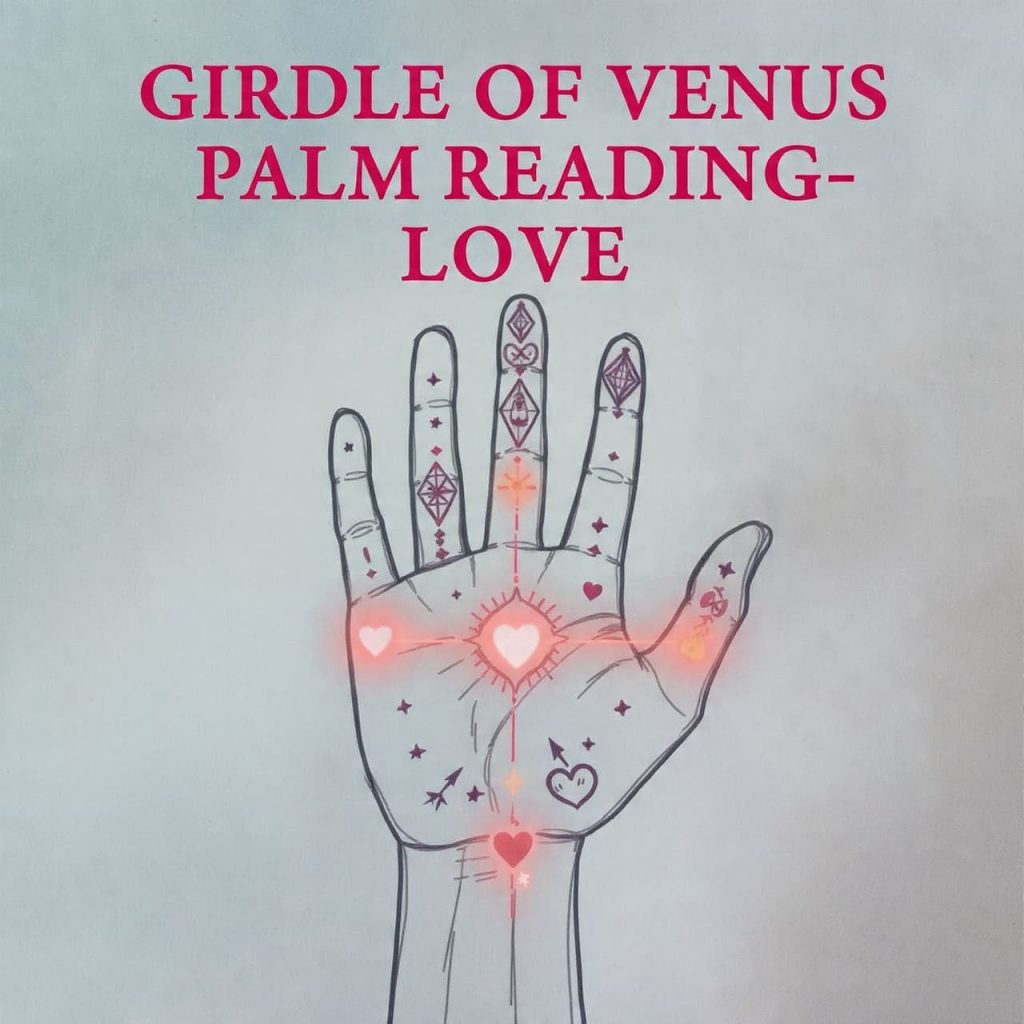
The claim that the Girdle of Venus in palm reading reveals information about love or romantic relationships is widespread, yet it is rarely examined with historical or factual rigor. Popular explanations often present this palm marking as a direct indicator of emotional or relational qualities, creating an impression of certainty unsupported by evidence.

💜 Need a clear answer right now?
CONSULT THE YES OR NO TAROT Free · No registration · Instant resultThis misunderstanding arises when symbolic associations are treated as factual descriptors rather than as products of tradition. Such framing can persist even in contexts that emphasize consultation with qualified professionals, where the distinction between cultural symbolism and evidence-based evaluation is not always made explicit.
This article addresses one narrowly defined question: does associating the Girdle of Venus in palm reading with love have historical or evidentiary validity? Using evidence-evaluation principles discussed at astroideal, the analysis isolates the claim, examines its origins, reviews textual and archaeological sources, and reaches a single yes-or-no conclusion grounded in documented evidence.
Historical Definition of the Girdle of Venus
In palmistry literature, the Girdle of Venus is typically described as a curved line arching across the upper palm, usually above the heart line and between the index and little fingers. It does not appear on all hands and is often portrayed as a distinctive feature.
Historically, however, definitions were inconsistent. Some authors described a single continuous arc, while others included fragmented or partial markings. Many early palmistry texts omit the Girdle of Venus entirely. Crucially, early sources do not define this feature in relation to love or romantic attachment. This lack of standardization undermines later claims repeated by individuals presented as reliable readers, because the feature itself was never uniformly defined or consistently interpreted within the tradition.
Symbolic Origins of Love Associations
Palmistry developed within symbolic systems grounded in analogy rather than observation. Features of the hand were interpreted through correspondence with planets, mythological figures, and abstract qualities. The name “Girdle of Venus” reflects this symbolic logic, drawing on classical mythology rather than empirical observation.
Love-related meanings emerged through symbolic association, not evidence. Venus, as a mythological figure, was associated with attraction and desire, and this association was retroactively applied to the palm feature bearing her name. Early palmistry texts do not document observation of romantic behavior or relationship patterns in individuals with this marking. As palmistry traditions were simplified and popularized, these symbolic links were widely circulated through modern formats such as online tarot sessions, often without historical qualification.
Textual and Archaeological Evidence
An evidence-based assessment requires examining what historical sources actually record. Surviving palmistry manuscripts contain assertions about symbolic meaning but do not describe testing, comparison, or verification. There are no records of correlating the presence of the Girdle of Venus with love, marriage, or relationship outcomes.
Archaeological evidence does not support the claim. Artistic depictions of hands across cultures show natural variation in upper palm creases, including curved lines similar to those later labeled the Girdle of Venus. There is no indication that these markings were historically treated as indicators of romantic behavior. Modern sciences that study love and relationships rely on psychological, neurological, and sociological methods, not palm features. Claims sometimes implied in video readings therefore lack alignment with both historical documentation and contemporary research.
Development of Modern Love Interpretations
The explicit association between the Girdle of Venus and love is largely a modern development. In the nineteenth and twentieth centuries, palmistry authors expanded interpretive frameworks to address increasingly specific life domains. Love, being a universally compelling topic, was frequently incorporated into these expanded systems.
These interpretations were not grounded in new evidence. Different authors assigned different emotional or romantic meanings to the same marking, often contradicting one another. Despite this inconsistency, the association gained prominence through popular manuals and later through remote formats such as phone readings, where concise symbolic claims are easier to communicate than historically disciplined analysis.
Direct Evaluation of the Core Claim
The claim under evaluation is that the Girdle of Venus in palm reading has factual or historical validity as an indicator of love. Historical analysis shows that the feature is inconsistently defined, absent from many early sources, and rooted in symbolic naming rather than observation.
Scientific evidence does not support the claim. Love and attachment are studied through established psychological and social science methodologies that do not involve palm markings. No peer-reviewed studies demonstrate a correlation between the Girdle of Venus and romantic behavior or relationship outcomes. References to adjacent symbolic practices, including generalized horoscope insights, do not provide evidentiary support, as they rely on analogous non-empirical reasoning rather than measured data.
Why the Love Association Persists
The persistence of the Girdle-of-Venus–love association is best explained by cultural repetition and narrative appeal. Romantic themes are compelling, and attaching them to a visually distinctive palm feature makes the claim easy to remember and repeat. Over time, repetition can create an impression of validity even when no supporting evidence exists.
Modern compilations often group palmistry interpretations alongside other symbolic systems, such as love tarot readings, reinforcing the appearance of a coherent interpretive framework. Methodological analyses emphasized again at astroideal clarify that internal symbolic coherence does not establish factual accuracy.
Conclusion: Based on historical documentation and scientific review, the answer is no. Associating the Girdle of Venus in palm reading with love does not have factual or evidentiary validity.
Frequently Asked Questions
Is the Girdle of Venus historically linked to love?
No. Early palmistry texts do not associate it with romantic relationships.
Is there a standard definition of the Girdle of Venus?
No. Descriptions vary widely between authors.
Did palmists test love-related claims about this feature?
No. There is no record of systematic testing or observation.
Do relationship sciences use palm features?
No. Palm markings are not used in relationship research.
Are modern love interpretations evidence-based?
No. They are symbolic reinterpretations without empirical support.
Does mythological naming imply factual meaning?
No. Symbolic names do not establish empirical validity.
Call to Action
To evaluate claims like this rigorously, examine how associations arose, whether they were ever tested, and what evidence supports them. Applying that approach helps you get a clear yes or no answer based on documented facts rather than repeated symbolic claims.
