

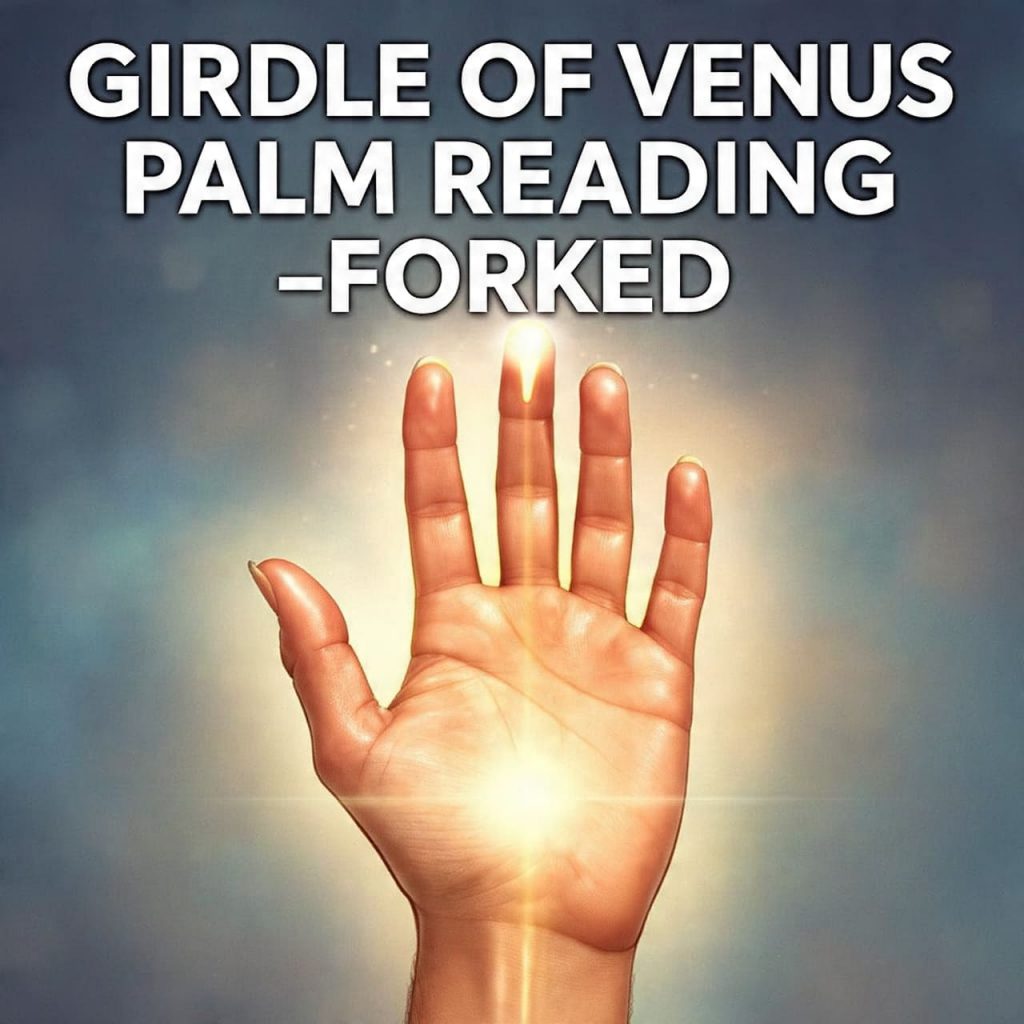
The Girdle of Venus is frequently cited in modern palmistry discussions as a distinctive secondary line whose shape is believed to carry interpretive weight. Among the most common contemporary claims is that a forked Girdle of Venus reflects specific psychological or emotional conditions. These assertions are often presented without reference to historical sources, creating confusion between documented tradition and later symbolic invention.

💜 Need a clear answer right now?
CONSULT THE YES OR NO TAROT Free · No registration · Instant resultThis ambiguity is reinforced on aggregation platforms such as astroideal, where historical material and modern commentary may appear side by side without clear differentiation.
For readers assessing statements made by qualified professionals, the key issue is whether any historically credible evidence supports a specific meaning for a forked Girdle of Venus.
This article examines one precise question only: does a forked Girdle of Venus have a historically verifiable meaning in palmistry? The analysis is strictly evidence-based and confined to historical texts, documented traditions, and what those sources do or do not establish.
Defining a Forked Girdle of Venus in Historical Terms
In palmistry terminology, a forked line refers to a single line that divides into two branches at one or both ends. Applied to the Girdle of Venus, this description implies a curved secondary line above the Heart Line that splits into two distinct arcs. However, historical palmistry texts do not consistently define or even acknowledge this variation as a separate category.
Classical manuals tend to describe the Girdle of Venus in broad visual terms, focusing on its general presence or absence rather than its internal structure. Forking, when mentioned at all, is usually discussed in relation to major lines. The absence of a standardized definition for a forked Girdle of Venus is significant, particularly when compared with later interpretive systems promoted by reliable readers, where symbolic variations are more explicitly labeled and explained.
Historical Origins of the Girdle of Venus Concept
The Girdle of Venus is not a feature of the earliest palmistry traditions. Foundational Indian and Chinese hand-reading systems emphasize palm shape, mounts, and primary lines, but they do not describe a curved secondary line equivalent to the modern Girdle of Venus. This absence indicates that the concept is not universal across early traditions.
The term and concept emerged in Europe during the 18th and 19th centuries, a period when palmistry was heavily influenced by classical mythology and Romantic symbolism. The naming of the line after Venus reflects cultural association rather than anatomical necessity. This historical context suggests that variations such as forks were observational notes rather than interpretive categories, similar to how symbolic distinctions later developed in online tarot sessions without firm grounding in original source material.
Examination of Classical Textual Evidence
A review of classical European palmistry texts reveals limited discussion of internal variations within the Girdle of Venus. Authors such as Desbarrolles and d’Arpentigny occasionally illustrate curved secondary lines with irregularities, but they do not systematically distinguish forked forms or assign them distinct meanings.
Where forks are discussed in palmistry literature, they are overwhelmingly associated with major lines, particularly the Head Line and Heart Line. Even in these cases, interpretations vary widely between authors. The lack of focused commentary on a forked Girdle of Venus indicates that this variation was not considered interpretively significant in classical doctrine. This stands in contrast to modern explanatory formats such as video readings, which often rely on clearly differentiated visual symbols to support narrative interpretation.
Archaeological and Documentary Limitations
Palmistry does not produce archaeological evidence in the conventional sense, so historical evaluation depends on manuscripts, diagrams, and comparative textual analysis. Across these sources, there is no documentary evidence establishing a consensus meaning for a forked Girdle of Venus.
Illustrations from the 18th and 19th centuries occasionally depict secondary lines that branch or taper, but these visual details are not accompanied by explanatory text assigning significance to the fork. This suggests that such variations were observed but not theorized. Without accompanying doctrinal explanation, claims of meaning cannot be substantiated historically. This evidentiary gap mirrors limitations acknowledged in interpretive services such as phone readings, where symbolic meanings are presented without empirical corroboration.
Development of Modern Interpretations
The attribution of specific meanings to a forked Girdle of Venus appears primarily in late 20th-century popular palmistry literature and online content. These sources often assert interpretive claims without citing earlier texts, relying instead on repetition and perceived symbolic logic.
This period coincides with the commercialization and simplification of esoteric practices, where complex historical ambiguity is replaced by easily communicable meanings. Forked lines, in particular, lend themselves to symbolic narratives, which may explain their prominence in modern explanations. Comparable patterns are evident in generalized horoscope insights, where symbolic associations are often presented as tradition despite limited historical documentation.
Critical Evaluation of the Core Claim
When the available evidence is assessed systematically, the conclusion is straightforward. There is no historically verifiable meaning specifically assigned to a forked Girdle of Venus in classical palmistry traditions. The line itself is a relatively late conceptual addition, and its internal variations were neither standardized nor interpretively codified in authoritative sources.
Modern claims regarding forked forms represent interpretive developments rather than documented historical knowledge. Analytical frameworks referenced by astroideal emphasize the importance of distinguishing between primary-source evidence and later extrapolation. Based on surviving texts and illustrations, the factual answer to the core question is no.
Frequently Asked Questions
Is a forked Girdle of Venus mentioned in early palmistry texts?
No. Early palmistry texts do not specifically describe or categorize a forked Girdle of Venus.
Did classical palmists assign meanings to forks in secondary lines?
No. Forks were rarely discussed in secondary lines and were not assigned consistent meanings.
Is the Girdle of Venus considered essential in historical palmistry?
No. It has consistently been treated as a secondary or auxiliary marking.
Are modern interpretations based on historical sources?
No. Most modern interpretations lack citations to primary historical texts.
Is there empirical evidence supporting meanings of forked lines?
No. Palmistry interpretations are not supported by empirical or scientific evidence.
Is there a historical consensus on this topic?
No. There is no documented historical consensus regarding a forked Girdle of Venus.
Conclusion
The historical record does not support the claim that a forked Girdle of Venus carries a specific or factual meaning within traditional palmistry. The concept of the line itself is a later development, and its forked variations were not systematically defined or interpreted in classical sources. Modern explanations reflect interpretive expansion rather than historical doctrine. The evidence leads to a single conclusion: there is no historically established meaning for a forked Girdle of Venus.
Call to Action
Readers evaluating palmistry claims should rely on documented sources and clearly distinguish historical evidence from later interpretation. Applying an evidence-first approach allows one to get a clear yes or no answer grounded in historical records rather than assumption.
