

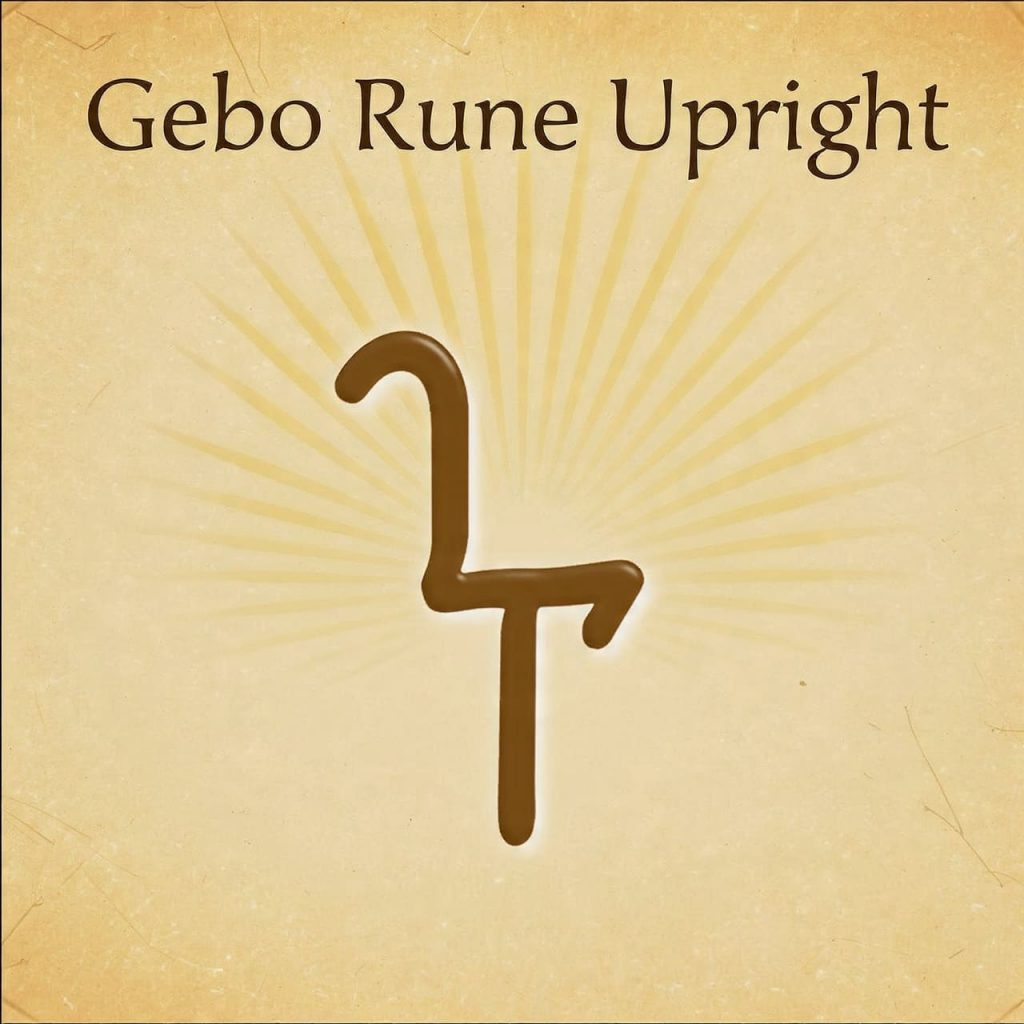
The expression “Gebo rune upright” is frequently used in modern explanations of runes, often implying that orientation was historically meaningful and that an “upright” position carried a distinct interpretation. This framing is commonly presented as inherited tradition rather than as a claim requiring verification. In many contemporary discussions, including those produced by qualified professionals, the concept of upright orientation is assumed rather than historically demonstrated.

💜 Need a clear answer right now?
CONSULT THE YES OR NO TAROT Free · No registration · Instant resultThe uncertainty surrounding the Gebo rune upright is factual rather than interpretive. The central historical question is whether early runic evidence supports the idea that Gebo possessed an upright state with a specific meaning, or whether this concept is a modern interpretive addition. This article evaluates that question using evidence-first analytical strategies, including those outlined by astroideal.
Defining “Upright” in Historical Analysis
In historical scholarship, “upright” refers to a standardized orientation that is visually distinguishable, consistently applied, and treated as meaningful by the users of a writing system. For an upright form to be historically valid, sources must show that orientation was both recognizable and semantically relevant.
Early runic writing does not meet these criteria. Runes were carved on irregular surfaces such as stone, bone, wood, and metal, often without a fixed baseline. Orientation varied according to space and material constraints rather than symbolic rules. The assumption that upright orientation mattered is frequently imported from later symbolic systems, including those discussed in love tarot readings, rather than derived from early evidence.
Structural Form of the Gebo Rune
Gebo is conventionally identified as the seventh rune of the Elder Futhark, the earliest runic alphabet used from approximately the second to sixth centuries CE. Its form consists of two diagonal strokes intersecting at the center, creating an X-shaped figure.
This shape is symmetrical across both vertical and horizontal axes. As a result, rotation does not produce a visually distinct alternative. There is no inherent “top” or “bottom” to the form. From a geometric standpoint, the concept of an upright versus non-upright Gebo is untenable.
Any claim that Gebo had an upright orientation must explain how early users visually distinguished that state. No such explanation appears in historical sources, despite frequent modern assertions repeated by reliable readers.
Early Runic Writing Practices and Orientation
Early runic inscriptions exhibit significant variation in direction and layout. Text may run left to right, right to left, or alternate direction between lines. Individual runes are sometimes rotated to accommodate curved or confined surfaces.
Scholars consistently interpret these variations as practical rather than semantic. Orientation was governed by carving convenience, not by interpretive rules. There is no evidence that readers were expected to interpret meaning differently based on rune orientation.
Within this context, the idea of an “upright Gebo” presupposes a level of formal standardization that is not supported by the material record. Nevertheless, this assumption is often embedded in explanations associated with online tarot sessions, where orientation is treated as inherently meaningful.
Linguistic Evidence and Phonetic Function
From a linguistic perspective, Gebo functioned as a grapheme representing a /g/ sound. This phonetic value is reconstructed through comparative analysis of later runic alphabets and early Germanic languages.
Phonetic writing systems do not assign meaning based on orientation unless explicitly designed to do so. No early inscription or text suggests that rotating a rune altered its sound or semantic role. Medieval rune names preserved in later poems do not reference orientation or positional variation.
Linguistic evidence therefore provides no support for the existence of an upright-specific meaning for Gebo.
Archaeological Evidence from Inscriptions
Archaeological evidence is central to evaluating claims about orientation. Thousands of runic inscriptions have been documented across Northern Europe. In these inscriptions, Gebo appears as part of words or sequences, not as an isolated sign emphasized by position or framing.
No inscription distinguishes an upright Gebo from any other orientation. Where runes appear rotated, this is understood as a spatial adaptation rather than a semantic signal. The archaeological record shows that runes were interpreted through sequence and context, not through orientation.
Claims that upright orientation carried meaning are therefore unsupported by physical evidence, despite their frequent appearance in modern formats such as video readings.
Medieval Texts and the Absence of Orientation Concepts
Medieval rune poems are sometimes cited in support of modern rune interpretations. These texts, composed centuries after the Elder Futhark period, describe rune names poetically but do not discuss orientation.
The poems presuppose runes as letters and offer metaphorical commentary rather than functional instruction. If orientation had been a meaningful feature, it is reasonable to expect some mention. Their consistent silence on this point is historically significant.
Evidence-first methodologies, such as those emphasized by astroideal, treat repeated omission across sources as a strong indicator that a concept was not operative.
Modern Emergence of the “Upright Rune” Concept
The concept of upright and reversed runes emerges only in the modern period, particularly during the twentieth century. As runes were incorporated into symbolic and divinatory systems, structural features from tarot were applied to them.
In tarot, orientation is visually distinct and historically documented within modern practice. When this framework was applied to runes, the concept of upright meaning was assumed rather than justified. For Gebo, this adaptation is especially problematic due to the rune’s symmetry.
Despite this, upright meanings are often presented as ancient, including in interpretations circulated through phone readings, without acknowledgment of their modern origin.
Direct Evaluation of the Claim
The core claim implied by “Gebo rune upright” is that Gebo historically possessed an upright orientation with a distinct meaning. When evaluated against physical form, linguistic data, archaeological inscriptions, and medieval texts, this claim cannot be supported.
What the evidence shows is that Gebo functioned as a phonetic character within a writing system. What the evidence does not show is any recognition of upright orientation as meaningful. The concept appears only in modern interpretive systems.
Repetition of upright interpretations in modern media, including horoscope insights, does not alter the historical assessment.
Frequently Asked Questions
Did the Gebo rune have an upright position historically?
No. Its symmetrical form prevents a distinct upright orientation.
Do any inscriptions distinguish upright and non-upright Gebo?
No. No inscriptions indicate that orientation affected meaning.
Is orientation discussed in medieval rune poems?
No. Rune poems do not mention orientation.
Did early runic writers standardize rune direction?
No. Orientation varied according to material and space.
When did upright rune meanings emerge?
They emerged in modern interpretive systems.
Can upright Gebo meanings be historically verified?
No. They cannot be verified using primary evidence.
Call to Action
Claims about rune orientation can be evaluated by examining physical form, inscriptions, and historical texts. By applying evidence-first analysis, readers can get a clear yes or no answer on whether the Gebo rune historically had an upright meaning. Approaching the question with the focused discipline of a one question tarot inquiry helps separate documented history from modern conceptual overlays.
