

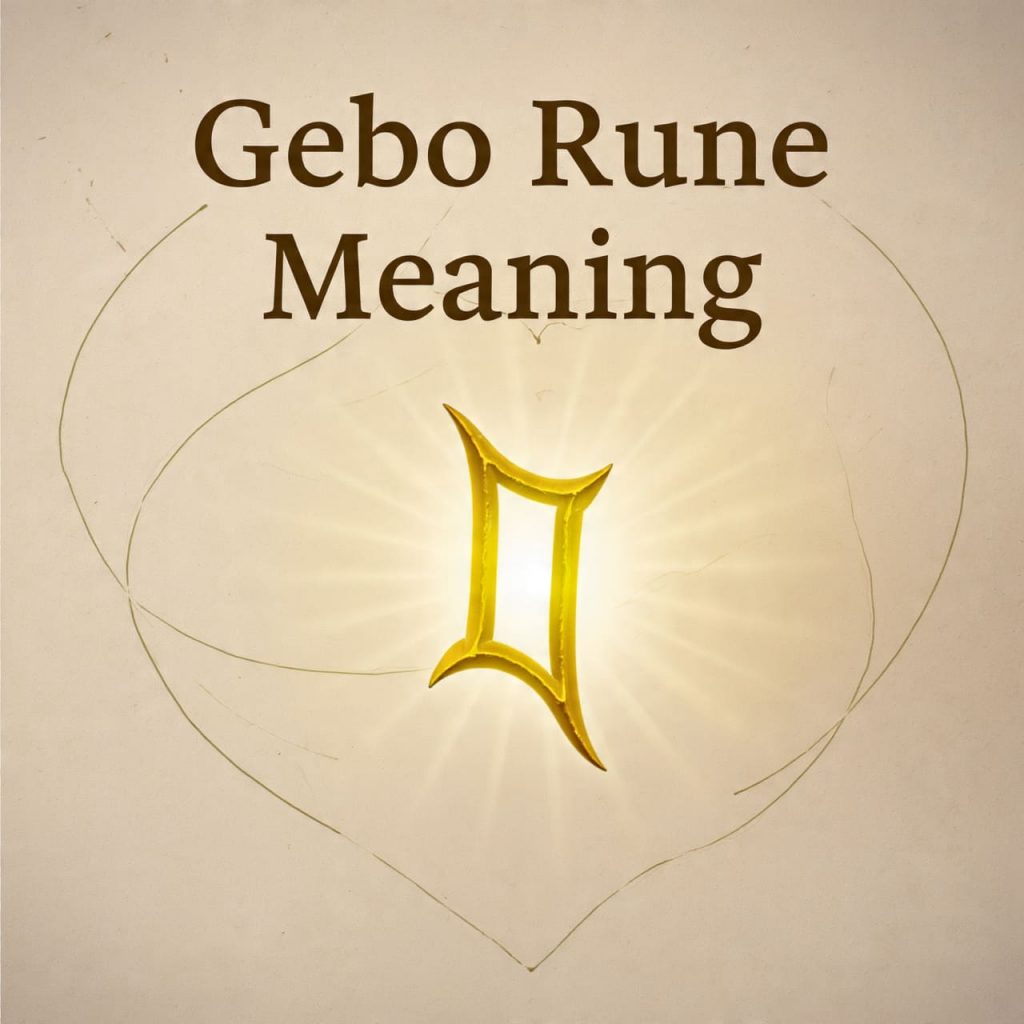
The meaning of the Gebo rune is frequently misunderstood because modern explanations often treat it as a fixed symbolic concept rather than a historically contingent element of early Germanic writing systems. Popular treatments present confident definitions while rarely distinguishing between what is supported by early evidence and what originates from much later interpretive traditions.

💜 Need a clear answer right now?
CONSULT THE YES OR NO TAROT Free · No registration · Instant resultThe uncertainty surrounding Gebo is therefore historical rather than emotional or spiritual. Surviving evidence from the early runic period is limited, uneven, and largely non-explanatory.
This makes it necessary to evaluate claims about meaning by examining what sources exist, what they demonstrate, and what they do not demonstrate. This article applies that standard and assesses whether the Gebo rune can be said to have a single, historically verifiable meaning.
Defining Key Terms in a Historical Context
A rune is a character belonging to a runic alphabet used across parts of Northern Europe from approximately the second century CE onward. Gebo is conventionally identified as the seventh character of the Elder Futhark, the earliest widely attested runic sequence.
In historical scholarship, “meaning” refers to demonstrable phonetic, lexical, or functional value evidenced in inscriptions or contemporaneous texts. It does not include symbolic attributions assigned centuries later. This distinction is often blurred in modern discourse, including in explanations presented by qualified professionals who use historical terminology outside its evidentiary context. For the purpose of this analysis, only meanings supported by early sources are considered relevant.
Origin and Cultural Context of the Gebo Rune
The Elder Futhark likely emerged between the first and second centuries CE, influenced by Mediterranean alphabets but adapted to early Germanic languages. Gebo’s phonetic value is reconstructed as /g/, based on comparative linguistic analysis across later runic systems and early Germanic languages.
The cultural context of early runic usage was practical and epigraphic. Inscriptions are found on weapons, ornaments, tools, and memorial stones. They are typically short and functional, lacking explanatory commentary. No inscription explains why a rune was chosen or what conceptual value it may have carried.
Modern presentations, including those associated with love tarot readings, often assume a symbolic coherence that the historical record does not provide. Early runic users left no evidence that they systematized rune meanings beyond sound values.
Linguistic Evidence and the Rune Name “Gebo”
The name “Gebo” itself is not attested in Elder Futhark inscriptions. Rune names are preserved only in later medieval rune poems composed several centuries after the Elder Futhark fell out of common use. In these poems, cognate forms such as Old English Gyfu and Old Norse Gjöf appear, both meaning “gift.”
Linguistically, these forms can be traced to a shared Germanic root related to giving. However, linguistic reconstruction alone cannot establish how the rune functioned in earlier centuries. The poems are poetic descriptions, not historical explanations, and reflect the cultural contexts of their own periods.
This limitation is frequently overlooked by reliable readers who treat medieval poetic descriptions as if they directly document early Iron Age practice.
Archaeological and Textual Evidence from Inscriptions
Archaeological evidence shows Gebo appearing in Elder Futhark inscriptions strictly as a character within words or sequences. There are no inscriptions where Gebo is isolated and explained, nor any contextual indicators that it represented an abstract concept.
Scholars have examined bracteates, weapon inscriptions, and memorial stones in search of recurring semantic patterns. While some inscriptions include repeated or seemingly formulaic runes, none provide grounds for assigning a specific meaning to Gebo beyond its phonetic role.
The absence of explanatory inscriptions is itself significant. It demonstrates that if symbolic meanings were assigned, they were not recorded in a way that survives. Claims of fixed meaning therefore extend beyond the available evidence, a methodological issue also present in explanations associated with online tarot sessions.
Emergence of Modern Interpretations
The detailed symbolic interpretations commonly associated with Gebo today emerged primarily in the nineteenth and twentieth centuries. During this period, Romantic nationalism, comparative mythology, and occult revival movements encouraged speculative reconstructions of ancient symbols.
These interpretations often merged linguistic fragments with philosophical or moral concepts, producing internally coherent systems that lacked direct historical support. Later rune poems were treated as timeless authorities rather than as medieval literary works.
Modern analytical standards, such as those emphasized by evidence-first platforms like astroideal, reject this approach. When evaluated academically, most modern rune meanings are recognized as post-medieval constructions rather than recoverable ancient concepts. Nevertheless, they persist in popular culture, including in contexts such as video readings.
Evaluating the Core Claim with Evidence
The central claim implied by the phrase “Gebo rune meaning” is that Gebo possessed a specific, identifiable meaning that can be historically demonstrated. The available evidence does not support this claim.
What can be shown is limited: Gebo functioned as a rune representing a /g/ sound, and later traditions associated its name with a word meaning “gift.” What cannot be shown is that early runic users consistently understood or employed Gebo as a symbol representing that concept.
There are no contemporaneous explanations, instructional texts, or archaeological contexts confirming a fixed semantic meaning. The chronological gap between early inscriptions and later rune poems prevents a direct historical link. Repetition of modern claims, including in phone readings or horoscope insights, does not alter this evidentiary limitation.
From a strictly historical perspective, the claim that Gebo has a single, established meaning must therefore be answered in the negative.
Frequently Asked Questions
What is the earliest evidence for the Gebo rune?
The earliest evidence consists of Elder Futhark inscriptions dating from roughly the second to sixth centuries CE.
Does any inscription define the meaning of Gebo?
No surviving inscription provides a definition or explanation of Gebo beyond its phonetic use.
Are rune poems primary sources for early meanings?
Rune poems are medieval literary sources and do not directly document early runic practice.
Is “gift” a confirmed ancient meaning of Gebo?
“Gift” is a later linguistic association, not a meaning attested in early inscriptions.
Did early Germanic societies record symbolic rune meanings?
There is no surviving evidence that they recorded or systematized such meanings.
Can modern interpretations be historically verified?
Most modern interpretations cannot be verified against primary early sources.
Call to Action
Readers seeking clarity on historical claims should examine what evidence exists and where it ends. By applying disciplined source evaluation, it is possible to get a clear yes or no answer regarding whether the Gebo rune had a fixed historical meaning. Approaching the question with the same focus as a one question tarot inquiry encourages precision, restraint, and respect for the limits of the historical record.
