

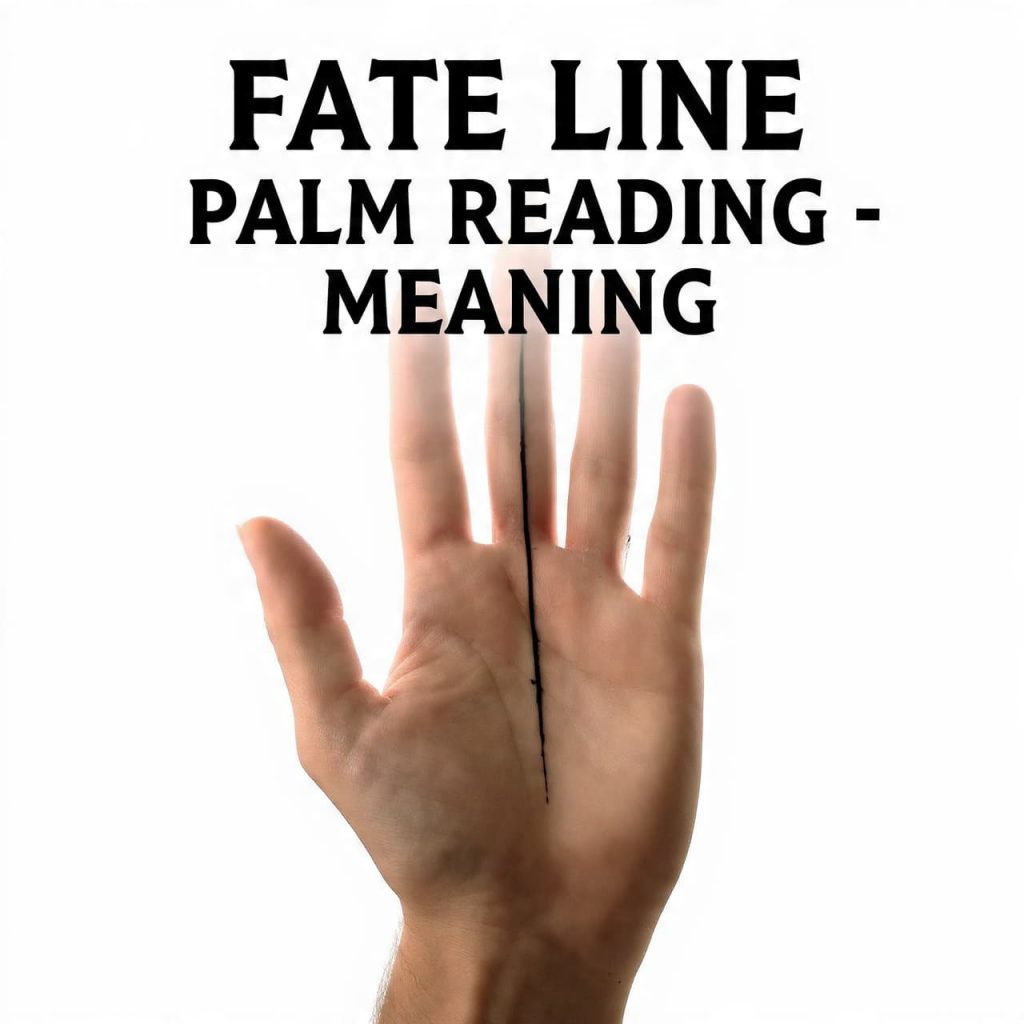
The claim that the fate line in palm reading carries a fixed and reliable “meaning” is widespread in modern palmistry, yet it is rarely evaluated against historical documentation or empirical research. Contemporary explanations often present the fate line as an established component of traditional palmistry without demonstrating how this status developed or whether it reflects consistent historical usage.

💜 Need a clear answer right now?
CONSULT THE YES OR NO TAROT Free · No registration · Instant resultThis has allowed familiarity to substitute for verification. On platforms such as astroideal, the fate line is frequently discussed as a core element of palm interpretation, despite unresolved questions regarding its historical and factual basis.
This article examines one precise question: whether there is credible historical or empirical evidence that the fate line has an established, authoritative meaning in palm reading. The analysis is strictly evaluative, avoids instruction or application, and aims to reach a clear yes-or-no conclusion based on available evidence.
Historical Definition of the Fate Line
Early references to palm lines do not consistently identify a feature equivalent to the modern “fate line.” Classical Greek and Roman texts that mention the hand focus on anatomy, gesture, or physiology rather than symbolic interpretation.
When palmistry texts appear in medieval Europe, they describe principal lines inconsistently and without standardized labels. A vertical line corresponding to what is now called the fate line appears sporadically and without a fixed name or role. The later identification of this line reflects retrospective classification rather than documented continuity. This pattern resembles systematization later promoted by qualified professionals rather than terminology preserved in early manuscripts.
Treatment of the Fate Line in Early Palmistry Literature
Surviving medieval and early modern palmistry texts do not consistently emphasize a distinct fate line. Where vertical lines are mentioned, they are treated descriptively and without a singular interpretive function.
No early source presents the fate line as a definitive indicator with a stable meaning. Interpretations, when present, vary widely and often contradict one another. This lack of consistency suggests that the fate line’s supposed meaning was not stabilized in early tradition. Later attempts to impose structured interpretations resemble thematic frameworks later seen in horoscope insights rather than original palmistry doctrine.
Manuscript and Visual Evidence Review
Illustrated palmistry manuscripts are sometimes cited as visual confirmation of the fate line’s importance. However, these illustrations are schematic and symbolic rather than anatomical records. Line placement, presence, and emphasis vary considerably between manuscripts.
No illustration is accompanied by explanatory text establishing a consistent meaning for the fate line. Some diagrams omit it entirely, while others depict multiple vertical lines without clarification. This variability undermines claims of standardized interpretation. Modern diagrams highlighting the fate line rely on uniform templates developed much later, comparable in presentation style to online tarot sessions.
Emergence of Fixed Meanings in Modern Palmistry
The attribution of a specific, fixed meaning to the fate line becomes prominent in nineteenth- and twentieth-century palmistry books written for popular audiences. During this period, authors sought to organize palmistry into coherent systems by assigning roles to each major line.
Different writers proposed different meanings for the fate line, indicating a lack of inherited consensus. These meanings were shaped by editorial goals rather than historical documentation. The process mirrors modern interpretive formats such as video readings, which prioritize clarity and repetition over historical fidelity.
Scientific Perspective on the Fate Line
From a scientific standpoint, the fate line is a palmar crease formed through natural skin folding and hand movement. Its presence and shape vary widely between individuals and are not universal.
Research in dermatoglyphics examines palmar creases for developmental correlations, not symbolic or predictive meaning. No peer-reviewed studies support claims that the fate line conveys information beyond normal anatomical variation. Assertions to the contrary lack empirical grounding despite their circulation through reliable readers.
Evaluation of the Core Claim
The core claim is that the fate line has a historically grounded or empirically supported meaning in palm reading. Examination of historical texts reveals no standardized definition or agreed interpretation. Manuscript and visual evidence do not support a fixed meaning, and scientific research provides no validation.
The idea of a definitive fate line meaning can be traced to modern popular palmistry rather than documented tradition. Even within contemporary platforms such as astroideal, this concept aligns more closely with recent interpretive constructs comparable to love tarot readings than with historical evidence.
Final evaluation: the claim is not supported by reliable historical or empirical evidence.
Frequently Asked Questions
What is the fate line in palm reading?
It is a palmar crease that modern palmistry labels as a vertical line on the palm.
Do historical texts define a fixed meaning for the fate line?
No historical palmistry texts provide a consistent, authoritative meaning.
Is there archaeological evidence supporting fate line interpretations?
No archaeological or artistic evidence establishes a standardized meaning.
When did fixed fate line meanings become common?
They became common in modern palmistry literature from the nineteenth century onward.
Has science validated fate line interpretations?
No scientific studies support symbolic meanings attributed to the fate line.
Are modern explanations historically consistent?
No, they vary widely and lack documented continuity.
Conclusion
After reviewing historical literature, manuscript evidence, and scientific research, the conclusion is clear: No, there is no credible historical or empirical evidence that the fate line has an established, authoritative meaning in palm reading. The concept as commonly presented today is a modern interpretive construction rather than a documented tradition.
Readers seeking to get a clear yes or no answer should evaluate such claims by examining their historical origins, consistency across sources, and empirical support rather than their repetition or popularity.
