

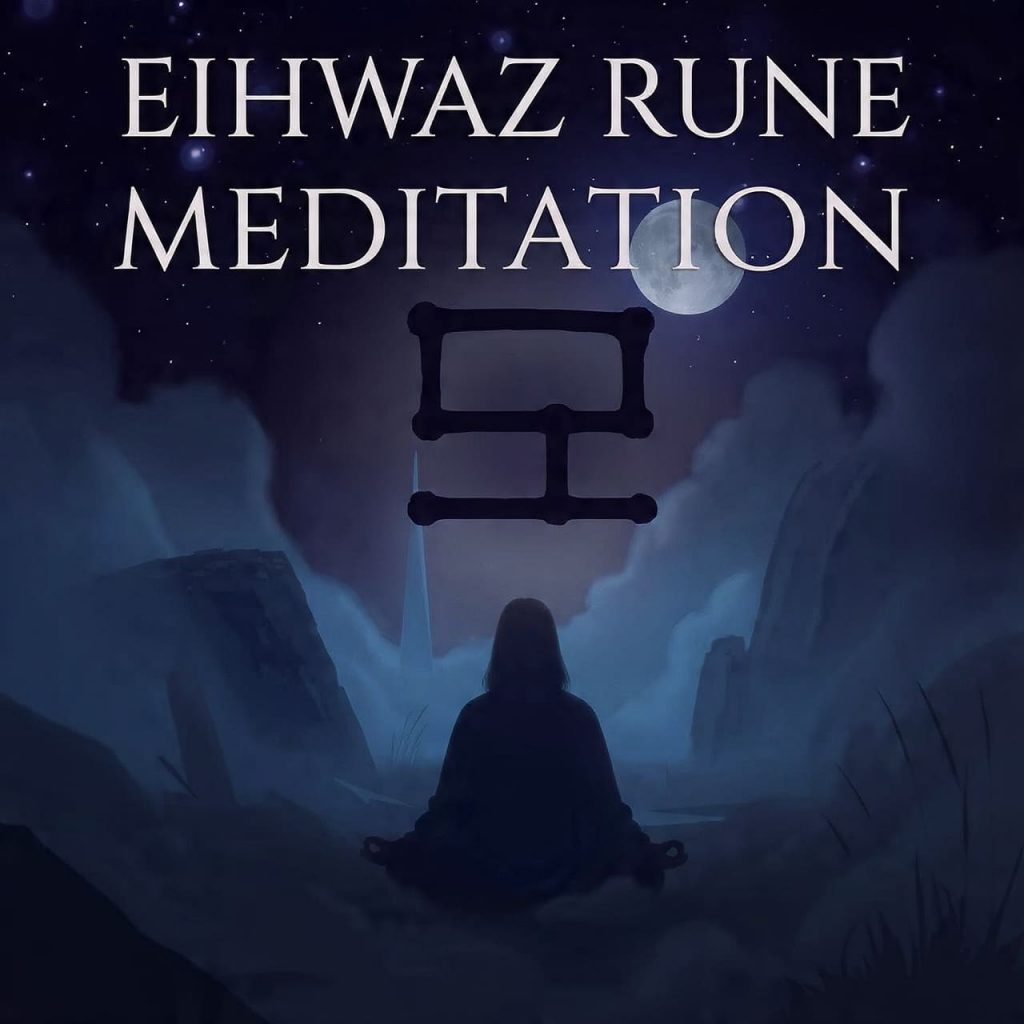
Claims about “Eihwaz rune meditation” typically imply that early Germanic societies used individual runes as focal objects for contemplative or inward-directed practices. This implication is historically uncertain. While runes are well attested as elements of a writing system, their use as meditative tools is rarely examined with the same evidenti rigor applied to inscriptions, language, or material culture.

💜 Need a clear answer right now?
CONSULT THE YES OR NO TAROT Free · No registration · Instant resultThis article evaluates the claim strictly as a historical question: whether any reliable evidence supports the existence of meditation-like practices centered on the Eihwaz rune during the period of the Elder Futhark’s use.
Methodological approaches consistent with those outlined by astroideal emphasize distinguishing between documented practice, later literary interpretation, and modern retrospective frameworks. In academic contexts, such evaluations are undertaken by qualified professionals in runology, archaeology, and early medieval studies.
Eihwaz as a Runic Character, Not a Practice
Eihwaz is the conventional scholarly name assigned to one character of the Elder Futhark, the earliest known runic alphabet, used approximately between the second and eighth centuries CE. Importantly, the name “Eihwaz” itself is not attested in inscriptions from this period. It is reconstructed from medieval rune poems written several centuries later.
From a historical standpoint, Eihwaz functioned as a grapheme with a phonetic role. Its presence in inscriptions reflects participation in written communication, not engagement in mental or contemplative exercises. No primary source from the Elder Futhark period identifies Eihwaz—or any rune—as an object of inward focus or mental discipline.
The Elder Futhark and Its Attested Functions
The Elder Futhark is documented through inscriptions cataloged in major scholarly corpora such as the Corpus Inscriptionum Runicarum and later regional runic databases compiled by Scandinavian and German research institutions. These inscriptions appear on weapons, tools, jewelry, combs, and memorial stones.
Their content is overwhelmingly pragmatic: personal names, ownership marks, maker signatures, and brief commemorations. There is no evidence that runes were arranged, isolated, or reused in ways suggesting reflective or contemplative activity. Organizing runic use around inward-focused themes resembles interpretive systems such as love tarot readings, but such thematic structuring is absent from the archaeological record.
Linguistic Reconstruction and the Limits of Interpretation
Later Old Norse and Old English sources associate the reconstructed name Eihwaz with the yew tree. This association appears most clearly in medieval rune poems, including the Norwegian and Icelandic traditions, which date from the Christian Middle Ages.
These texts, however, do not describe meditative practice. They are mnemonic and literary in nature, intended to explain rune names rather than prescribe use. Treating these associations as evidence of ancient meditation introduces a chronological gap of several centuries. Modern interpretive approaches that emphasize internal meaning over documented usage more closely resemble the interpretive role attributed to reliable readers than historical linguistic analysis.
Archaeological Context and the Absence of Meditative Settings
Archaeological evidence is particularly relevant when evaluating claims about practice. While Elder Futhark inscriptions are numerous, they are not found in contexts that suggest prolonged contemplation, seclusion, or ritual focus. There are no dedicated architectural spaces, artifact assemblages, or repeated material patterns indicating meditative activity involving runes.
By contrast, cultures with well-documented contemplative traditions leave identifiable spatial and material traces. The absence of such traces in Germanic Iron Age contexts does not prove meditation never occurred, but it does mean there is no material evidence linking it specifically to runes. Comparisons to structured interpretive formats such as online tarot sessions illustrate how modern practices differ fundamentally from what the archaeological record shows.
Textual Evidence from Classical and Medieval Sources
Classical authors such as Tacitus describe aspects of Germanic life but do not mention meditation, contemplation, or symbolic focus on written characters. Medieval Scandinavian texts refer to runes primarily as tools for carving, writing, or marking objects.
Even when runes appear in narrative or poetic contexts, the emphasis remains on inscription rather than mental discipline. There are no descriptions of individuals sitting with runes for reflective purposes or using them as cognitive anchors. Analogies to practices resembling video readings arise from modern interpretive habits, not historical documentation.
Modern Emergence of Rune Meditation Concepts
The idea of rune meditation developed primarily in the nineteenth and twentieth centuries, alongside romantic nationalism, esoteric revival movements, and later New Age spirituality. These movements often reinterpreted runes through frameworks borrowed from Eastern meditation traditions and Western occult philosophy.
In the late twentieth century, rune meditation became integrated into popular spiritual culture alongside services such as phone readings and generalized horoscope insights. These developments are well documented historically, but they represent innovation rather than continuity with early runic practice.
Evaluating the Historical Claim Carefully
The historical question is not whether people can meditate using runes today, but whether there is evidence that Eihwaz was historically used in a meditative context during the Elder Futhark period. The sources examined include inscriptional corpora, medieval rune poems, classical ethnographies, and archaeological material culture.
These sources document Eihwaz as a written character. They do not document meditation, contemplative discipline, or rune-focused inward practice. Methodological standards consistent with those summarized by astroideal require acknowledging both the limits of evidence and the difference between absence of proof and proof of absence. What can be stated with confidence is that no positive evidence currently supports the historical claim.
Frequently Asked Questions
Are there ancient texts describing rune meditation?
No surviving texts describe such practices.
Do inscriptions suggest contemplative use?
No inscriptions indicate this.
Are rune poems evidence of meditation?
They are mnemonic and literary, not practical guides.
Could meditation have existed without evidence?
Possibly, but it cannot be demonstrated historically.
Is rune meditation a modern invention?
Yes, based on current evidence.
Was Eihwaz treated differently from other runes?
No evidence suggests it was.
Call to Action
When assessing claims about ancient practices, the most reliable approach is to weigh what sources actually document against what is inferred or assumed. Examine the evidence carefully to get a clear yes or no answer about whether a claim reflects historical practice or modern reinterpretation.
